The Bluebell Railway's Locomotives
Visiting Locomotive
Other Operational Locomotives
The Loco Roster provides details of which locomotives are expected to be running on which days.
 Visiting Locomotive
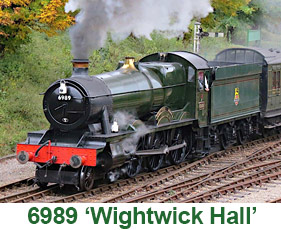
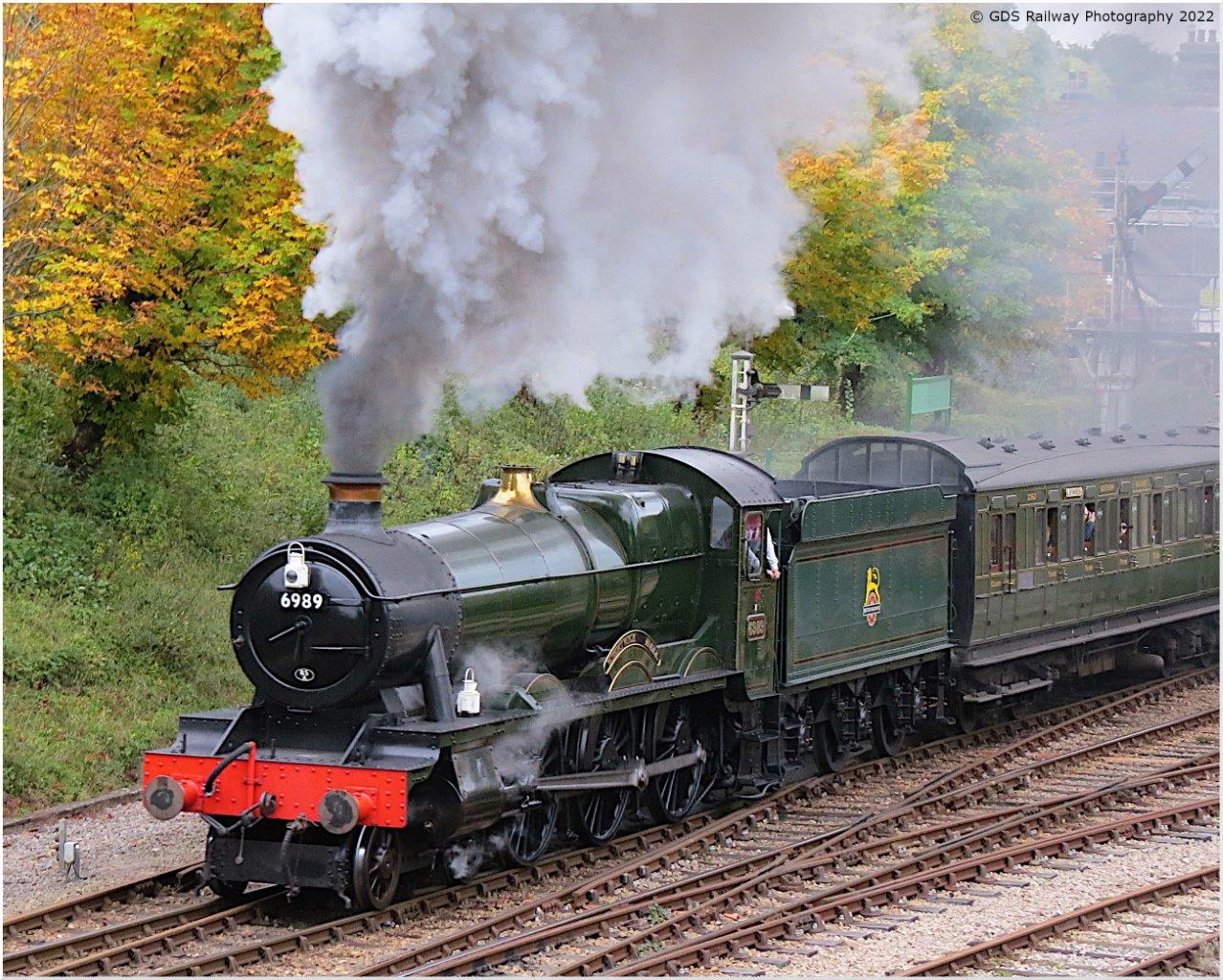
BR (GWR Design) No. 6989 ‘Wightwick Hall’
Class: Modified Hall
Designer: Frederick Hawksworth, a development of Charles Collett’s earlier Hall Class
Wheels: 4-6-0
Built: March 1948, Swindon Works
Withdrawn: June 1964
Arrived at the Buckinghamshire Railway Centre: 9 January 1978
Restoration completed: December 2018
Re-entered service: 2 March 2019
Owned by The Quainton Railway Society – web page and Facebook
Photo by Gary Smith, at our Giants of Steam Gala in October 2022
In 2018 ‘Wightwick Hall’ became the 150th steam locomotive to have been restored to operational condition after being rescued from Dai Woodham’s famous Barry Scrap Yard in South Wales. This was the culmination of a 41 year restoration by the 6989 Restoration Group.
Arriving on loan to the Bluebell Railway on 23 June 2022, and initially expected to stay until after Giants of Steam that year, its visit has been extended through to late 2024.
‘Wightwick Hall’ spent its working life around Hereford. and Gloucester. After withdrawal it was one of the locomotives saved by being sold on from Barry scrapyard, moving to Quainton Road in January 1978, and restored to operational condition over the following 41 years.
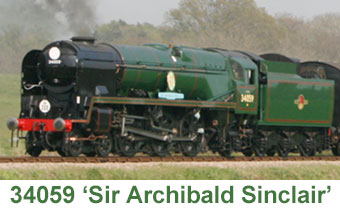
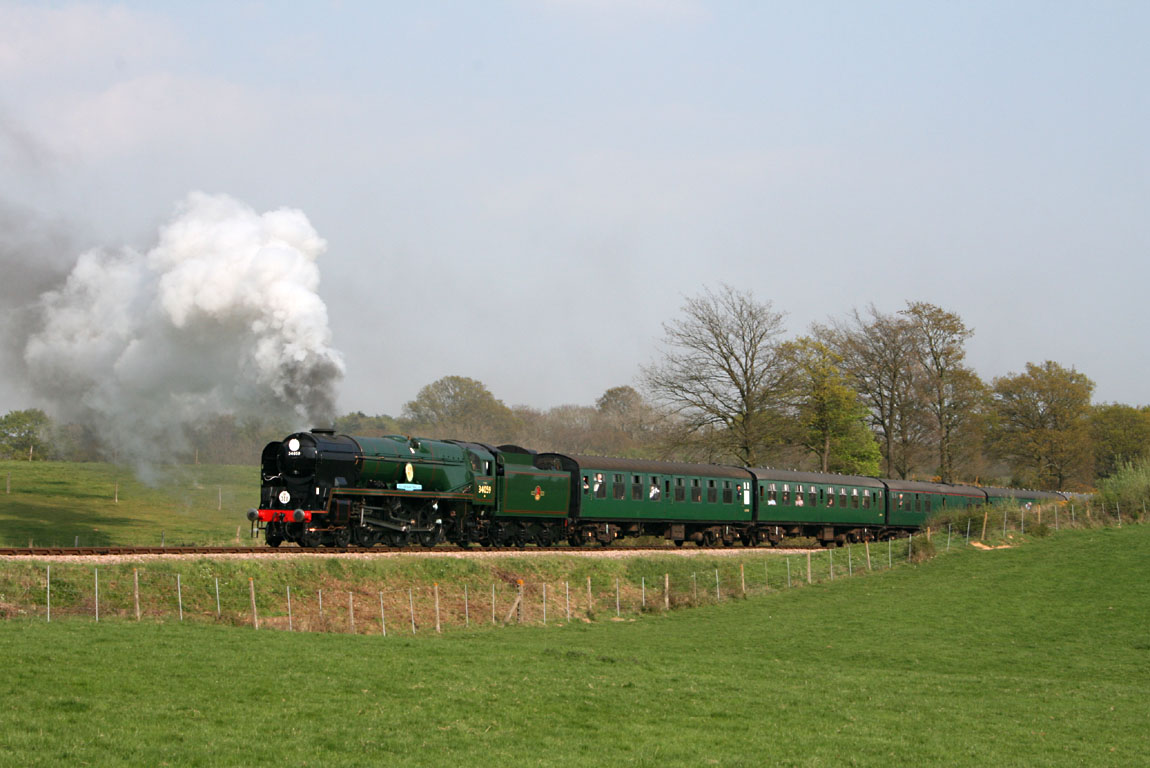 Rebuilt SR Bulleid Light Pacific, ‘Sir Archibald Sinclair’
Class: Battle of Britain (Rebuilt)
Wheels: 4-6-2
Built: 1947, Rebuilt: 1960
Numbers carried: 21C159, 34059
Withdrawn by BR: 1966
Previously operational on Bluebell: April 2009 to October 2011
Last overhaul completed: November 2023
Owned by the Bluebell Railway
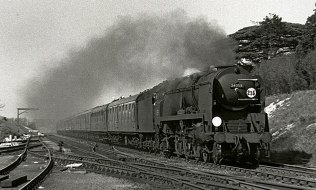 The identical “West Country” and “Battle of Britain” pacifics were built to provide increased power for use on the Southern’s secondary main lines, especially those in the West country with weight restrictions. However, some of Bulleid’s novel ideas, designed to reduce maintenance costs, proved troublesome. Therefore in 1957 a programme of rebuilding the locomotives along conventional lines was started. The rebuilding of the Bulleid light pacifics added several tons to their weight, but produced, to all intents, brand-new locomotives, whilst retaining the distinctive light-weight Bulleid-Firth-Brown wheels and his superb free-steaming boiler, along with many other of the successful innovative design features.
Rescued from Barry scrapyard in 1979 without a tender, this locomotive has since then been the subject of ongoing restoration work and fundraising. A tender underframe was salvaged from a steel-works, the original intention being to use this in conjunction with a new body. However this underframe was in poor condition, and in the end only some fittings from it were used, with the tender frames being constructed at Sheffield Park from new material. A new 5250-gallon tender body has been made, and placed on it.
The formal launch into Bluebell service, as the first rebuilt Battle of Britain to steam in preservation, performed by Viscount Thurso (grandson of Sir Archibald Sinclair, who was the wartime Secretary of State for Air from 1940) on 24th April 2009. Regrettably, the loco was withdrawn during October 2011, in need of further major firebox repairs; the construction of a new firebox has been contracted out, and with the boiler work completed in house, and the frames and tender overhauled, it returned to service in November 2023.
Although the locomotive is owned by the Bluebell Railway, the Battle of Britain Locomotive Group who brought it to the Bluebell from Barry, along with The Bulleid Society, are heavily involved in fundraising and assisting in the overhauls of this locomotive.
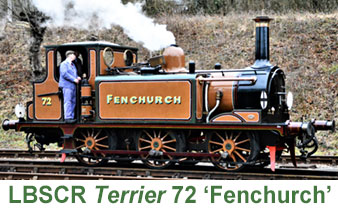
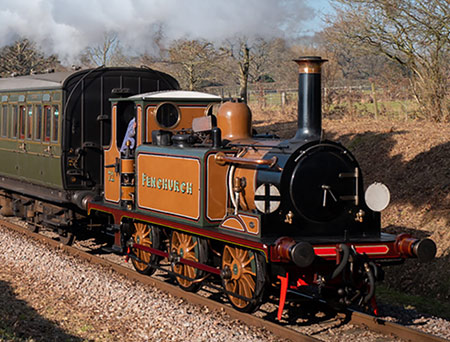 LBSCR Terrier No. 72 ‘Fenchurch’
Class: A1
Designer: William Stroudley
Wheels: 0-6-0T
Built: 1872, Brighton Works
Numbers carried: 72, B636, 2636, 32636
Last operational period: February 2001 to 23 January 2011, as No. 672
Last major overhaul completed: 10 January 2023 – Details of 2001 overhaul
Owned by the Bluebell Railway
Photo by courtesy of Nick Gilliam
Stroudley’s famous Terriers survived for decades after more modern designs had been scrapped, working on lightly laid Branch lines. ‘Fenchurch’ was sold to the Newhaven Harbour Company, being light enough to cross a bridge within the docks. It came back into Southern Railway ownership, and continued to work at Newhaven for many years. It came to the Bluebell in 1964, having been for a number of years a celebrity as the oldest locomotive working on British Railways.
In early December 2019 ‘Fenchurch’ entered the Locomotive works, was dismantled to remove the boiler for assessment, and the remainder of the locomotive reassembled for a return to public display in the locomotive shed. Completed in November 2022, an intensive period of running in and testing followed. It is now painted in its original Stroudley Golden Ochre livery. You can see details of this recent overhaul, here.
During its 2001 overhaul ‘Fenchurch’ had been converted back to represent its original A1 rather than A1X form and painted as 672 in Marsh Umber, after which it gave ten years of pretty reliable service.
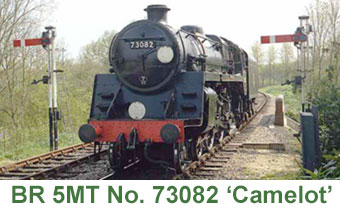
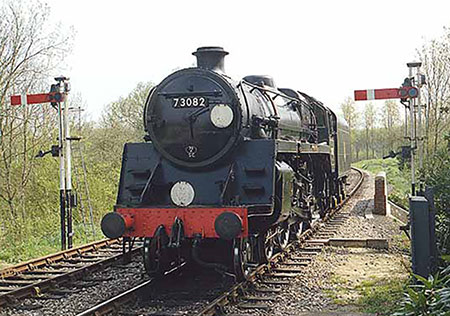 BR Standard, No. 73082 ‘Camelot’
Class: 5MT
Designer: Robert Riddles, with design work done at the ex-LNER Doncaster Drawing Office
Wheels: 4-6-0
Built: 1955, Derby Works
Previously operational: 28 October 1995 – June 2005,
25 October 2015 – December 2020
Last major overhaul completed: September 2021
Owned by The 73082 Camelot Locomotive Society – Their web site and Facebook
Photo by courtesy of Hiroshi Naito
One of the range of “Standard” locomotives designed for British Railways, the basic design took as its starting point William Stanier’s LMS Black Fives, but with larger wheels and cylinders, and a higher running plate. The first 30 were built between April 1951 and January 1952. No. 73082 was part of a second batch, of 100 locomotives, built 1953-57.
Modern engines with roller bearings, highly capable and easy to maintain, they were withdrawn long before they were worn out thanks to BR’s rush to get rid of steam in the 1960s. ‘Camelot’ was one of the Southern Region’s allocation of Standard 5s, and when the King Arthur class, which they replaced, were being withdrawn, a staff suggestion led to the names being transferred to the new engines.
This locomotive is believed to hold the record for the highest speed for the class, at 107 mph (on Christmas Eve 1964, near Andover). With a late-night parcels train and a driver keen to get home in time for a party, the 36 miles from Salisbury to Basingstoke was completed in 28 minutes start to stop, an average speed of 77.1 mph!
A survivor of Barry Scrapyard, ‘Camelot’ is the only remaining one of the named Standard 5s. It was returned to working order thanks to the dedication of the Camelot Society, which carried out fund-raising and engineering work. The latter included the construction of a brand-new tender body, fitted to frames recovered from a South Wales Ironworks, since, like so many Barry locos, it had lost its tender. It was a core member of the Bluebell’s loco fleet for the decade after it returned to traffic in 1995.
In preparation for its next overhaul, the Camelot Locomotive Society prepared the loco for the boiler lift, major work was undertaken on the wheelsets and the roller-bearings, the boiler received heavy repairs off-site, and the overhaul and painting was completed in October 2015.
To mark 60 years since 73082 was constructed at Derby in 1955 (although relaunched complete with its nameplates at the Giants of Steam weekend in 2015) it ran for the following year without nameplates, to mark this anniversary. ‘Camelot’ received its nameplates at Eastleigh works in August 1959, whilst still carrying the early BR tender emblem, and now carries them again.
At the end of 2020, with the country entering a third Coronavirus lockdown, the opportunity was taken to carry out some remedial work on ‘Camelot’ in the Bluebell’s workshop. A problem had arisen with leaks at the foundation ring rivets, and to allow these to be replaced, the boiler was lifted. Although there were still 4 years remaining on the boiler ticket, while it was out of the frames other work was carried out as necessary, including partial retubing, gaining a new 10 year boiler ticket.
You can see news of this locomotive on the owning group’s Facebook page.
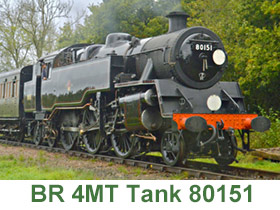
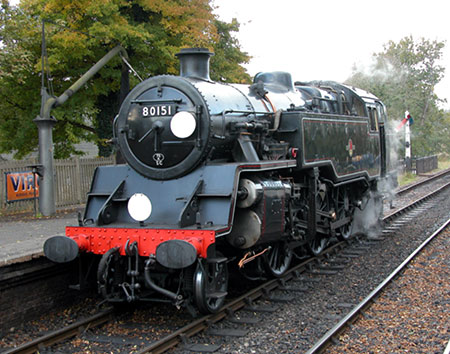 BR Standard Tank No. 80151
Class: 4MT
Designer: Robert Riddles, with design work done at Brighton
Wheels: 2-6-4T
Built: 1957, Brighton Works
Returned to service: 27 July 2019
Previously operational: Oct 2001 to 19 May 2012
Owned by The 80151 Locomotive Company Limited *
Photo: 80151 taking water at Sheffield Park, 28 October 2003, Derek Hayward
* Note: The Bluebell Railway Trust currently holds 40.3% of the shares in The 80151 Locomotive Company Limited.
The 4MT tank locomotives were closely linked to the last years of the Bluebell line, and although the last Brighton-built locomotive, 80154, escaped preservation, the Bluebell now plays host to three other members of the class, all one-time residents of Barry scrapyard. 80151 arrived from another preservation site in 1998 and returned to steam after the completion of its overhaul in the Bluebell’s workshops in October 2001. Additional boiler work during early 2011 saw its operational period extended to May 2012.
Its latest overhaul, which cost over half a million pounds saw, along with routine heavy maintenance and boilerwork undertaken in-house, new tyres fitted to the driving wheels.
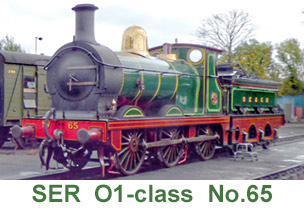
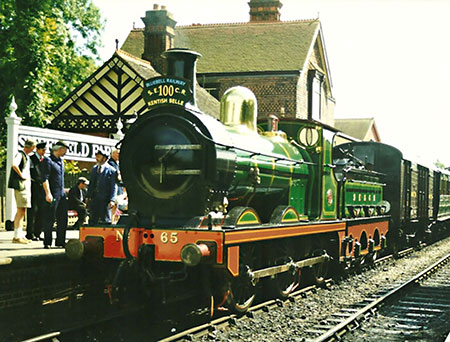 SER 0-6-0 goods engine No. 65
Class: O, rebuilt as O1
Designer: James Stirling, 1878, rebuilt Harry Wainwright
Wheels: 0-6-0
Built: 1896, Ashford Works; Rebuilt 1908
Numbers carried: 65, A65, 1065, 31065
Returned to service: 15 July 2017
Previously operational: 5 August 1999 to 7 July 2009
Owned by The Bluebell Railway Trust
Web page
Photo: at Sheffield Park, Jon Horrocks, 1999
Built at Ashford as an ‘O’ class locomotive to a design already 18 years old, it received a rebuild to class ‘O1’ in 1908, and ran on until finally withdrawn in 1961. In 1963 it was obtained by the late Mr Lewis-Evans and kept at Ashford Steam Centre until its closure. for the following 20 years its whereabouts became something of a mystery (with boiler, frames and tender separated) until it was brought back together at the Bluebell Railway for overhaul, and was returned to steam for the centenary of the amalgamation of the SER and the LCDR in August 1999.
0-6-0s were the commonest locomotives in this country, and the Bluebell now hosts a sequence of three unique survivors of this type, demonstrating their development through the first half of the 20th century, from the O1 through the SECR C-class to Maunsell’s Q-class built by the Southern Railway.
The Bluebell’s spare O1/H boiler was overhauled at The Flour Mill workshop, and has now been fitted in place of its previous boiler during the recent overhaul, which took place at Sheffield Park. The locomotive was purchased from the family of the late owner by the Bluebell Railway Trust in December 2021.
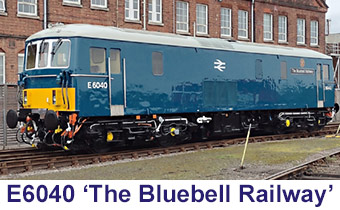
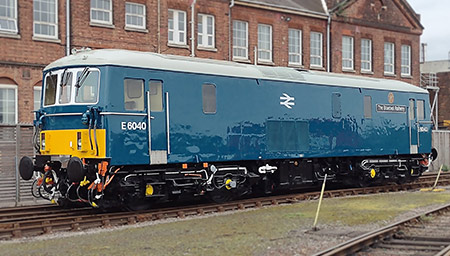 JB (later Class 73/1) Electro-diesel Locomotive
Built: 1966, English Electric, Vulcan Foundry
Wheel arrangement: Bo-Bo
Number: E6040 (was 73133 under TOPS)
Name: ‘The Bluebell Railway’
Arrived on Bluebell Railway: 25 April 2023
Owner: Private
Current status: Operational
Web page and Facebook Group for this locomotive.
Photo: E6040 ‘The Bluebell Railway’ fresh from overhaul, outside Eastleigh Works – Paul Auckland – 5 April 2023
Known latterly as Class 73s, these were electric locomotives for the Southern Region’s third-rail system, but incorporating a 600 hp diesel engine, similar to those used in the Southern Region’s DEMUs, intended for use in sidings and other non-electrified areas. Six prototypes, the ‘JA’s, were designed and built at Eastleigh in 1962 using English Electric equipment. They were built to the narrow ‘Hastings Gauge’, giving universal track access across the region.
43 more Electro-diesel Locomotives, ‘JB’s in Southern Region classification, were ordered from English Electric, built between 1965 and 1967, as part of the fleet to operate the newly electrified Waterloo-Southampton/Bournemouth line. Initially numbered E6007-E6049, they differed slightly from the ‘JA’s, most notably having higher tractive effort and a 90mph maximum speed.
73133 (as E6040 had become in 1973) was named ‘The Bluebell Railway’ in September 1990, and ran onto what is now Bluebell property two years later at the ceremony passing ownership of the viaduct at East Grinstead to us.
The locomotive just escaped being scrapped in 2004, entered preservation, but returned to main-line use in 2013 and having been used as a shunter at Bournemouth Depot and more recently at Eastleigh Works, was privately purchased from there in December 2022 by a member of the Bluebell Railway’s locomotive department. It was refurbished at his expense at Eastleigh Works in early 2023, prior to moving to the Bluebell Railway.
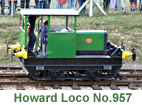
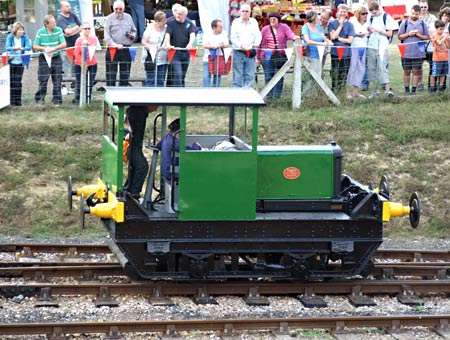 Howard Petrol-engined locomotive
Class: 2-speed 7 ton Main Line Loco
Wheel arrangement: 4w, chain driven, maximum speed 8mph
Engine: Dorman type 4-JUD 3970cc developing 41bhp at 1000 rpm
Built: 1926 by James & Frederick Howard Ltd, Britannia Iron Works, Bedford
Maker’s number: 957
Operated: 1926-1965
Arrived on Bluebell Railway: March 1965
Used on Bluebell until 1969, and returned to service: August 2010
Photo: at Horsted Keynes during the 50th anniversary gala, Richard Salmon, 8 August 2010
Built by Howards in 1926, No 957 was used to shunt their agricultural implement and railway wagon factory sidings in Bedford. The Britannia Iron & Steel Works Ltd took over the site in 1932 to make pipe fittings and continued using it until a larger shunting loco was obtained in 1965. Through the intervention of a local enthusiast the company presented 957 to the Bluebell Railway where it was used for light shunting until about 1969. Under the auspices of the Alf Brown Group an overhaul (details of which are here) was begun in the 1970s at Horsted Keynes which had to include new wheelsets, and it made its debut at the 50th Anniversary Gala in August 2010.
Although nominally operational, at the present time more work is required to complete the restoration of the locomotive.
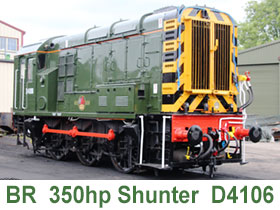
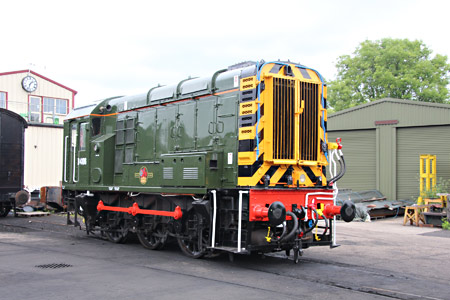 350HP Diesel shunting locomotive No. 09018 was purchased by a consortium of members who have set up a company to manage the loco, which is hired by the Railway as and when it is needed.
The 09 class of diesel-electric shunters were a Southern Region version of the ubiquitous 08 class, geared for slightly higher speeds. D4106 was built at British Railways’ Horwich Works on 13 November 1961. It was renumbered as 09018 on 31 December 1973. On the Bluebell it initially retained HNRC orange and grey livery, with the lettering removed, since the priority was the acquisition of a pool of spare parts.
Owned by B350 Ltd – Facebook Group
Tony Sullivan’s photo shows it on 8 June 2017, soon after being repainted the previous month into its original BR Green livery with wasp stripes, numbered as D4106.
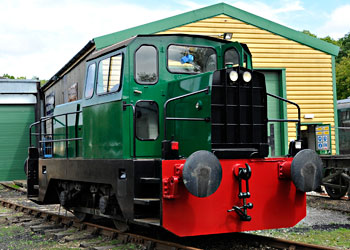
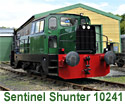
Sentinel/Rolls-Royce/Thomas Hill 4-w Diesel-Hydraulic loco No. 10241
Acquired by the Bluebell Railway’s C&W department mainly for shunting work around the carriage yard, this loco arrived on 7th May 2010, in working order.
A Sentinel designed loco, this one was built after the company became known as Rolls-Royce and is their No. 10241 of 1966. However, the loco was rebuilt by Thomas Hill (Rotherham) in 1973 (who had by then acquired the Sentinel/Rolls-Royce locomotive business), becoming their No. 247V.
Photo: Sentinel in the yard at Horsted Keynes, Derek Hayward, 13 August 2011
The Locomotive Roster indicates which locos should be working our trains on what days.
Note: Boiler Certificates. Steam locomotive boilers are certificated by our Insurance Company’s inspector, initially for seven years from the date of pressure testing after overhaul. The dates given above assume that a mid-term boiler examination/test allows an extension to a full ten-year term. In addition boilers require an annual inspection which they must also pass to remain in use. The mechanical condition of the locomotive may also prevent it attaining the potential 10-years. At the end of this period, unless a futher short extension is granted, the locos must be taken out of service for a boiler overhaul including a complete re-tube, and detailed inspection of the entire boiler and firebox, which will usually require the boiler to be removed from the locomotive’s frames. It is also usual at this time to undertake a full mechanical overhaul.
- Operational Locomotives
- Locomotives under overhaul
- Locomotives on static display
- Multiple Units
- Locomotives formerly based on the Bluebell

Locomotive Roster – Loco Stock List – Loco Works News – Atlantic Project – Standard 2MT Project – Awake the Giant – Project 27
Last updated by Richard Salmon, 14 January 2024