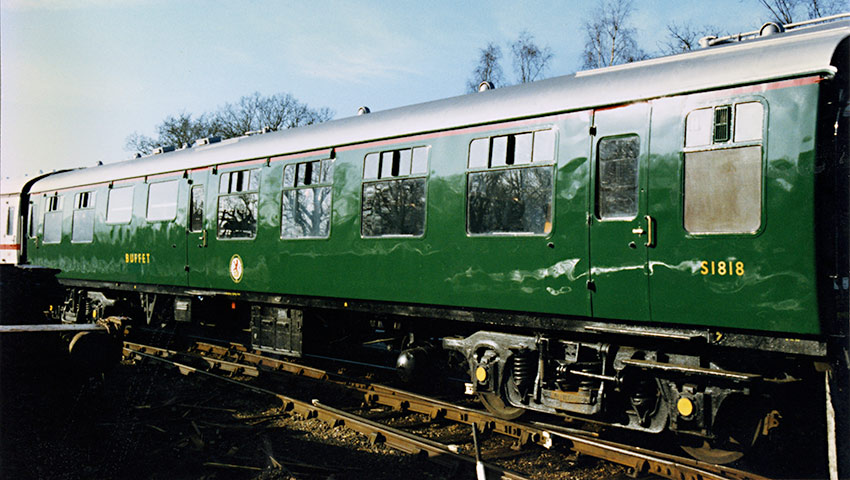
RMB No. 1818, one of two Restaurant Miniature Buffet Cars on the Bluebell Railway which provide on-train catering facilities for our visitor.
RMB stewards have a unique role in the operation of the train. Whilst they are not essential (the train can run without them), they perform a useful and profitable service of great importance to both customers and staff. Passengers travelling down from Victoria and East Croydon welcome the opportunity to buy a tea or coffee when getting on the train. Similarly engine crews like a soft drink on a hot day and the Kingscote staff get quite upset if they can't buy their cakes! The RMBs might not be essential but they are a great help to customer relations.
The working day begins about an hour before the 11am train leaves Sheffield Park. Having "signed on", the keys and cash box are collected from the Bessemer Arms, and the buffet area opened up. There is then time to check the float and stock the shelves, obtaining fresh supplies from the buffet as required. Having arranged everything to your liking (every steward has their own design!) the flaps can be lowered and given a quick wipe over, and then the RMB is ready for business.
The amount of trade can vary depending on the time of year and the timetable in operation. Table 2 days (two trains in service) are more profitable than Table 1 (when only one train is run). There is also an unofficial annual competition for the greatest take in a single day.
Although the RMBs are open for the duration of every trip, the majority of passengers seem to prefer buying their food and drinks when the train is standing still. The busiest moments therefore tend to be at Horsted Keynes, particularly in the "down" direction, and East Grinstead. On Table 2 days, where the set spends half an hour at Sheffield Park, there can also be some overflow from the restaurant building. When there are no customers, the stewards clean the tables, counter and shelves, re-stock the bar and fridge from the store-cupboard, and write the stock list for the following day. Clearing up at the end of the day takes half an hour, but as the last trip is often very quiet, it can be done on the way back from East Grinstead. The money is counted, float made up and bin liners replaced. Any problems are also noted and passed on to the relevant department.
Being an RMB steward is a good way of meeting our customers, and makes a pleasant change from other duties on the railway. There are few fixed qualifications for the job - provided you are smart, numerate and enjoy talking to people, the job can be yours.
New volunteers are always required. If you would like to find out more then join us on a Find out more day - now held monthly, or talk to an RMB steward on the train when you visit. Full training will, of course, be given.





 Text based on Bluebell News article by Tom Windsor.