
Overhead cover for our stock?
Operation Undercover
 Latest news for OP4 Latest news for OP4
Phase 1: The Carriage Works Extension
The Bluebell Railway Carriage and Wagon Department has an excellent
reputation consistently producing high quality restorations. We also
have a unique collection of carriages spanning the years from the
1850s to the 1960s.
In 1999 three carriages, whose average age was 100, were
outshopped to wide acclaim. These are proving excellent crowd pullers
in every sense.
These restorations were done in the cramped conditions of the old
carriage shed.
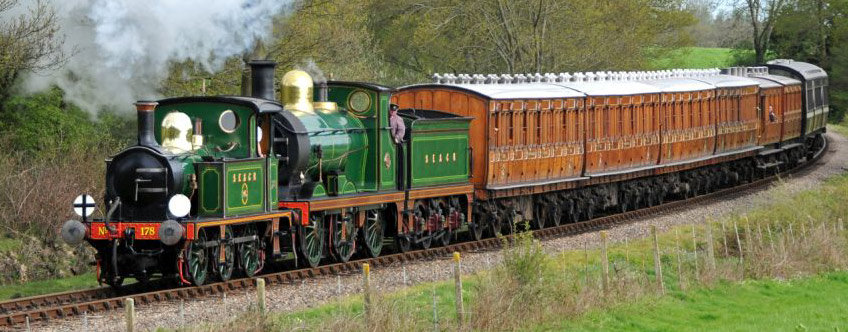
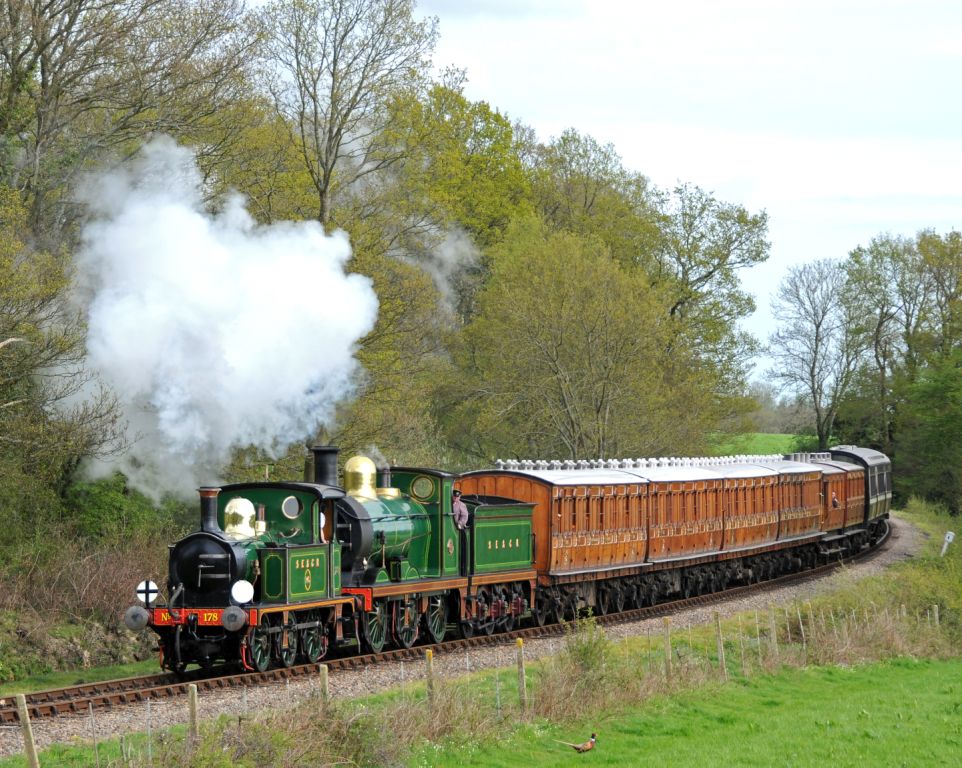
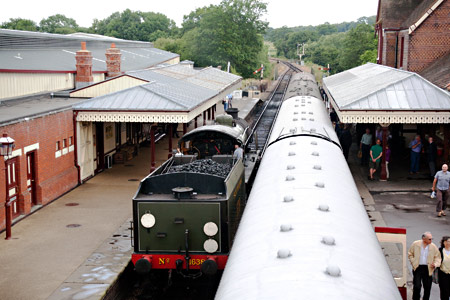
Seven vintage carriages behind SECR Locos 178 and 592 (Derek Hayward - 1 May 2010)
This gives a sense of the many vintage
carriages we have which must be kept under cover to ensure their
long-term survival.
The long term plan has three schemes to ensure we can maintain our
high quality vintage trains and restore more of our historic
collection. The first of these was an extension to the existing
carriage shed. This provided 3 properly laid out restoration bays and
allowed the return to storage use of half the old shed and the
remainder to be reorganised to provide another 3 restoration bays.
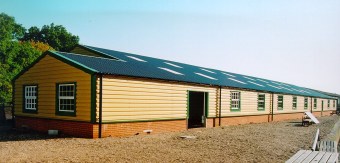 Left: The cladding and roof completed September 2000.
The Southern Railway style and colouring of the building, which is
designed to match that of the rest of the station, has already
received much praise. Since this photo was taken the windows have
been glazed, a mammoth task in itself.
The generous assistance of The Bluebell
Railway Trust in contributing half the cost of the cladding is
acknowledged.
The project involved us in raising a total of £170,000 over a
two-year period, which we have achieved, thanks to tremendous support
from members.
During 2003-4 the last parts of this project fell into place, with the relocation of the paint shop to the south end of the old building, construction of a fire-break wall between the two halves of the shed, and partial re-cladding of the paint-shop area. Having achieved this, we move on to:

Phase 2: Completion of north end of loco running shed
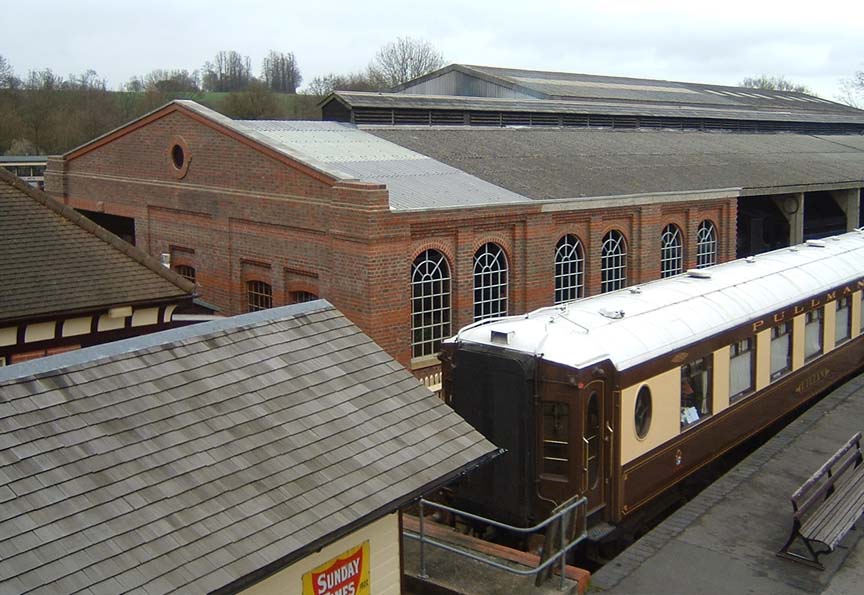
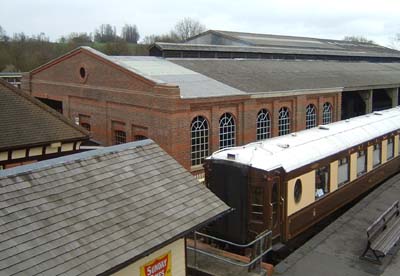 This project involved the tidying up of unfinished work, and was the relatively minor scheme to complete the north end of the existing Locomotive Running Shed, which was extended by one bay, and brickwork completed at that end, on foundations laid some years ago. This has been funded partly from money already raised over many years for the purpose, by new donations given specifically for this latest work, and by a contribution from the Bluebell Railway Trust, under the auspices of "Operation Undercover".
With this completed as seen in the photo taken in April 2004, over the winter of 2005/6 the railway decided that the remaining length of shed wall should be completed, and this was funded by the Bluebell Railway Trust, along with the long-standing "shed wall fund".
Phase 3: Woodpax Site - Sheffield Park Carriage Shed, Museum and much more
The big push during 2003 was the purchase of part of the former Woodpax site at Sheffield Park, for about £300,000, money which was raised by an appeal during the first few months of the year.
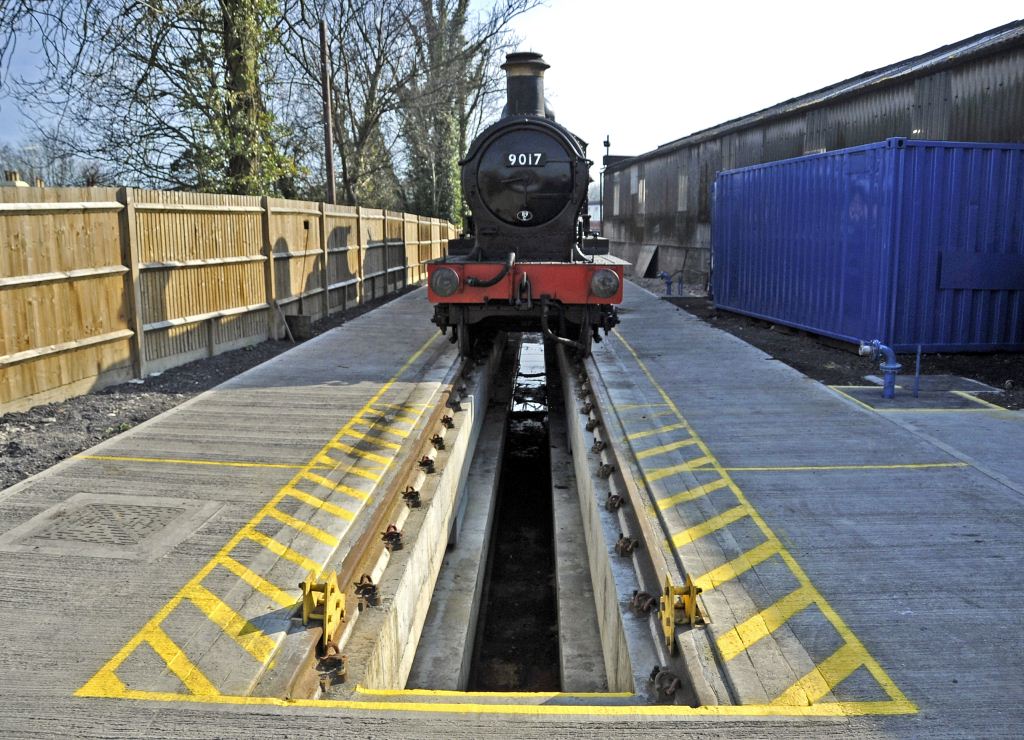
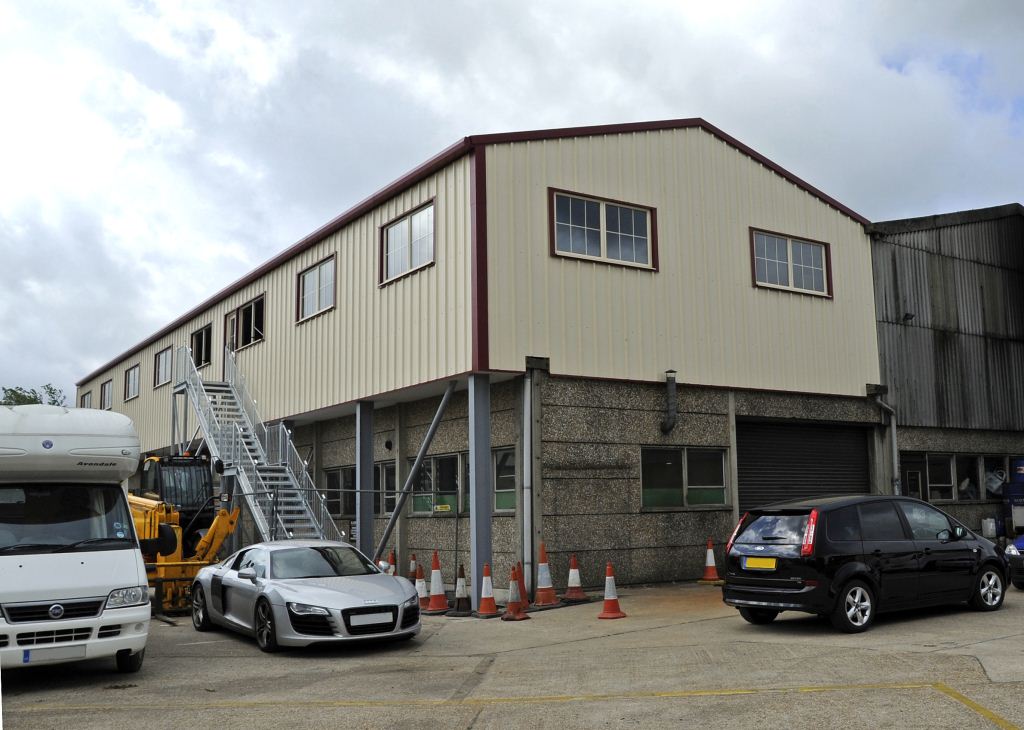
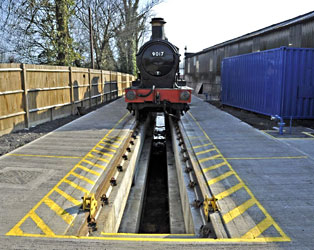
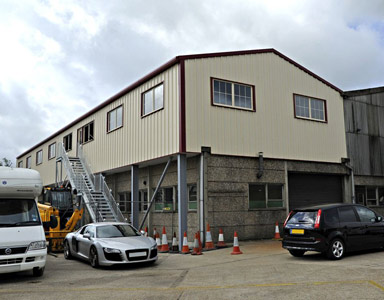
The Woodpax site forms the basis for Phase 3 of Operation Undercover, which provides covered accomodation for up to 17 carriages, a new museum building, a new loco washout pit, the repair and reconstuction of the platform buildings and canopy, provision of toilets on platform 2, and the shell of a building for new loco staff facilities, all at Sheffield Park. The total project cost was £3.9 million, of which £2.875 million was covered by a grant from the heritage Lottery Fund, awarded in March 2008. Sheffield Park Carriage Shed and the new Museum both opened during 2011.
Full details and news reports relating to Phase 3 are available on a separate web page and there's also a report available detailing the first phase of the fit-out of the Above Workshop Facility.
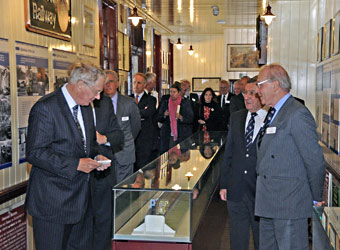
Phase 4: Horsted Keynes Carriage Works/Shed Extension - OP4
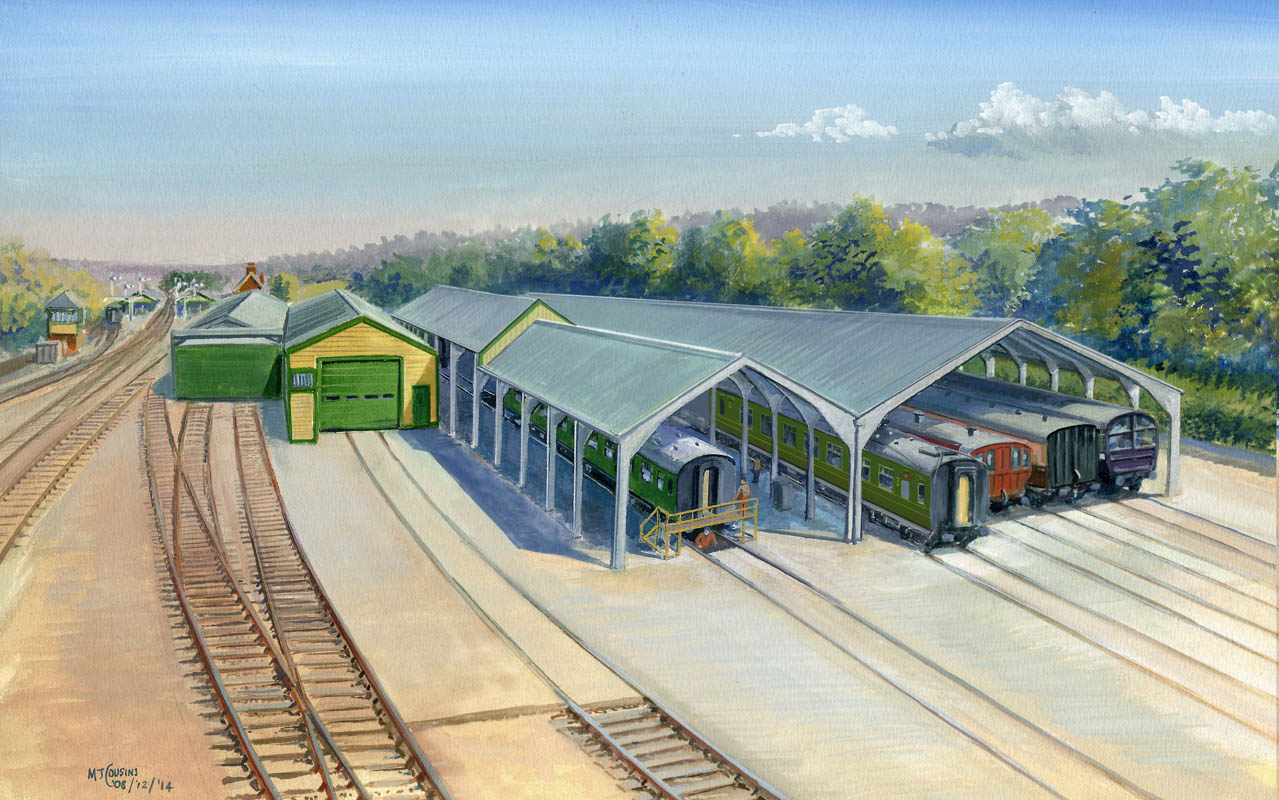
 At Horsted Keynes we have raised the money for, and have built the shell and roof of a 24-vehicle storage shed behind
the existing shed/works in the Down Yard. The limited length of the down-yard headshunt
means that this shed would not be suitable as a running shed for 6-car
rakes. It is therefore considered that this shed would eventually be the home
of the shorter vintage sets, but in the immediate future will simply be the home of those vehicles stored awaiting overhaul.
At Horsted Keynes we have raised the money for, and have built the shell and roof of a 24-vehicle storage shed behind
the existing shed/works in the Down Yard. The limited length of the down-yard headshunt
means that this shed would not be suitable as a running shed for 6-car
rakes. It is therefore considered that this shed would eventually be the home
of the shorter vintage sets, but in the immediate future will simply be the home of those vehicles stored awaiting overhaul.
It also covers the coaches on the maintenance/pit road and jacks.
This puts virtually all the pre-Mk.I carriages under cover. The plans also include a Heritage Skills Centre, and a component storage shed to clear the shipping containers and open-air component storage.
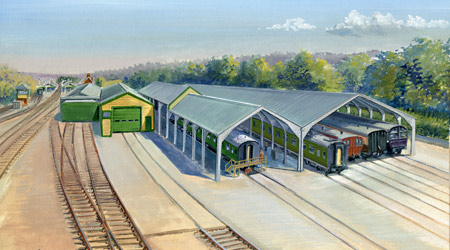
Fund-raising in the Autumn of 2014 enabled contacts to be let for the foundations, structure and roof, and the Wall-to-Wall Appeal in 2018 has enabled the completion of walls and the cladding of the Heritage Skills Centre. The building can then be completed in manageable stages over the coming years as funding permits, but immediately gave the benefit of the cover to our most valuable vintage carriages (as seen in Matthew Cousins drawing here). Funds are currently being raised to complete the firebreak wall between the two halves of the shed, and for the fit-out of the Heritage Skills Centre.
 More details and news of Operation Undercover Phase 4 are available here - the appeal for funds, is still open. More details and news of Operation Undercover Phase 4 are available here - the appeal for funds, is still open.
Accessible Steam Heritage (ASH)
Outside the Operation Undercover banner, at Sheffield Park the ASH project has resulted in a 2-road locomotive maintenance shed on the site of the original small loco shed, providing much improved frost protection for the locomotives used during the winter, also covering the new loco washout pit, and providing a maintenance facility independent of the main loco works. The roof of the main running shed and its lighting were also replaced as part of this NLHF-funded project which also created the Steamworks! exhibition.
OP5? - Longer term plans
We now need to press forward with plans to get the remainder of our locomotive fleet undercover. One possibility could be a roundhouse for the smaller pre-grouping locomotives, which would take space from the top car-park, or a small southern extension of the main loco shed, but the main options for what is possibly to be "OP5" appear to be either a museum/display/exhibition building on the up side at Horsted Keynes, or a new carriage shed on the Pump House and Newick sidings, enabling the Woodpax shed (Phase 3) to be converted into a Locomotive and rolling stock exhibition space.
These plans are still evolving, and input from around the railway is constantly being canvassed as ideas are developed. It is clear that the long-term aim must be, somehow or other, to get our entire collection of historic stock (locos, carriages, vans and wagons) under cover.

Return to BRPS Home Page,
to the Timetable or to Special
Events
Visitor Info. -
Museum -
Trust -
Catering -
Contacts -
What's New -
Projects -
Locos -
Carriages & Wagons -
Signals -
History -
Other -
Links -
Search -
FAQ
Why not become a BRPS Member? -
Get more involved as a Volunteer
Your ideal Film/TV location?
 Last updated 8 July 2020 by Richard
Salmon.
Last updated 8 July 2020 by Richard
Salmon.
© Copyright BRPS. Privacy Policy
|