Carriage & Wagon Dept -
Stock Lists: Carriages, Vans, Wagons & Multiple Units -
C&W News
SR Coach Group - Goods Division -
Operation Undercover -
Technical -
Join us


London Brighton & South Coast Railway
Bogie First No. 142, (SR No. 7598)
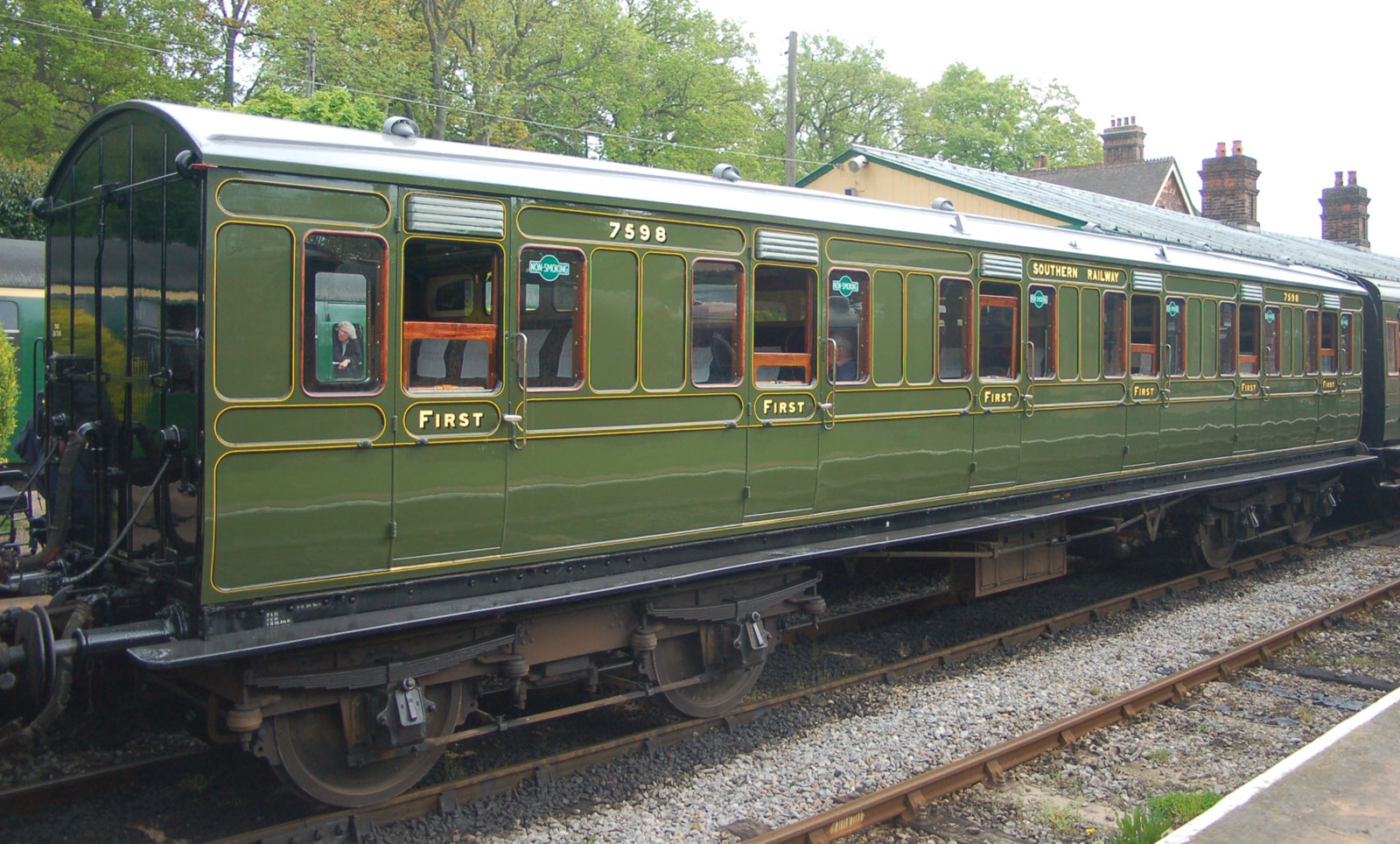
No.7598 is seen on 19 May 2012, just a week after it returned to service after an intermediate overhaul. Unlike its previous paint-finish, this time the lining follows the edge of the lower body panels, as well as the upper, accurately reflecting the traces of lining discovered on the coach when it was stripped down for its initial restoration (Photo: Keith Leppard)
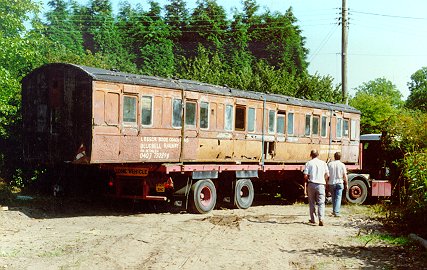
Left: The LBSCR coach body leaves West Chiltington in 1989, where it had stood since 1931, used as a domestic dwelling and latterly as an aviary! It survived in relatively good condition having been placed on a good base, and with a roof covering it completely. (Photo: Gerry Bixley)
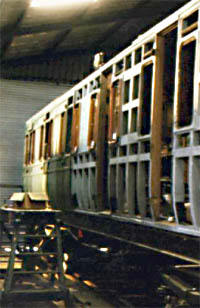
Right: The body of the coach under repair in the carriage shed, December 1995.
This is the only ordinary LB&SCR bogie coach on the mainland of Britain, and for many years we have run an ex-LB&SCR line with none of that company's rolling stock in service! This carriage is a good example of a Billinton arc-roofed coach, at one time so common on Sussex branch lines and more prominently on the Isle of Wight.
Built for the London-Brighton main line, it provided the most luxurious first class accommodation, with only six seats in a compartment nearly eight feet square, although on the relatively short journeys to Brighton or Eastbourne it was obviously decided that lavatories would be unnecessary.
You can read more about the origins of the design, dating back to Stroudley days, in Ian White's article "The Brighton Bogie First: Is it a Stroudley?" written in 2019.
Its length of 48 feet was once the standard length of much of the rolling stock built by many different railways, but now very few survive. Like so many coach bodies, it survived as a bungalow. Few survive in such good condition, and this one was selected after several years' search for such a vehicle. Many parts for it, including replacement partitions, electrical and brass fittings, and some spare doors, have come from other old bodies which did not survive complete, and have now been broken up.
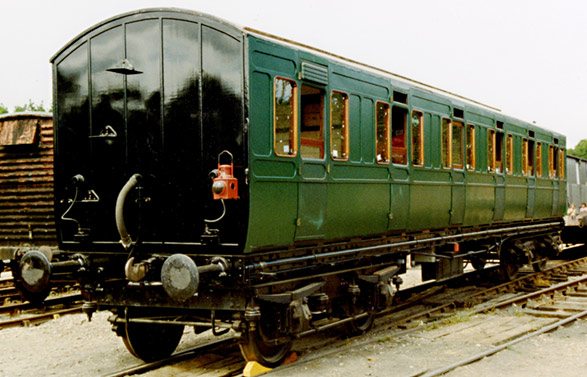
Left: One side complete and in undercoat, August 1996
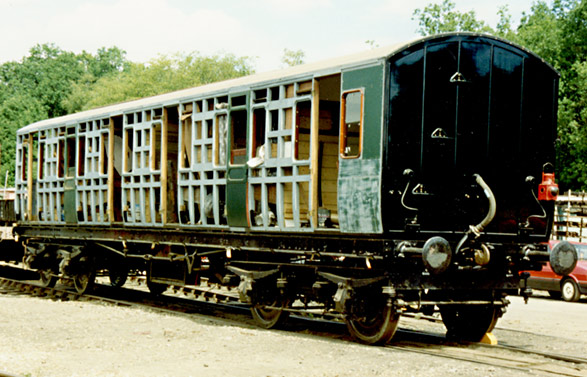
Right: The other side of the coach showing what was left to be done!
The restoration of this vehicle has been undertaken and funded entirely by volunteers. It has involved the reconstruction of a suitable underframe (shortened from 50 feet to 48), the complete re-cladding of the exterior as well as much work on the interior of the coach. With replacement springs for the bogies costing £2,500 such a restoration has to be paced such that the funding and the work progress together!
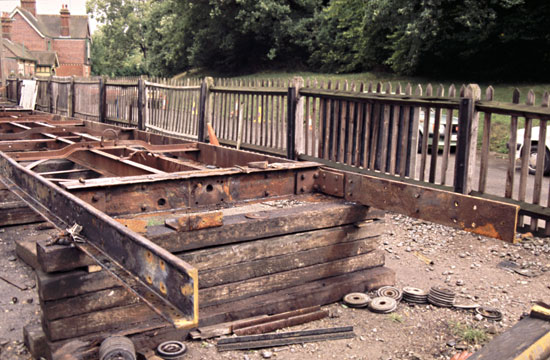
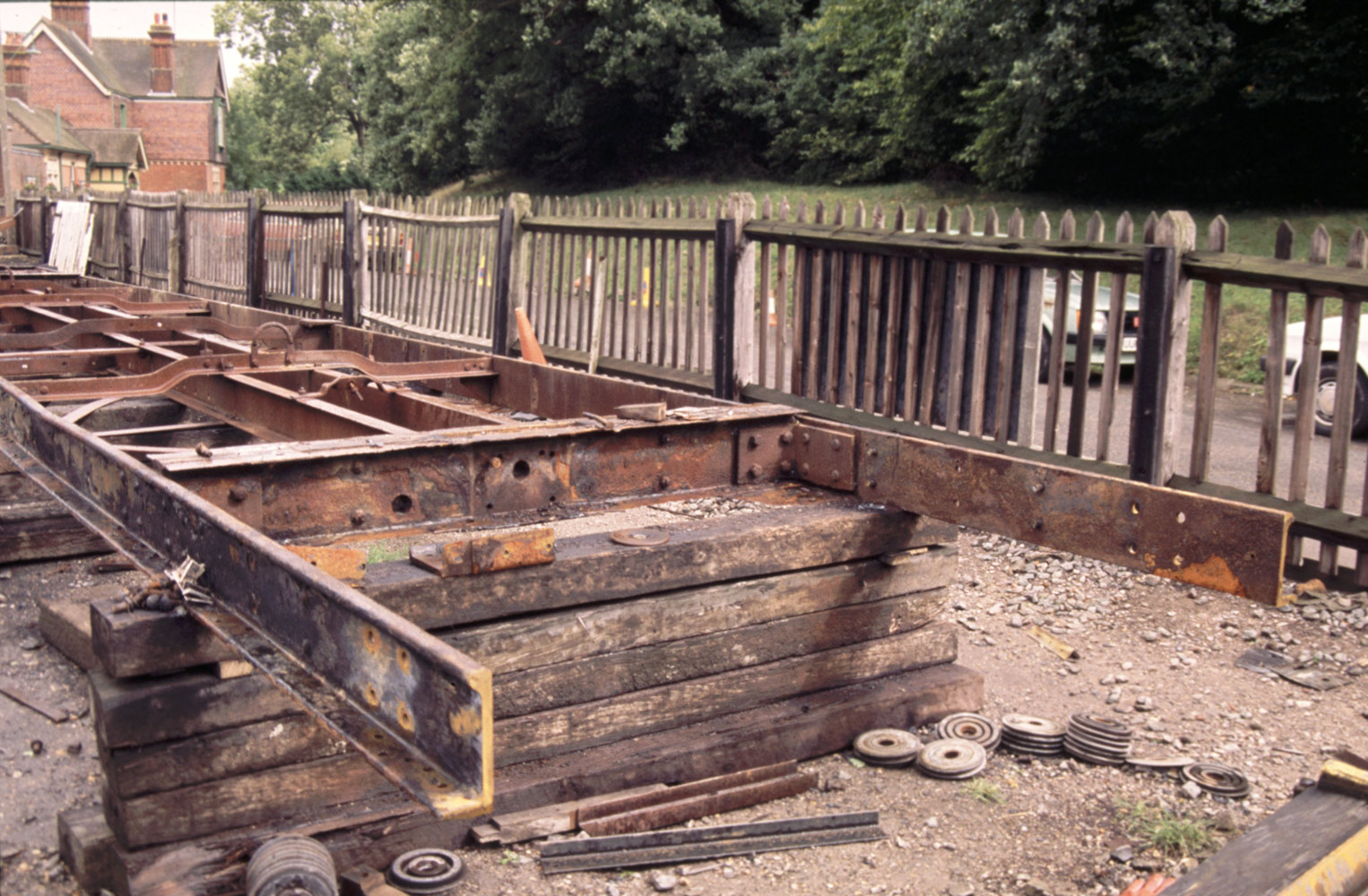
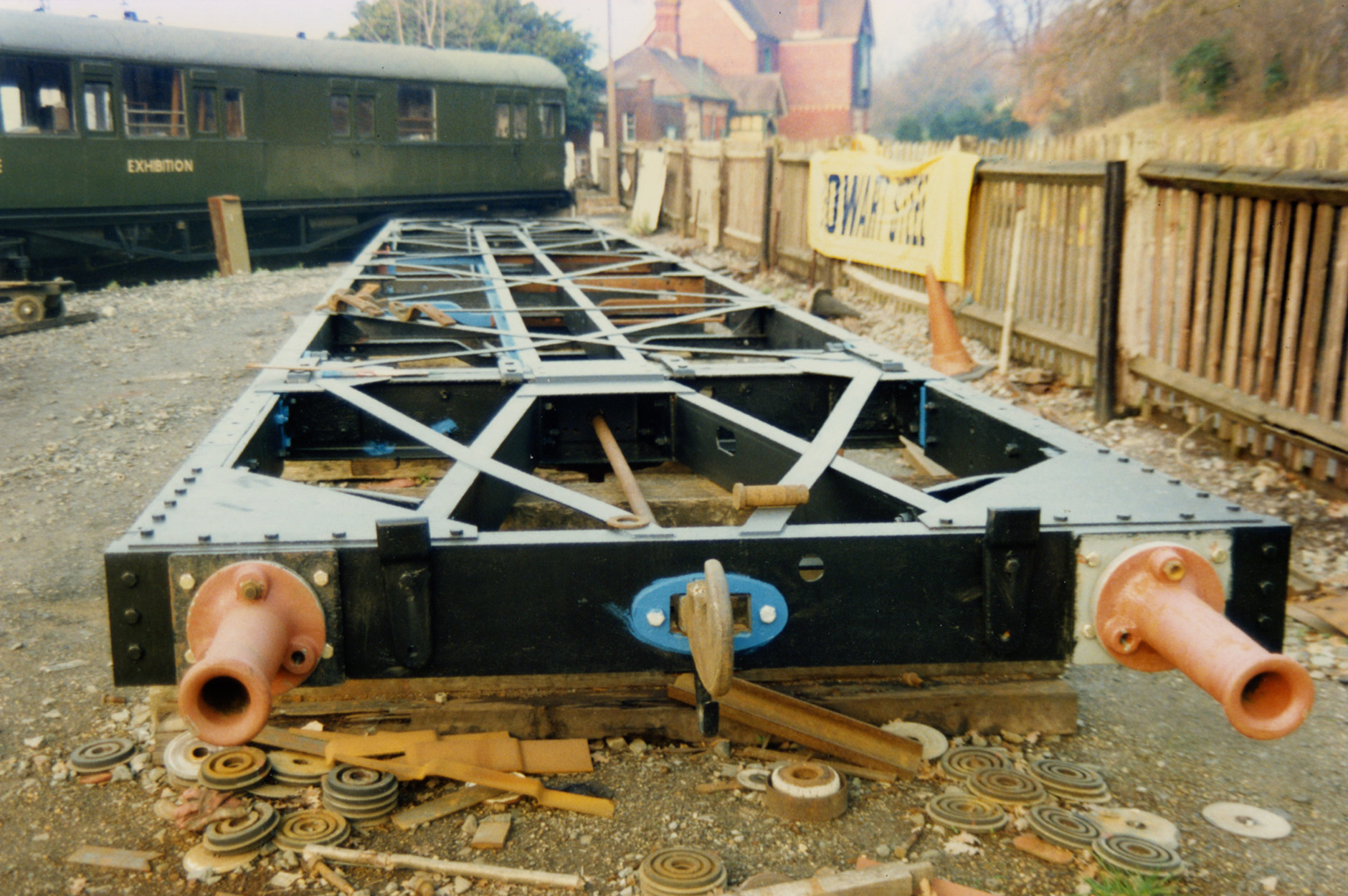
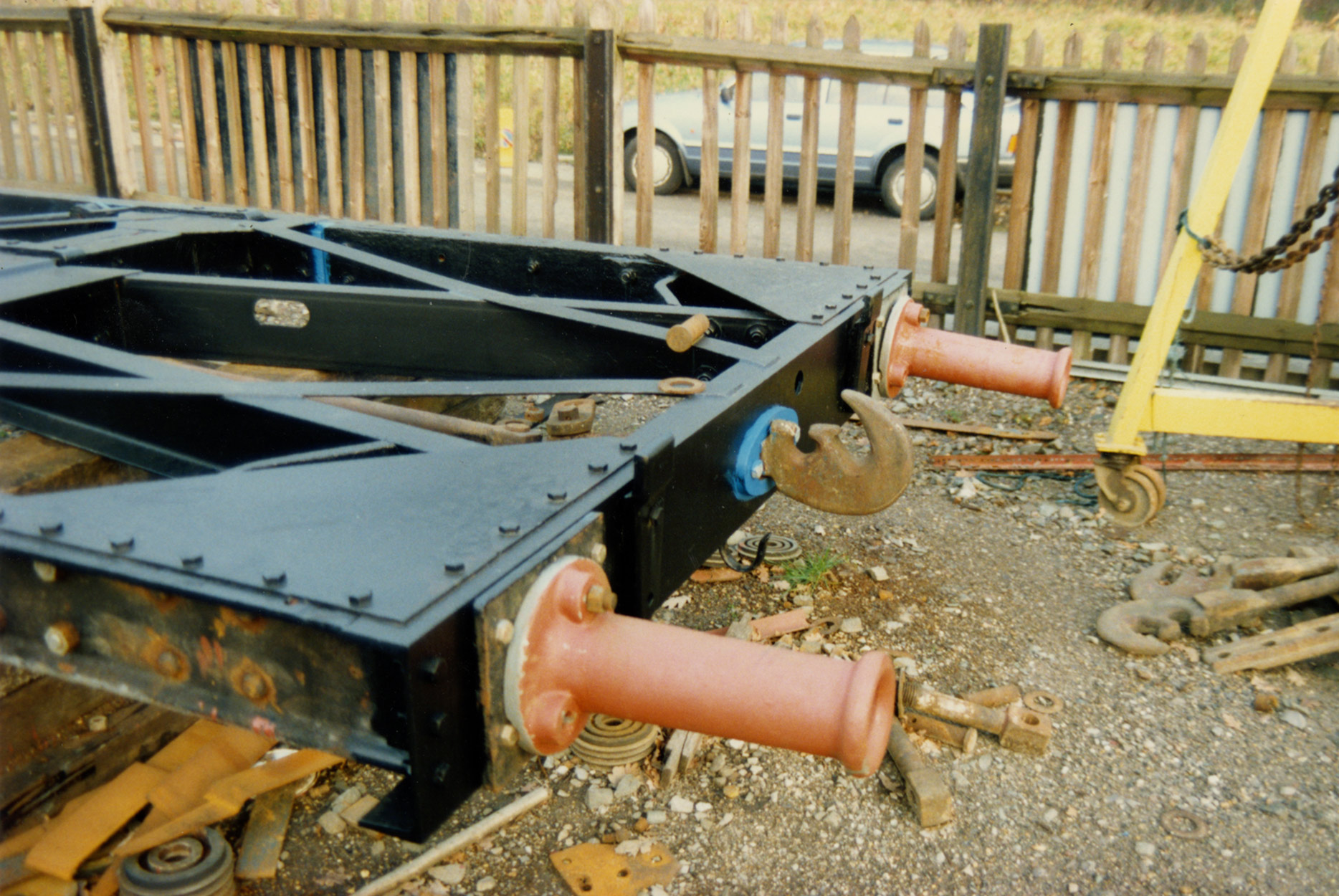
We were very fortunate in being able to obtain a LNWR underframe with Fox's 8' Plate bogies, the same type that the LBSCR used. The underframe had to be shortened by removing a foot at each end, and completely reconstructing the end sections.
The photo on the right shows it upside down and being stripped for rebuilding. The transom seen in the middle of this photo, a steel-timber-steel "composite" sandwich, was also replaced due to corrosion.
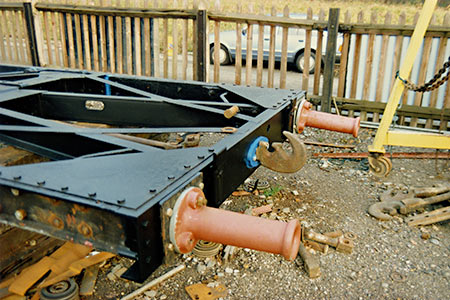
The photos below show the underframe, now the right way up again, nearing completion.
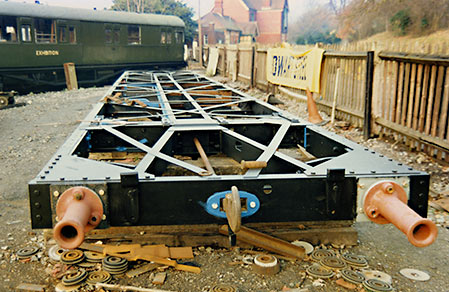
Left: The underframe prepared for this vehicle by shortening and repairing an old one which we were able to purchase.
Right: Detail of the underframe, after one foot had been cut off each end.
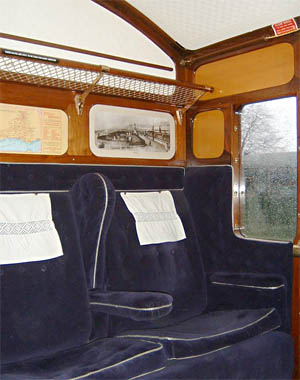
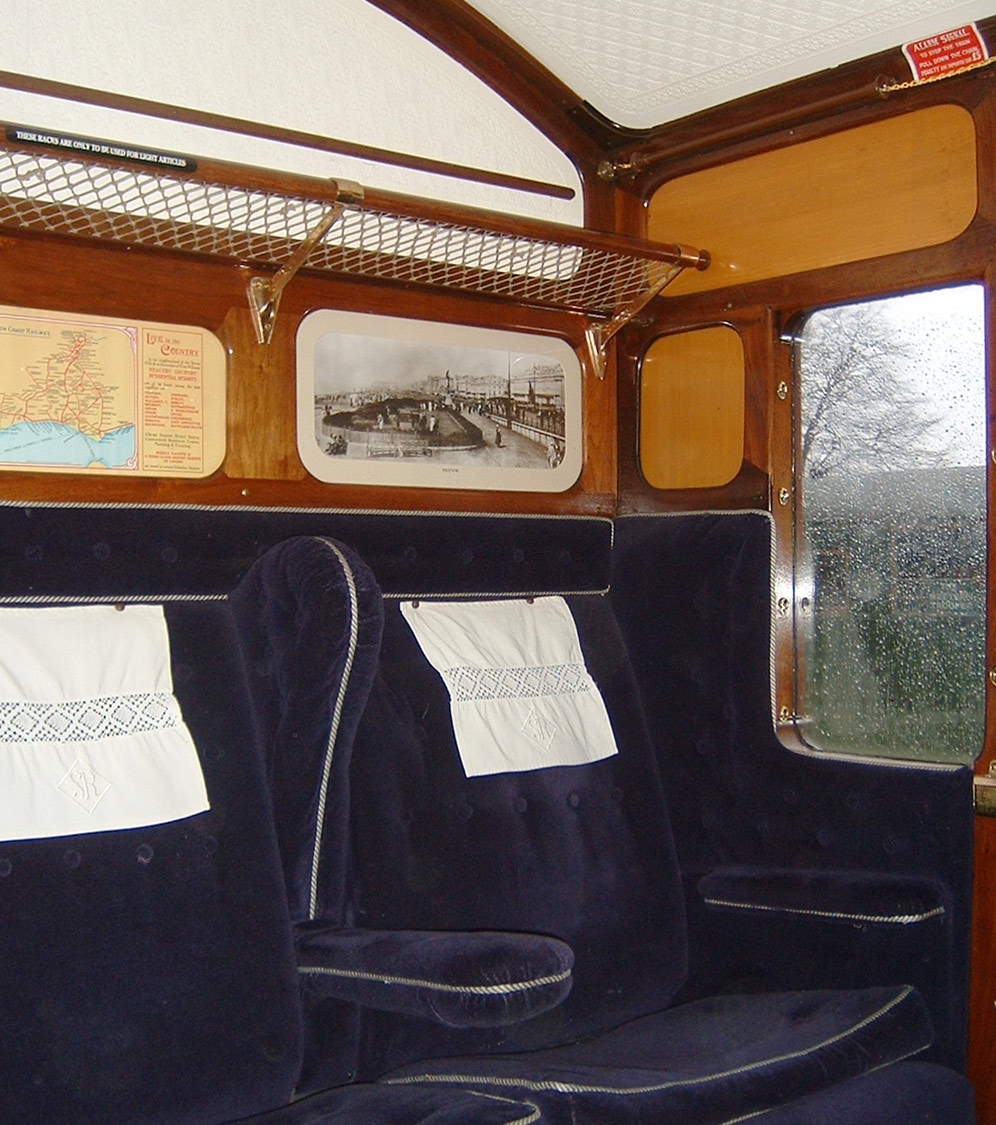
Right: Interior photograph showing the spacious seats, sycamore and American walnut panelling, and anaglypta ceiling.
Following six years of restoration, the coach undertook its first test run on 19th June 1998, and the following day, with painting, lettering and lining still to be completed and with seating completed only in one compartment, the coach was included in the branch-line train hauled by LBSCR No.473 "Birch Grove" at the re-launch into service of this centenarian locomotive.
The seating then took another year to complete. Five compartments are trimmed in a deep blue moquette which matches closely remnants of the original material which survived in the body. The sixth compartment is finished in original Southern Railway floral pattern moquette, without arm rests, as an 8-seater first-class compartment, such as would have been found in similar coaches on the Isle of Wight.
The exterior finish is to the 1920's Southern Railway livery of Olive Green, which the coach carried in the final years before withdrawal. This is appropriate since, for the foreseeable future the vehicle will operate in our vintage train with the two SECR thirds which are also painted in this livery. When, in the future, other LBSCR and LSWR coaches are restored, it might be appropriate to repaint it in LBSCR colours.

Left: Restoration completed, April 1999 (Richard Salmon)
The coach was launched into service with a special day for all the supporters of the project on 29 May 1999, and carried its first fare-paying passenger for 68 years the following day, as part of the Bluebell's scheduled "Vintage Branch-line Train".
In 2003 it was awarded the Heritage Railway Association "Coach of the Year" award.
Subsequently it has needed wheels re-tyring, and during 2010-12 all twelve of the doors, two of which on initial restoration were indeed expected to only have a life of 10 years, have been replaced, the steam heating upgraded, and the coach given a full repaint (as seen in the photo at the top of the page).

Type: First
Built: June 1903 at Brighton
Seating: 36 1st class (38 as restored)
Length: 48'
Weight: approx 25 tons (original weight 22 tons)
Original No: 142
Other Nos: SR 7598 (from September 1925)
Withdrawn: October 1931
Preserved: 1989
To Bluebell: 1989
Right: Restoration completed, April 1999 (Richard Salmon)

Return to BRPS Home Page,
to the Timetable or to Special
Events
Carriages & Wagons -
Intro -
Development -
Stock Lists: Carriages, Vans, Wagons & Multiple Units -
Carriage Fleet Review -
Join us
C&W Works News - SR Coach Group - Goods Division -
Operation Undercover -
Carriage Shop -
Technical Pages
Visitor Info. -
Museum -
Trust -
Catering -
Contacts -
What's New -
Projects -
Locos -
Carriages & Wagons -
Signals -
History -
Other -
Links -
Search -
FAQ
Why not become a BRPS Member? -
Get more involved as a Volunteer
Your ideal Film/TV location?
 Copyright © 30 July 1998.
Last update 29 January 2026 by Richard Salmon.
© Copyright BRPS. Privacy Policy
|