
|
|

|
|
Carriage & Wagon Dept - Stock Lists: Carriages, Vans, Wagons & Multiple Units - C&W News SR Coach Group - Goods Division - Operation Undercover - Technical - Join us 

Carriage & Wagon Works NewsSECR Birdcage Brake No.3363 of 1910
22 October 2011
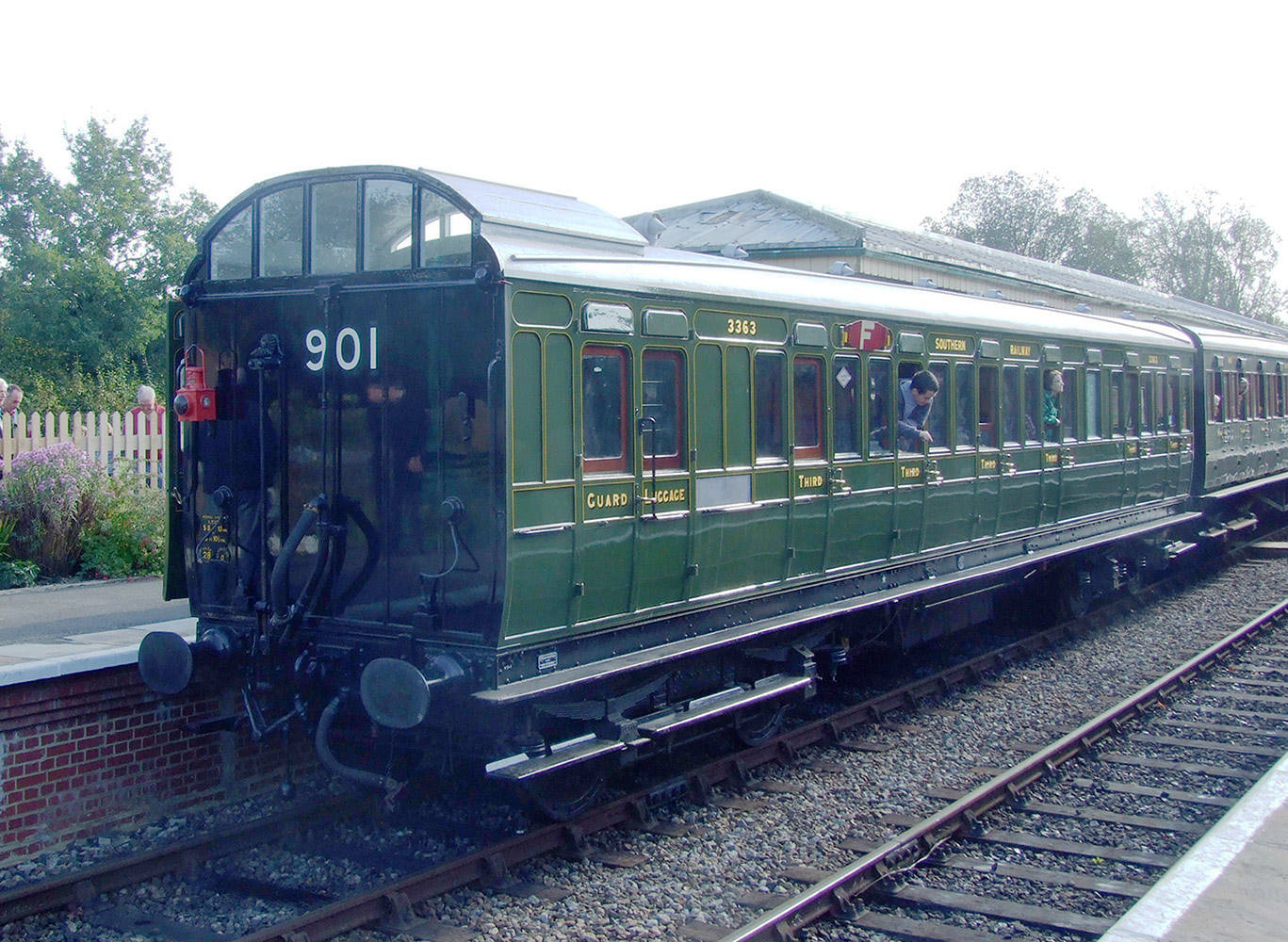
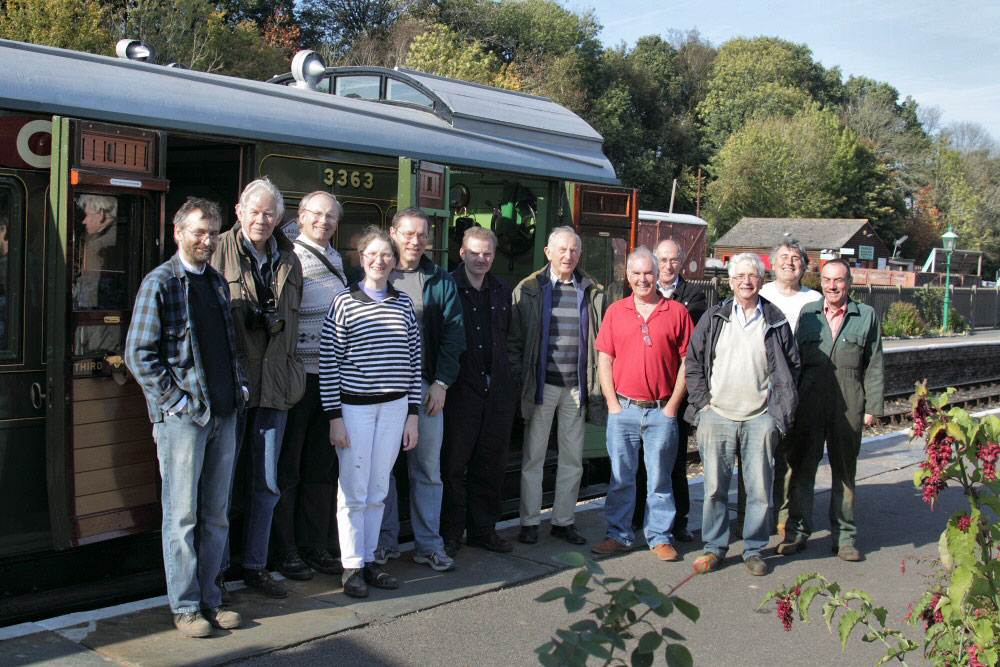
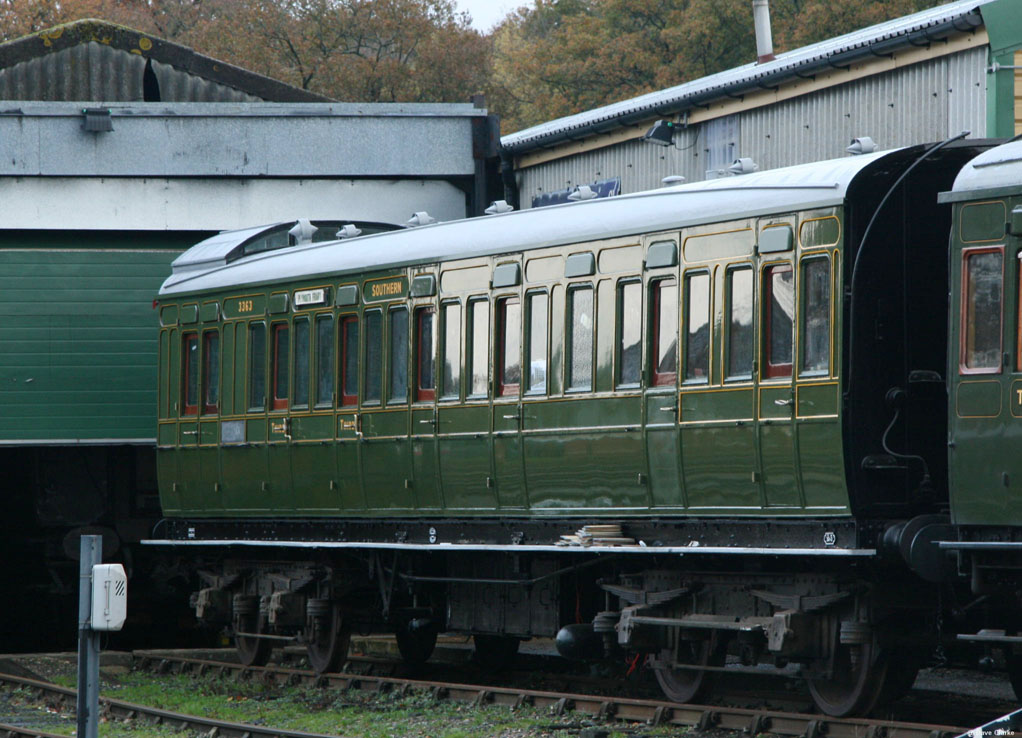
SECR birdcage No.3363 is seen right in Richard Salmon's photo on its first day in Bluebell service, Saturday 22 October 2011. That evening a special train ran to celebrate its return, for those who'd contributed to the restoration. The planned loco (C-class No.592) was changed for the SR-liveried E4, to harmonise with the new carriage. 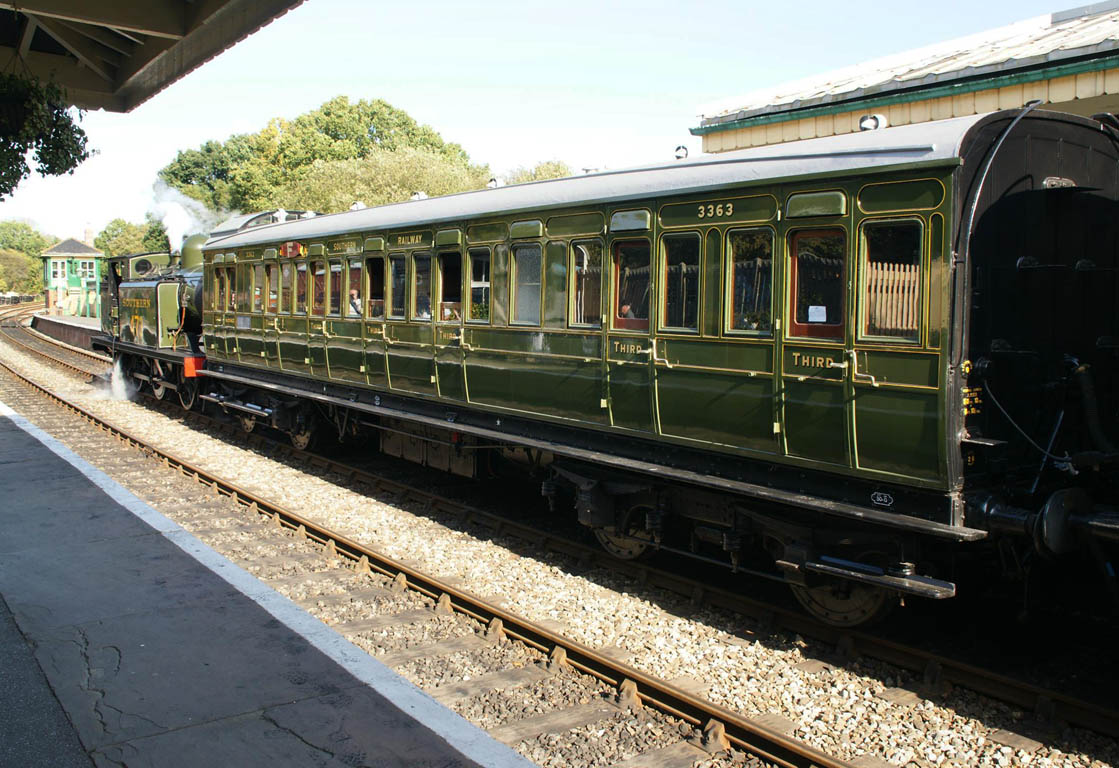
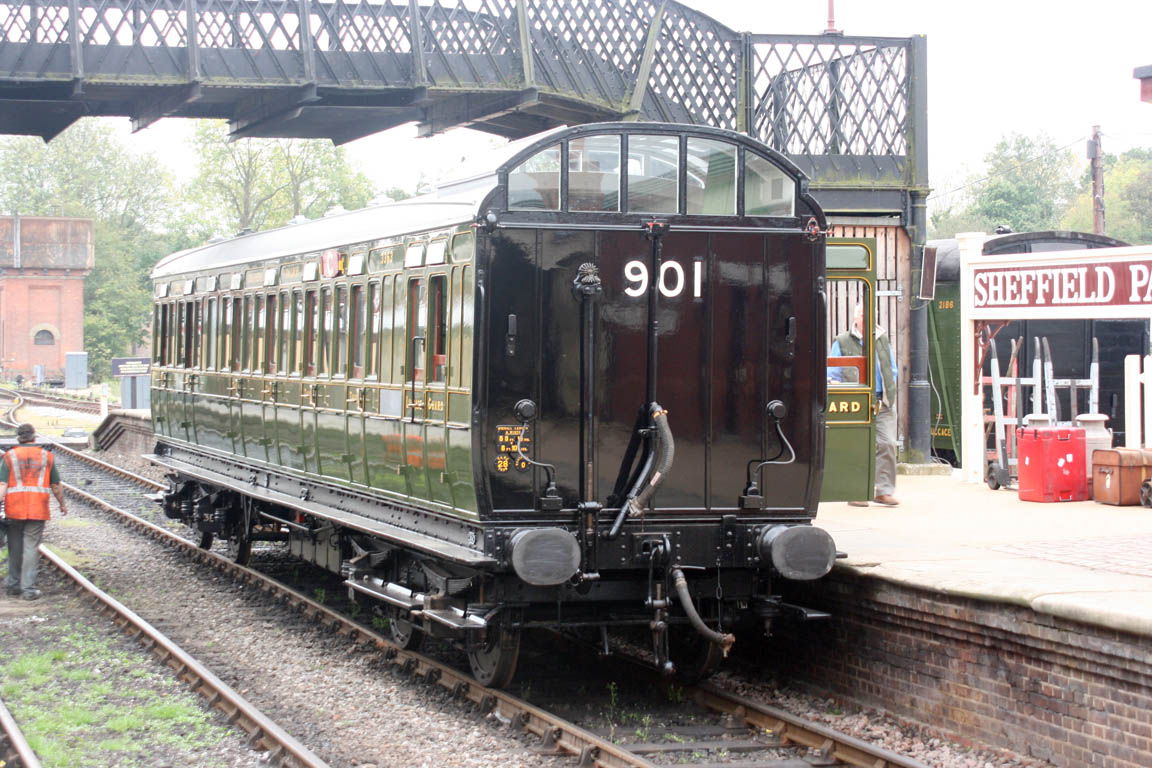
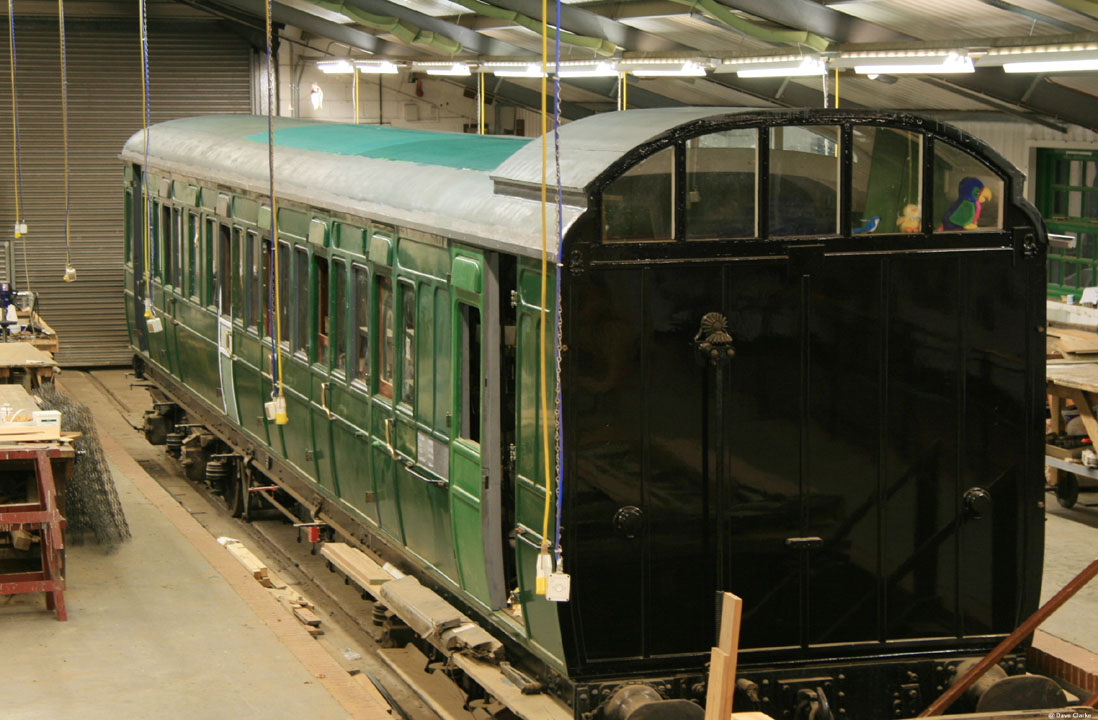
Tony Sullivan's photos, left and below, show the Birdcage brake at Sheffield Park during its test run on 13th October 2011. 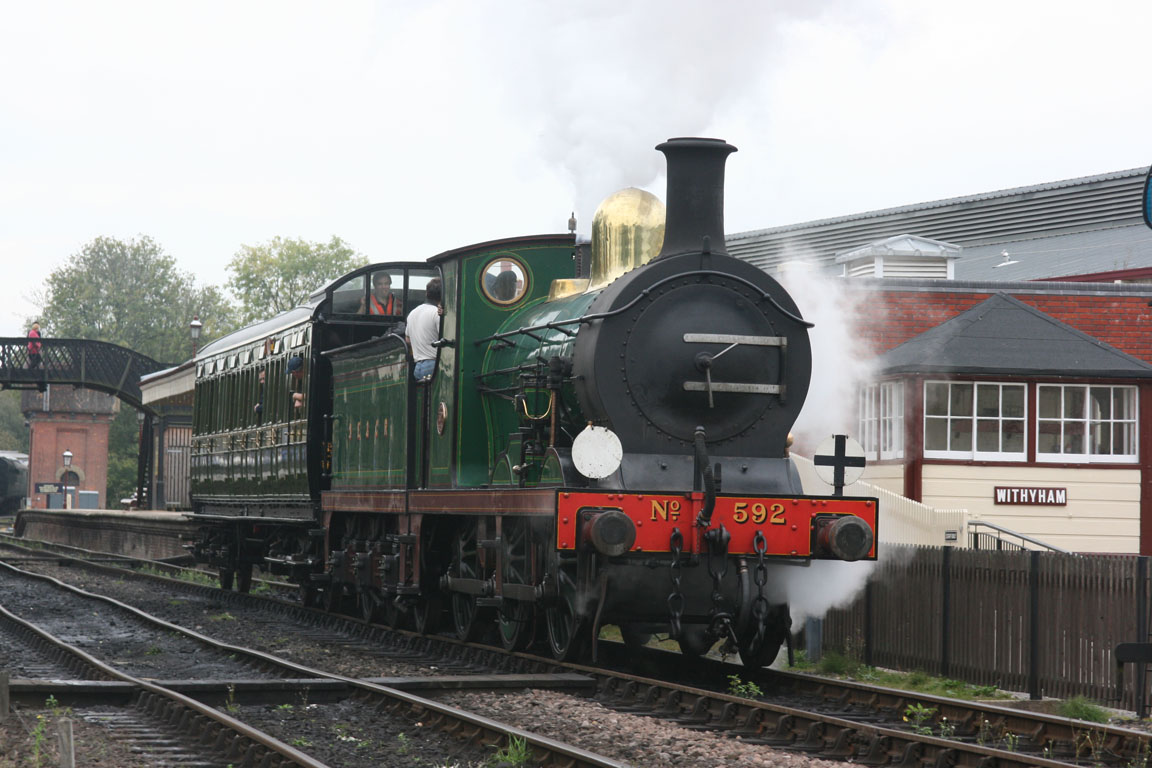


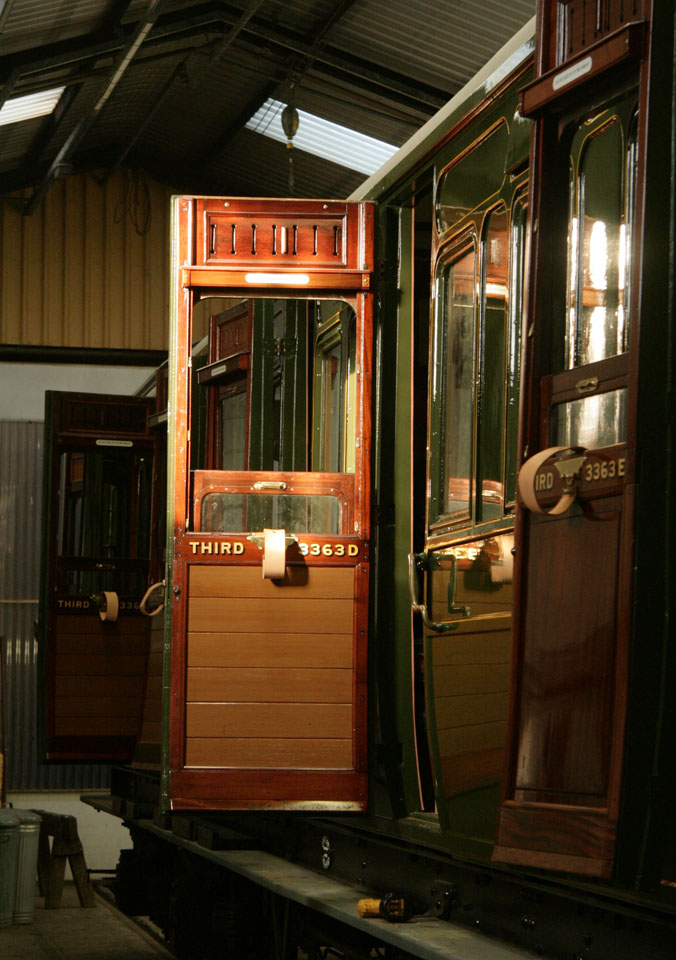
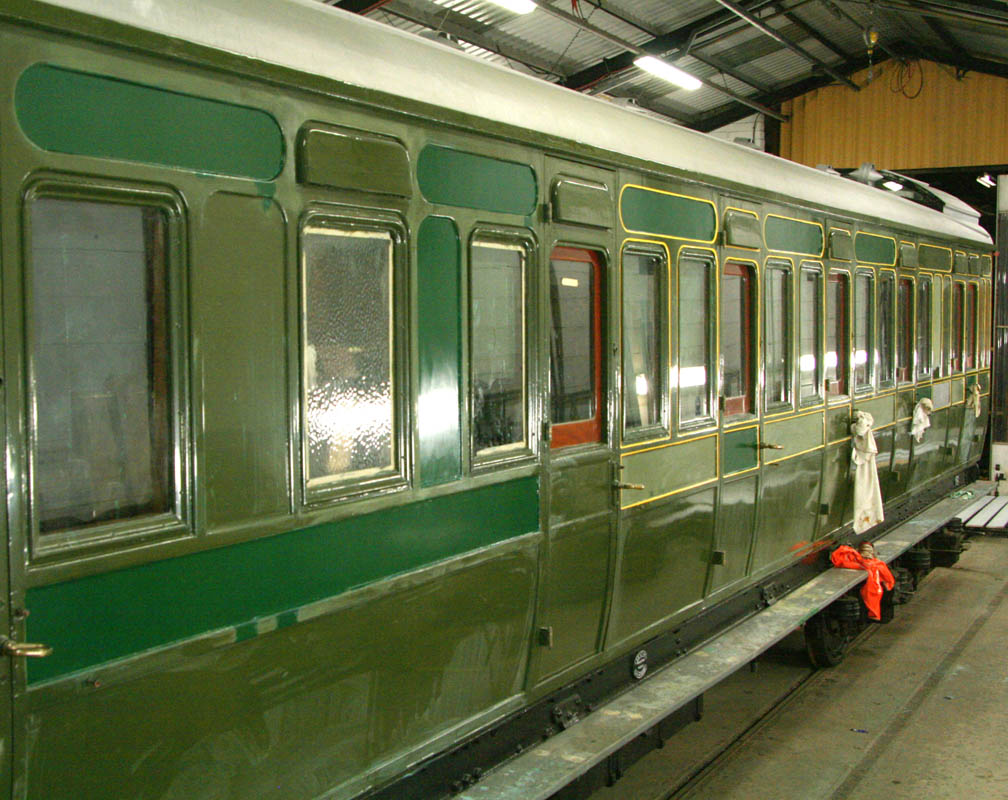
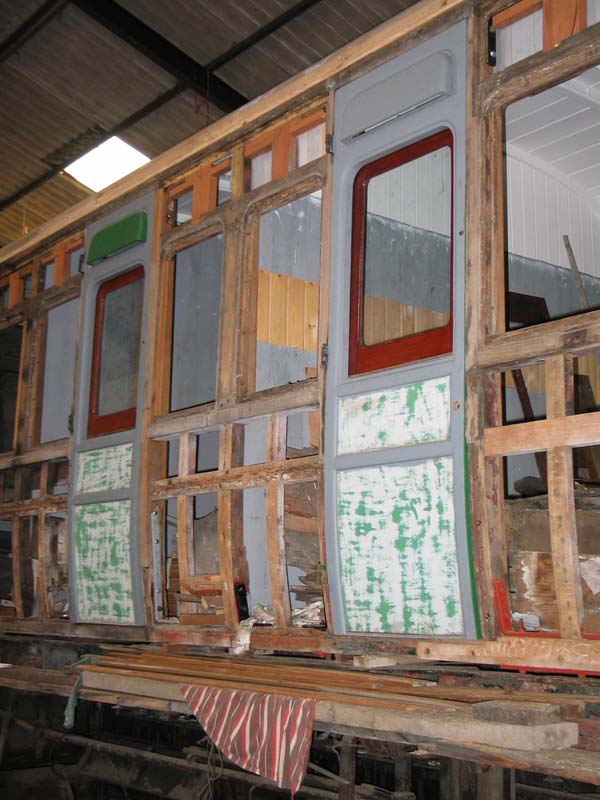
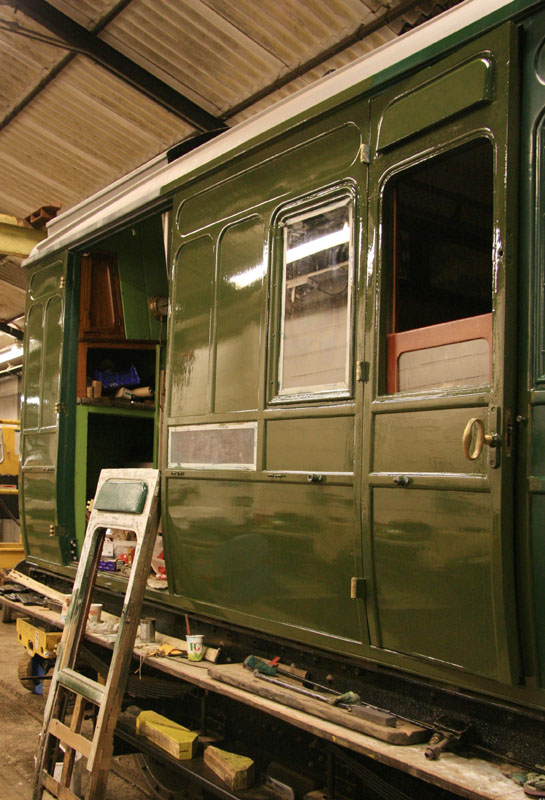
Having stayed outside through the winter and spring, the incomplete paintwork had suffered, particularly it's thought from the sun; the surface of some of the ply panels was causing problems and a few have had to be stripped back to bare wood. They have now been sealed, primed, undercoated, had brushing filler applied and sanded back, more undercoat then a further application of filler where necessary and then another undercoat, as seen on 31 July 2011. The signwriting meanwhile continued on the other side of the vehicle. 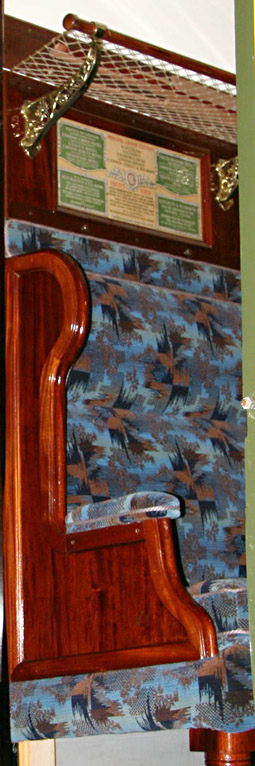
14 February 2010
Dave Clarke's photo on the right shows the first section of Olive (Middle Bronze Green) topcoat applied on the west side of the brake and A compartment. 

Following on from the last report, once the canvas had been bedded down, trimmed and tacked around the edges, it was painted. Here the first (thin) coat of paint is partially applied (Dave Carke, 1st November 2009). 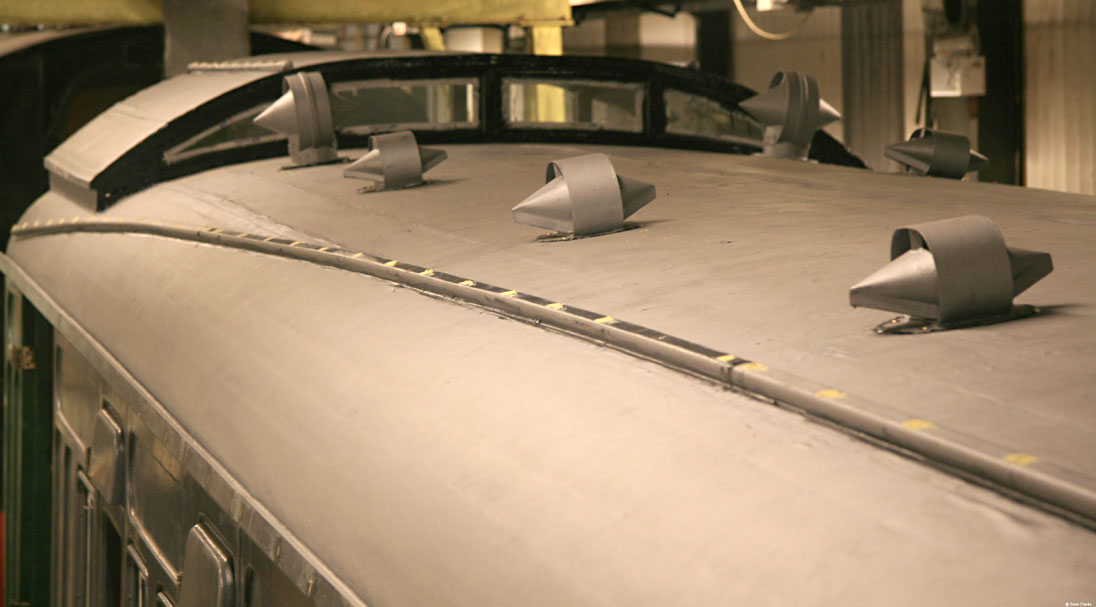
16 October 2009
David Chappell's photo shows the preparations in hand for canvasing the roof. Since this photo was taken, the canvas has been cut in around the base of the raised birdcage, which has had a separate canvas applied. 30 April 2009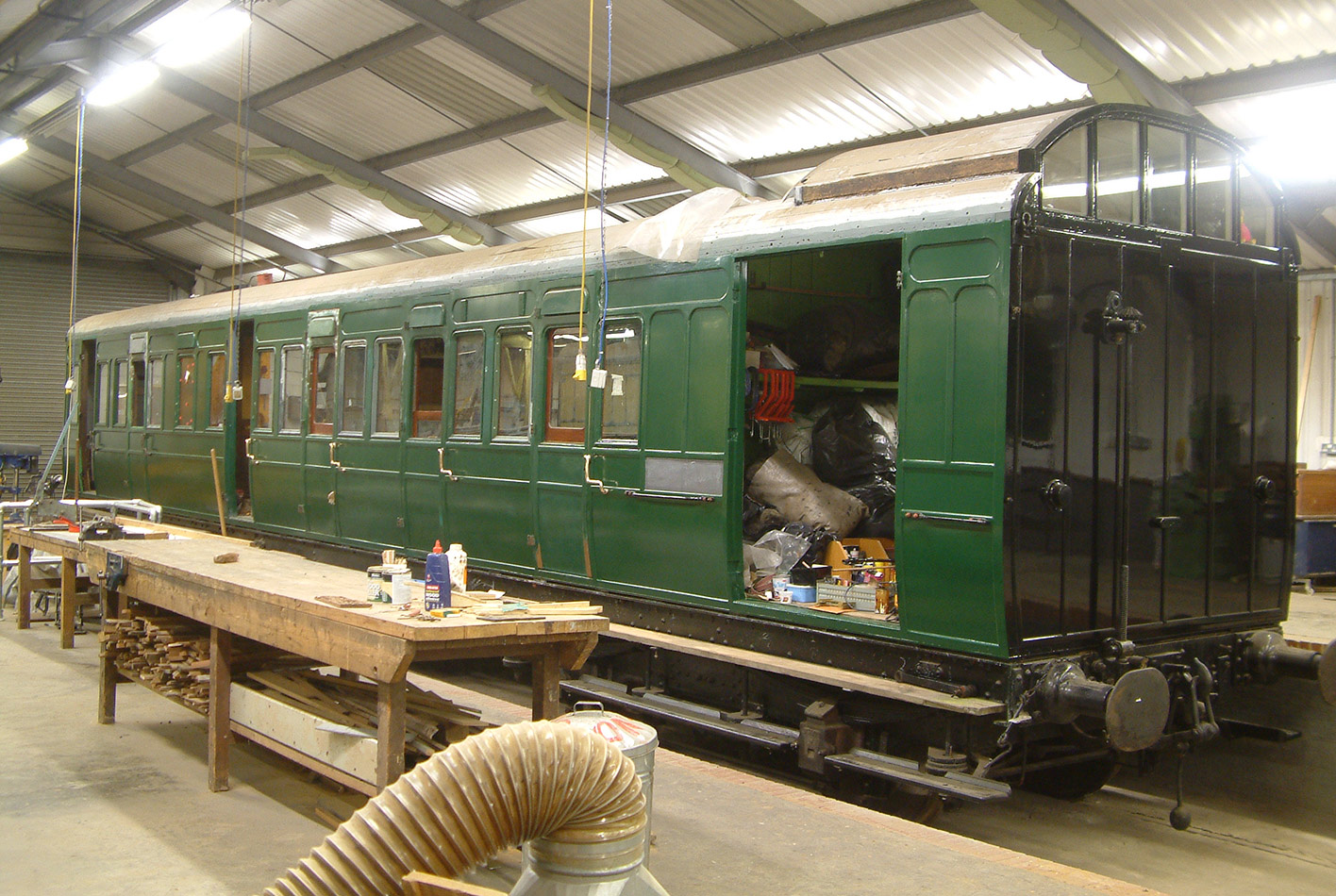
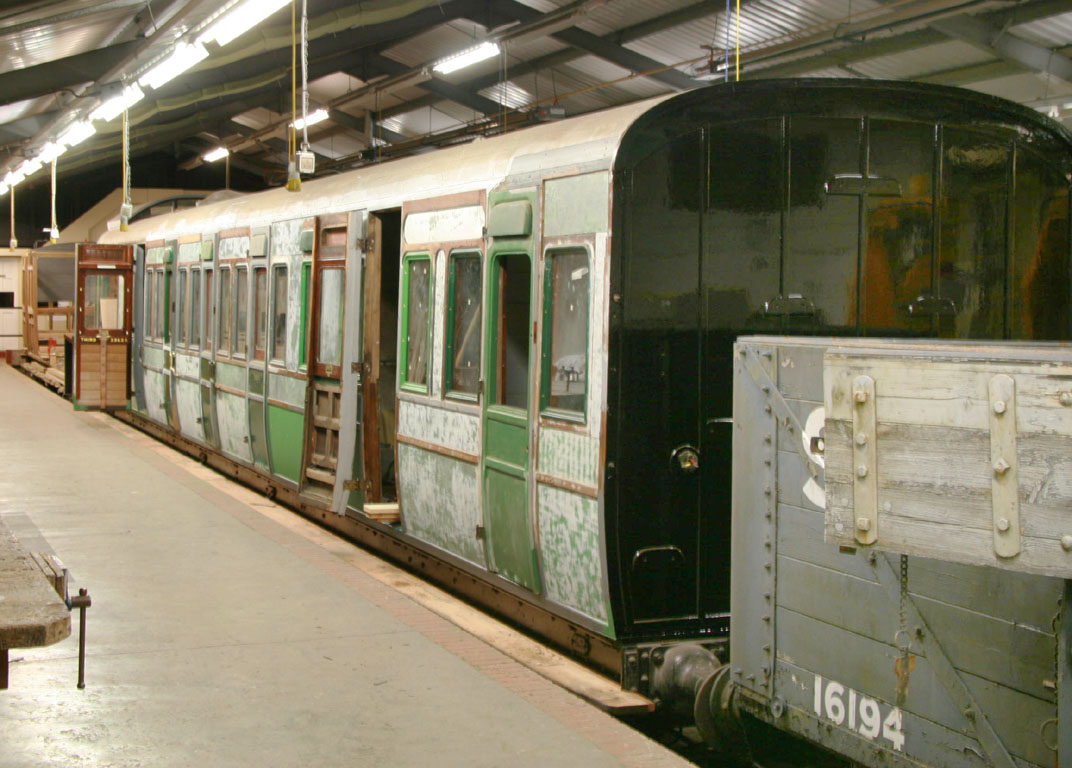
David Chappell's photo taken a month ago shows that the carriage has moved into the main work area. This follows the signing of a revised agreement between Trevor Rapley, the coach's owner, and the Railway. The external panelling is now complete on both sides, all of the windows are in, and only a small number of mouldings remain to be fixed on the west side. Only about three doors remain to be overhauled. The interior fit of the four third-class compartments is pretty much complete, and attention is now focussing on the more detailed interiors of the two former second class compartments at the south end. The largest outstanding jobs remaining are canvassing of the roof, completion of the seat carcasses, then trimming of the seat backs, bases and cushions, completion of the 4 remaining steam heaters, completion of the electrics, and work on the wheelsets. Dave Clarke's photos below show another view of the coach, from the viewing gallery in the workshop at the end of March, and a view of the other side of the coach where the south-west corner is seen shortly before having its mouldings added. Painting of this side will begin in earnest once Bulleid Brake 2526 is completed. 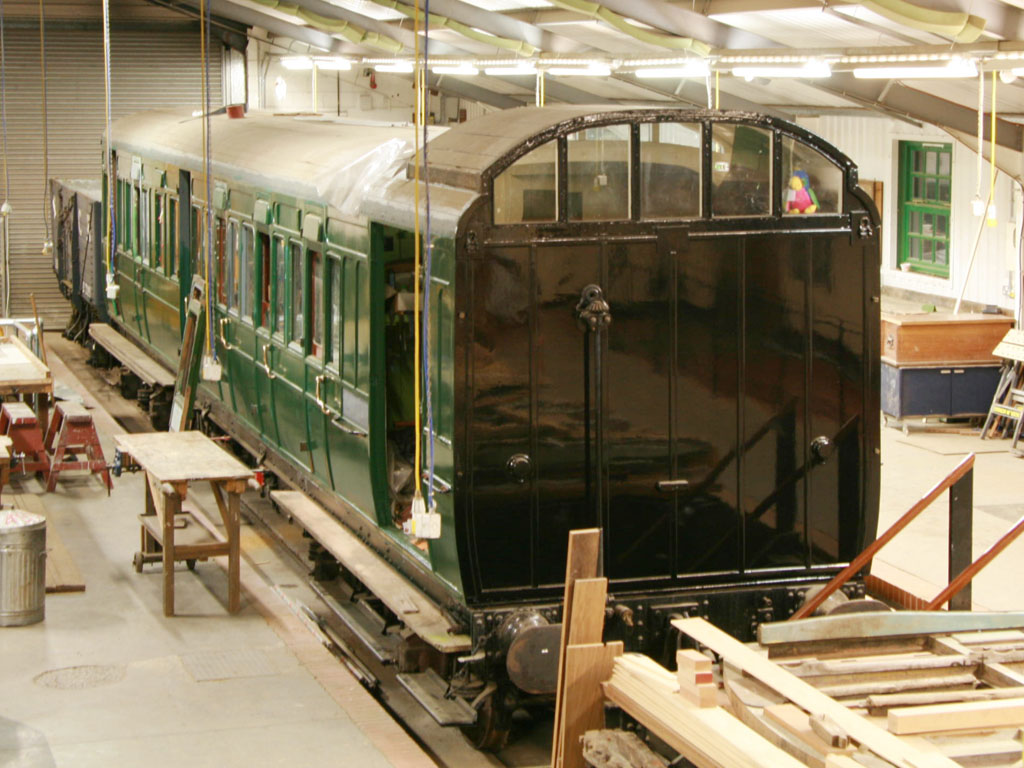
1st January 2008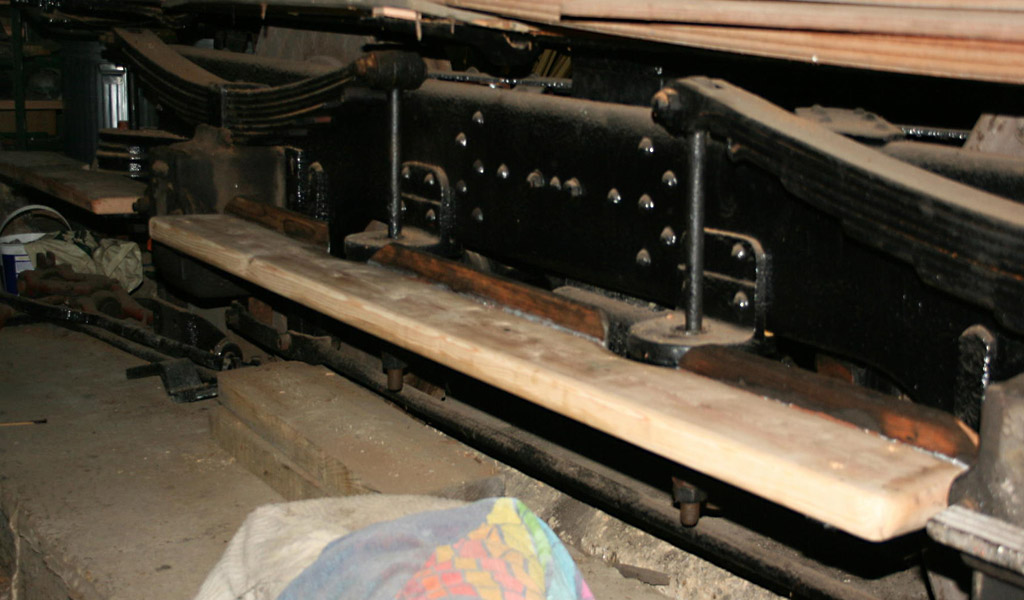
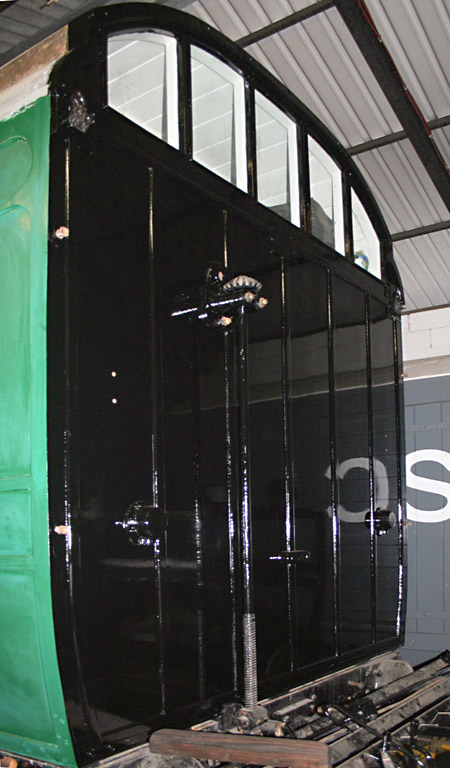
The photo on the right shows the first of the lower stepboards, which have been fabricated and fitted to the bogies. These have been made by re-using those short sections of the carriage's main step-boards which remained in good condition. The first of the photos below shows that nearly all of the plywood panels have been fitted to the east side of the coach. The last panel on that side was fitted a couple of months later. The first black gloss coat has been applied to the birdcage end. Photos: Dave Clarke 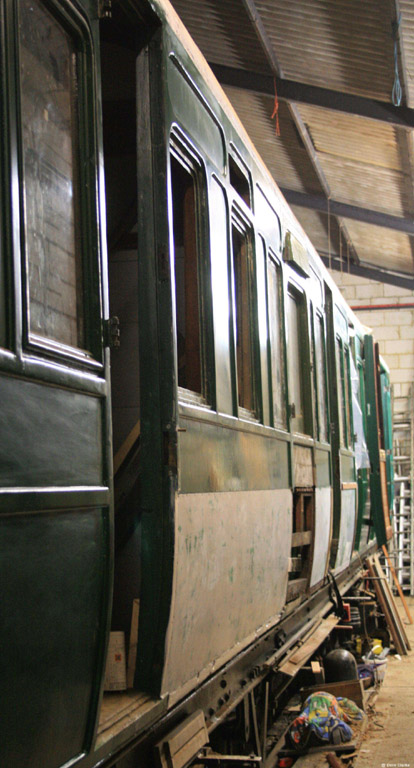
25th November 2007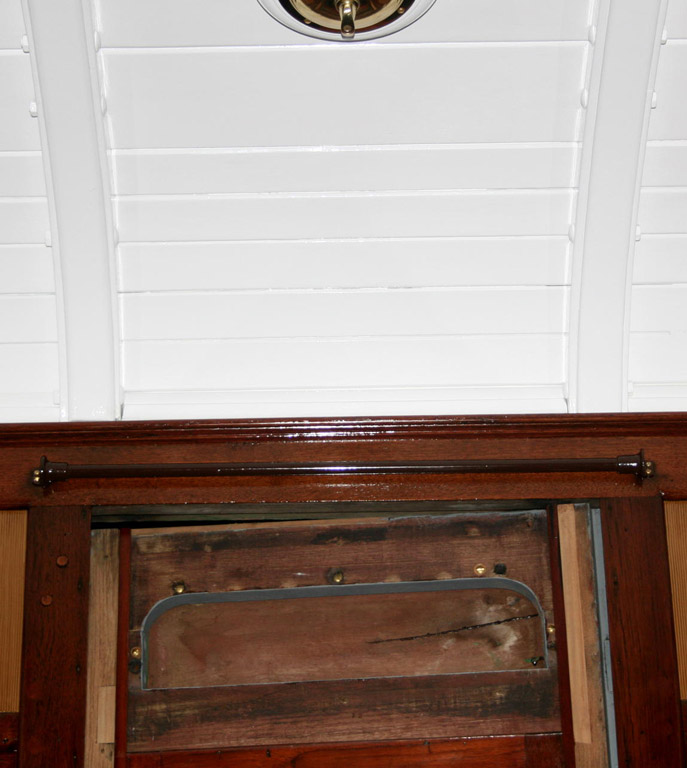
The first tubing for the communication chain has been fitted above the western door in C Compartment. The partitions still require drilling before the chain can be fitted.
Photo: Dave Clarke
3rd October 2007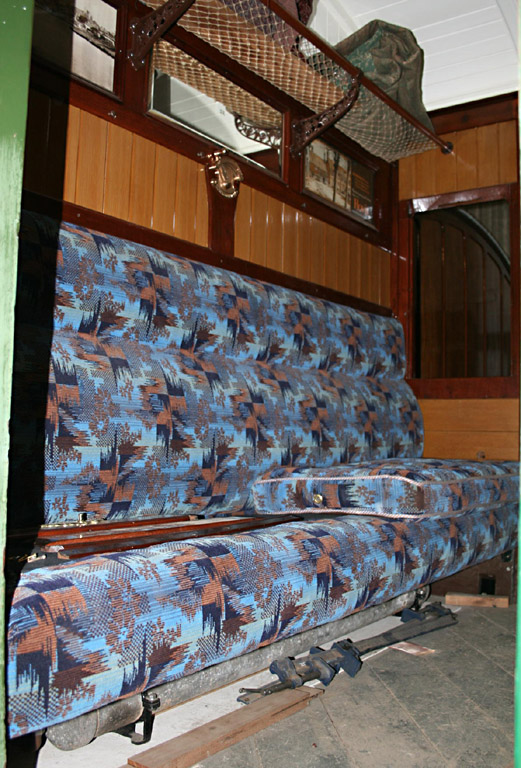
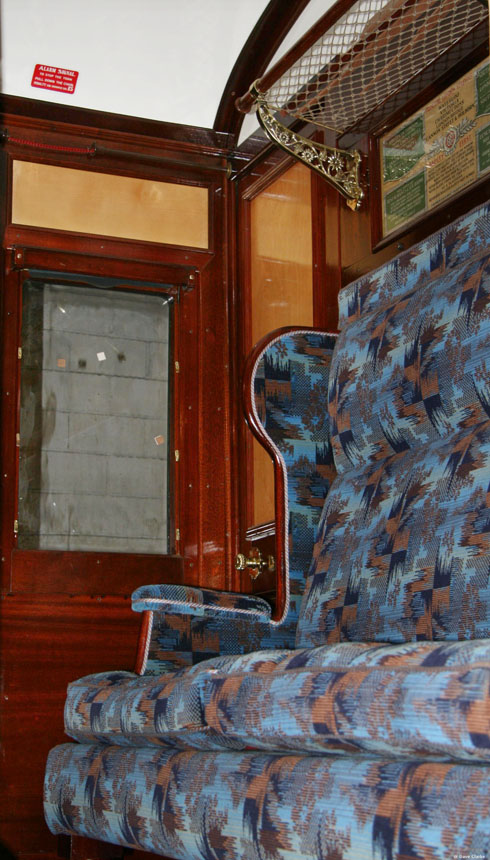
The completed seat base and first seat cushion have been trial fitted in compartment A. The mouldings from the door of B compartment can be seen where the unfinished second cushion is awaited. It shows the reproduced "jazz pattern" moquette to good effect. This is a Southern Railway design, one of three (at least) which were used in the 1930s, both in coaches such as this, and in vehicles which were brand new at that time, such as Maunsell drop-light open third 1336, for which this run of material was specifically made.
Photo: Dave Clarke
12th August 2007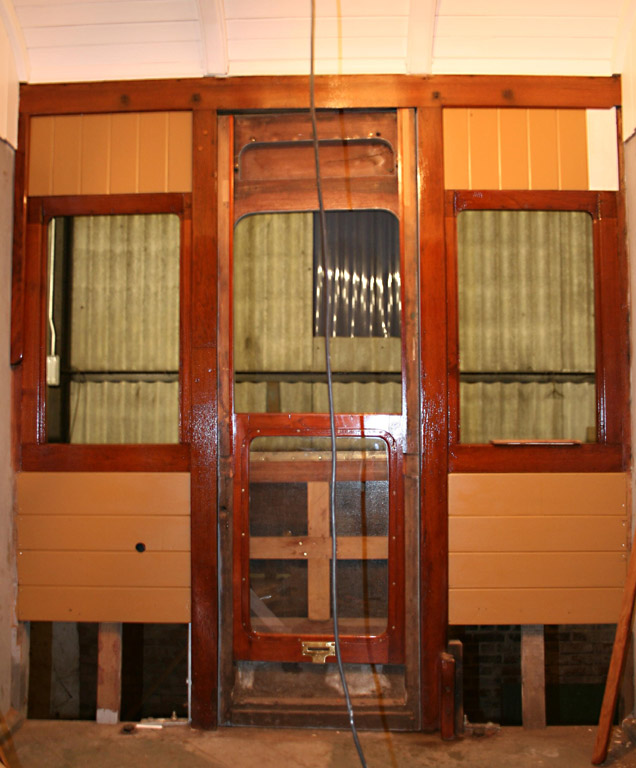
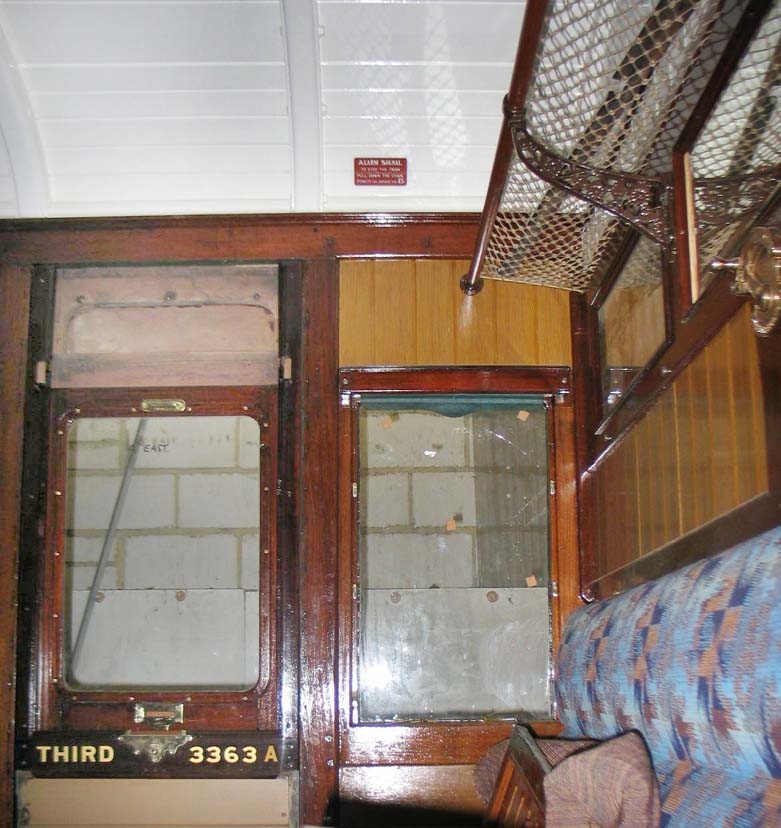
The teak framing has been varnished and the matchboarding undercoated prior to scumbling (graining) in C compartment. The photo also shows how the droplight (window) in the door sits in its lowered position, since the internal boarding has yet to be fitted to this door.
Photo: Dave Clarke
20th May 2007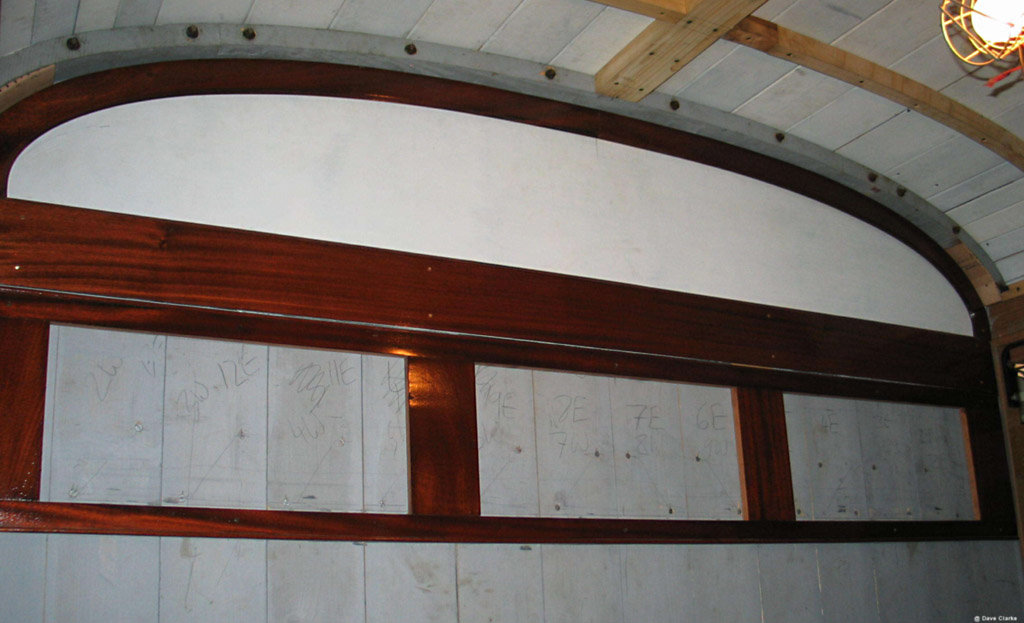
The mouldings and view frames have been trial fitted in Compartment E - the first of the second class compartments.
Photo: Dave Clarke
11th March 2007
A photo showing the interior of a pair of overhauled doors on the East side of the coach, before and after graining and the fitting of mouldings.
Photo: Dave Clarke
11th February 2007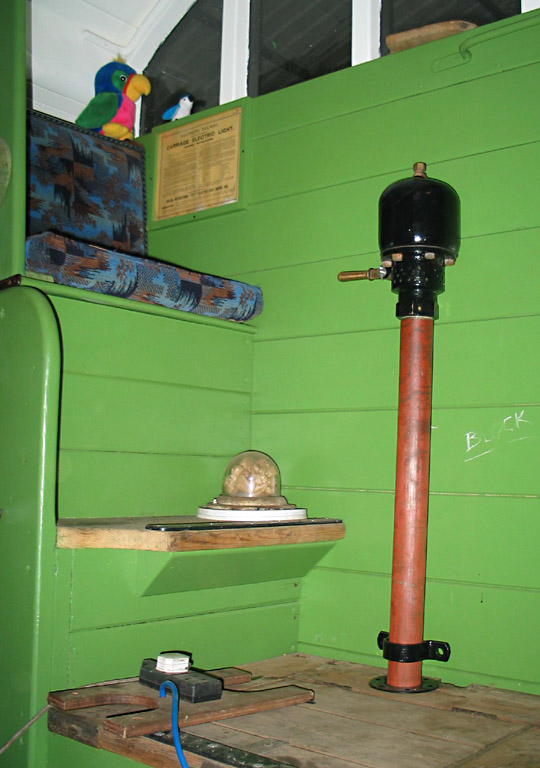
The brake setter has been fitted in the brake compartment. A small shelf will prevent guards from accidentally applying the brake when they get out of their seat, which is also seen to good effect, along with the steps goving access to it. This is the arrangement which one of the monthly magazines described rather curiously as a "spiral staircase".
Photo: Dave Clarke
June 2006
Another set of photos from Dave Clarke, taken over the last three months, illustrating progress on the Birdcage Brake.
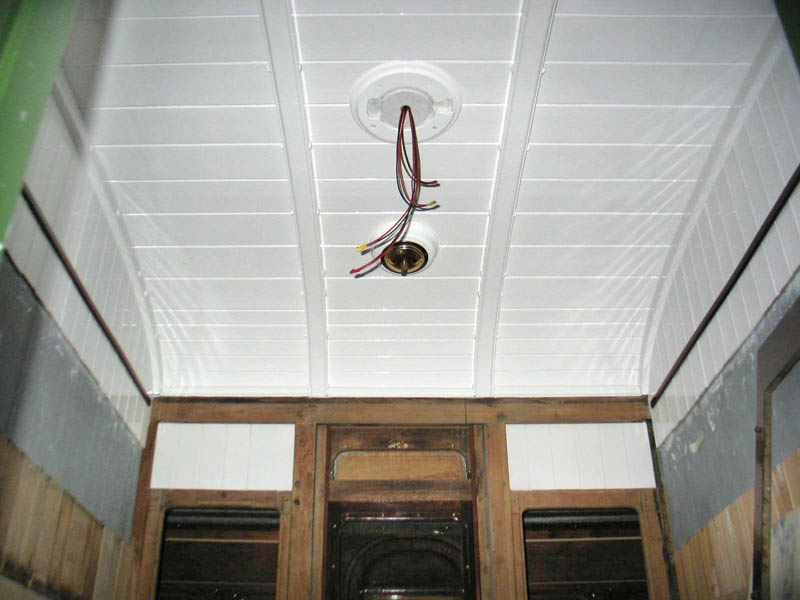
Right: Now that the ceiling in D Compartment (third class compartment with access to a lavatory) has been finished, the vent covers and luggage rubbing strips have been installed.
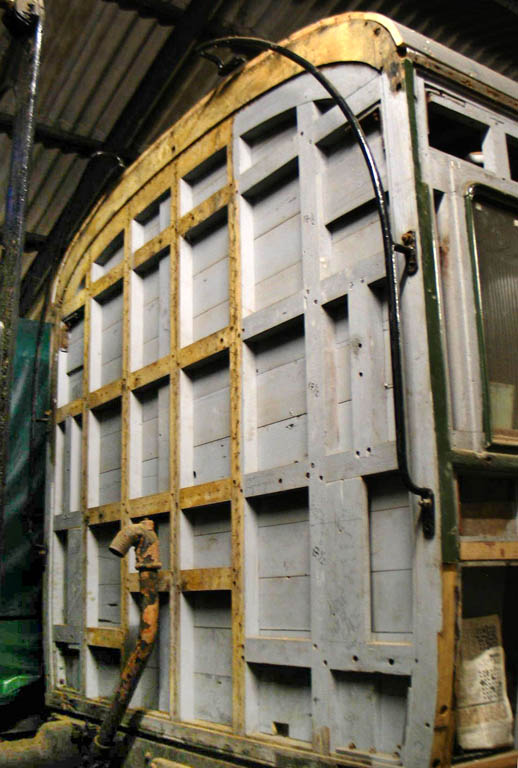
Left: The south end is being 'de-pinned' in readiness for fixing the cladding. Some of the structural timber sections here were replaced right at the start of the project due to cracks or rot. They are largely those which have been painted. Below: The marine ply panelling for the non-birdcage (south) end of 3363 is being cut to shape. They are now prepared almost to topcoat stage, before being fitted to the coach. The panelling and the large curved moulding at the top (repaired by George Jones) must be fitted to the end of the coach before the roof can be re-canvassed. 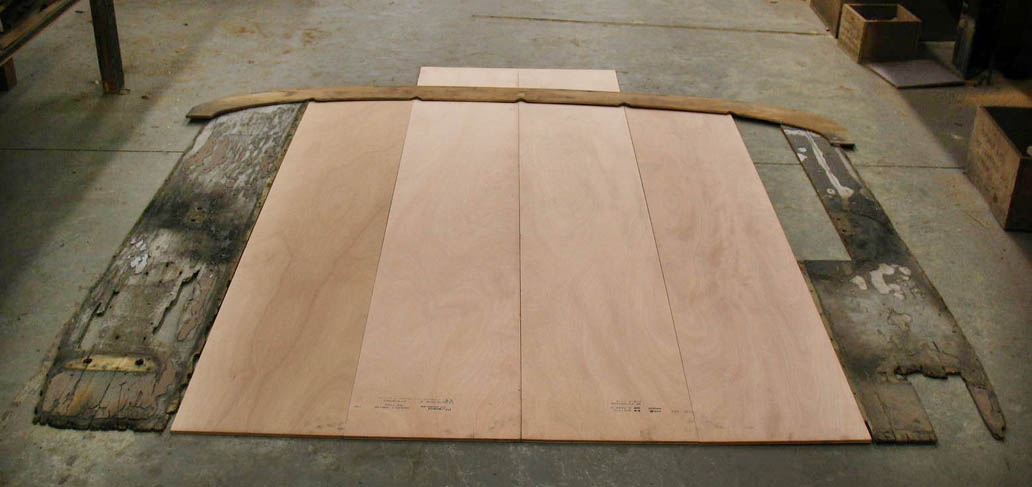
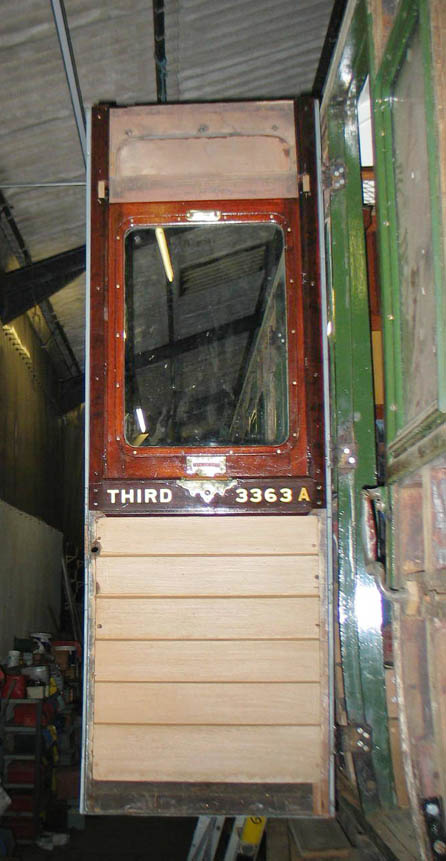
The first of the doors on the East side has been dismantled, had a new bottom made for one side, and a new lower-mid-rail, and been re-assembled and hung. In this photo it still awaits the lowest (kick) board, and the hit-and-miss sliding ventilator arrangement at the top.
The photo to the right shows how everything is coming together in compartment A (closest to the brake van).
November 2005
Both of the birdcage's massive battery boxes have been overhauled in the last few months. This has entailed some replacement of steel brackets (seen leaning against the further box). Of the timber structure the only surviving portions in good enough condition to re-use have been the tops.
Trevor Rapley first overhauled the four doors (one is seen leaning against the end of the nearer box), and then each of the boxes, with John Coleman fabricating new corner and mid pillars for each box. The soft-wood planking has been second-hand reclaimed timber.
February 2005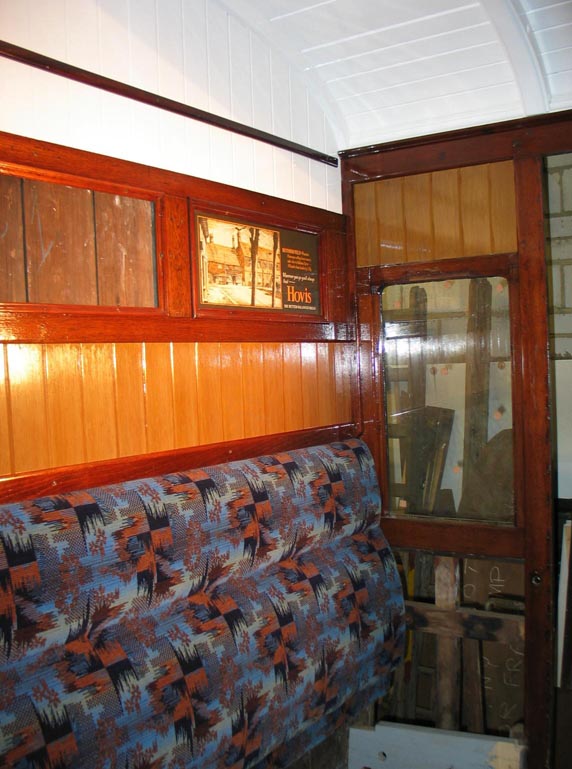
Left: The first seat back has been trimmed as a trial, to ensure everything will fit together, and is seen here together with the new support (painted grey) for the seat base. The moquette is a 1930s Southern Railway Jazz pattern, specially reproduced for use in our SR droplight open third 1336, and also suitable for use in this coach, since the last trim it had before withdrawal was in the 1930s, and used another, similar, jazz pattern.
Both photos: Dave Clarke
Right: Over the winter Trevor Rapley has been overhauling suitable droplights, glazing them, and finishing them (varnished on the inside and scumbled outside). About two-thirds have been done so far. Here the first two are seen fitted to the overhauled doors on the West side of compartments B and C.
January 2005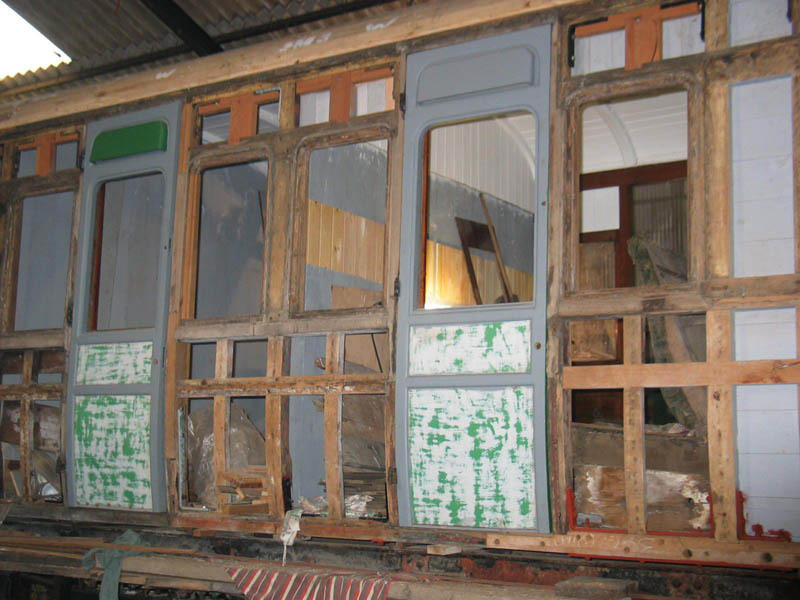
Left: A shunt of the shed on Monday 3rd January opened up this photo-opportunity, and the west side of the coach is seen, complete with two of the overhauled doors. These two compartments are third-class ones, with bare roof-boards and no internal ceiling (which only the two second class compartments have).
Both photos: Dave Clarke
Right: The most advanced passenger compartment is 'A', the one closest to the guard's compartment. The mirror and a 'Hovis' advert have been test fitted. Note that the other side of the compartment is seen in the mirror. The decorative T&G boarding is scumbled as the originals were in SR days, with a very straight scumble pattern. Also seen is a test fit of the new heating control mechanism, and below, out of sight, is a test fit of the seat structure.
October 2004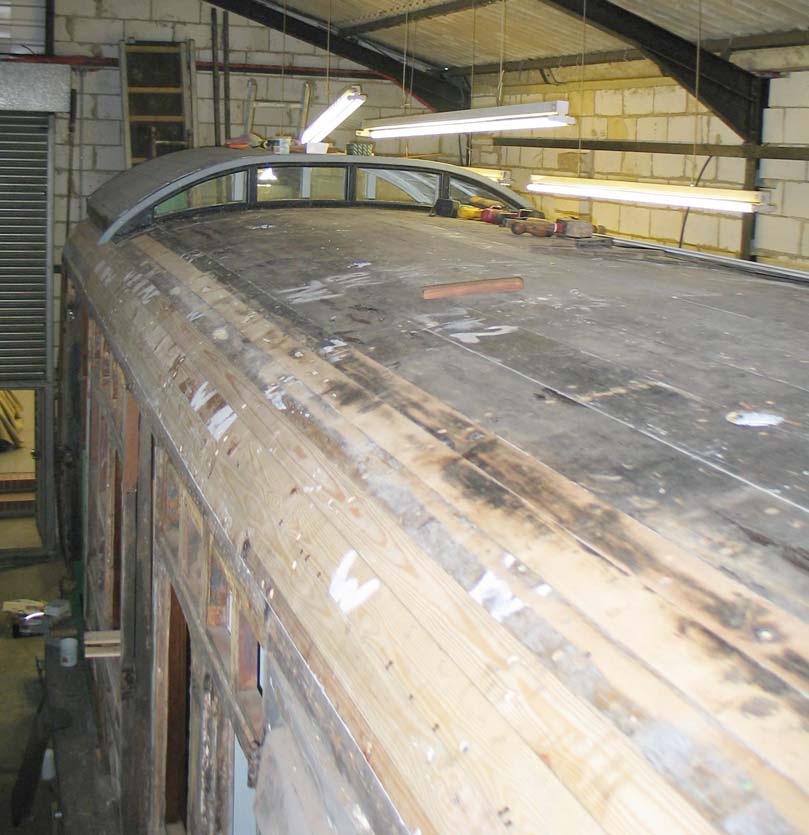
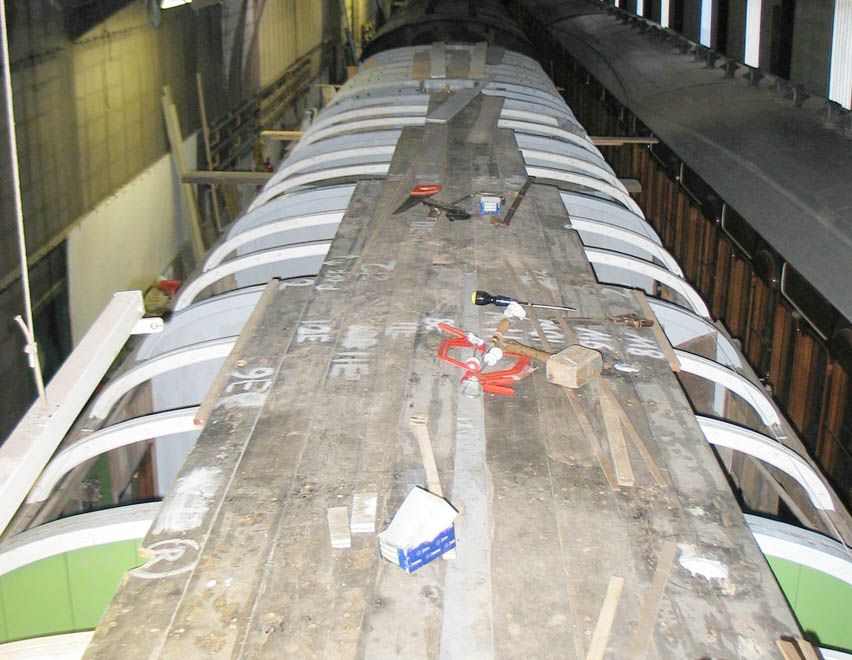
By the end of October the last roof planks were going on. The ones closer to the edge are narrower, due to the sharper curve, and some, as seen here, are new, being surplus ones left over from the re-roofing of Maunsell No.1336.
Photo: Dave Clarke
June-July 2004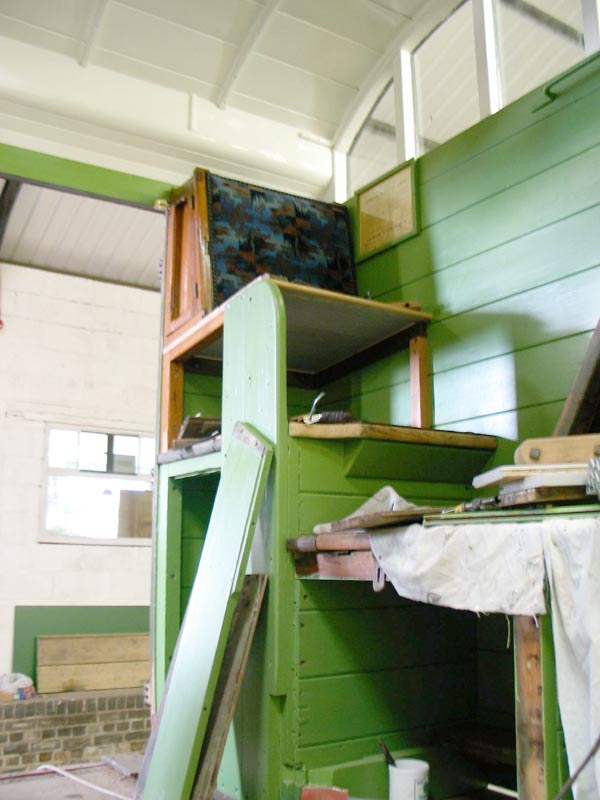
Right: The interior of the guard's compartment, painted in a very carefully researched shade of green, complete with the guard's seat up next to the birdcage, which now features laminated safety glass. The first half of 2004 saw the interior of this part of the coach essentially completed, save for the brake wheel.
Both photos: Dave Clarke
Left: Having made good progress on the roof planking of the raised birdcage, and spent a lot of time getting all the roof hoops repaired and fixed in place (and level!), in July a start was made on the main stretch of roof. The roof planks are a mixture of original ones from this coach, and ones salvaged from some of the SR vans which have been broken up to provide underframes for 4-wheel coaches. The van roof planks were about half an inch too wide, and have been cut down and new grooves routed in the edge. Loose tongues, made of teak offcuts, are used, since the planks have grooves both sides.
March 2004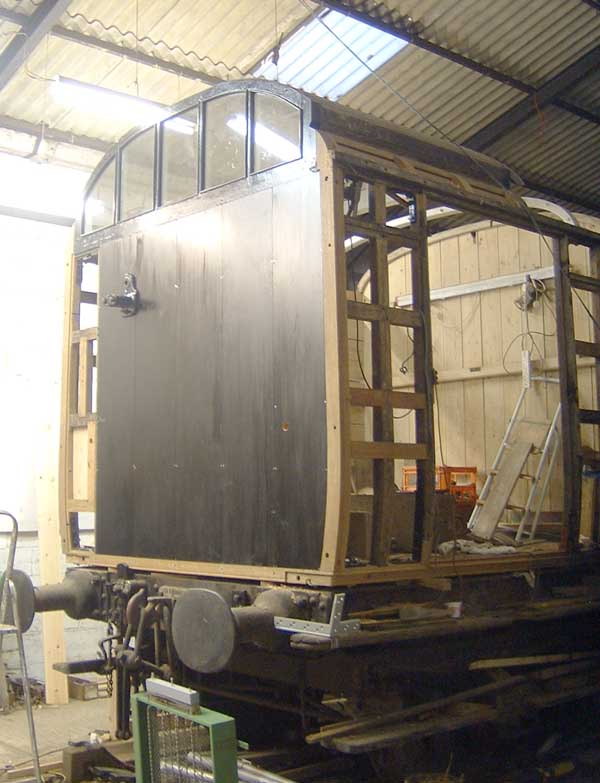
The SECR Birdcage brake is becoming ever more complete at the brake end, as seen in this photo taken at the end of March shows. The birdcage roof has been re-erected, and the internal and external panelling at the ends is progressing well. A new stainless steel water tank have been made for this coach. 2 November 2003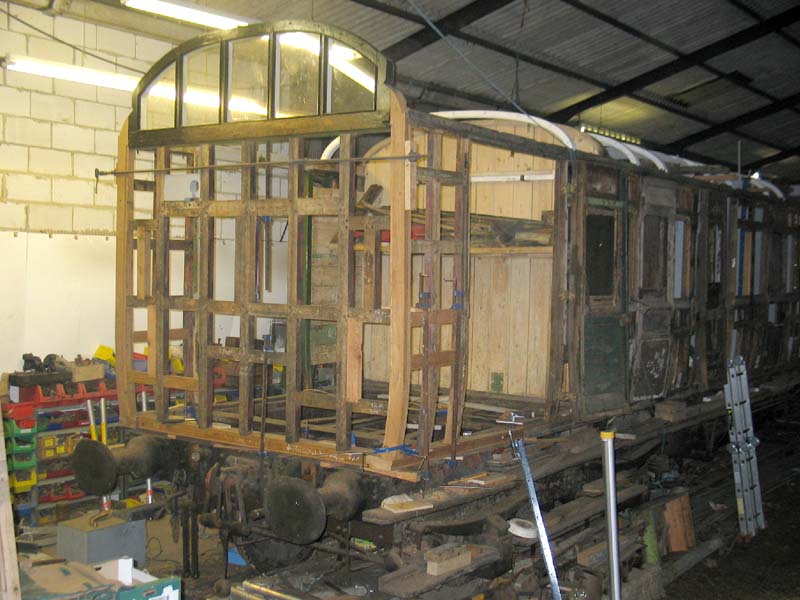
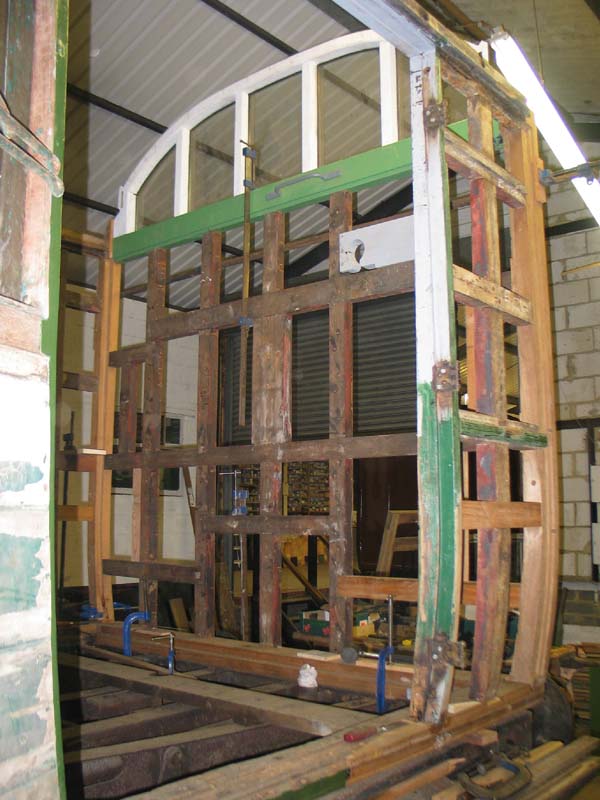
After six months spent repairing and re-making the end structure, this was the big day! The entire end, including the ready-glazed birdcage end and the last sections of the sides of the coach were winched into position. These photos are from David Clarke. 
28 October 2003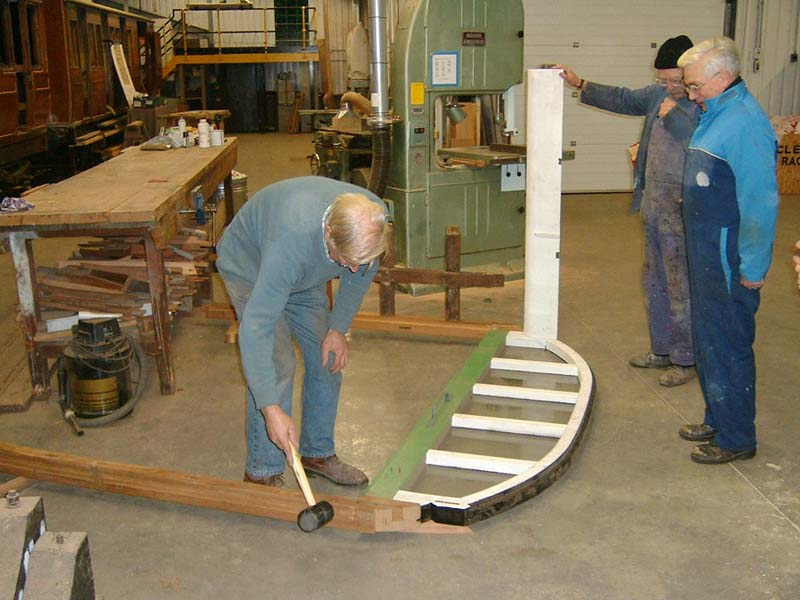 A dry-run assembly on the workshop floor of the new corner pillars with the re-glazed birdgage top-light section.
14 May 2003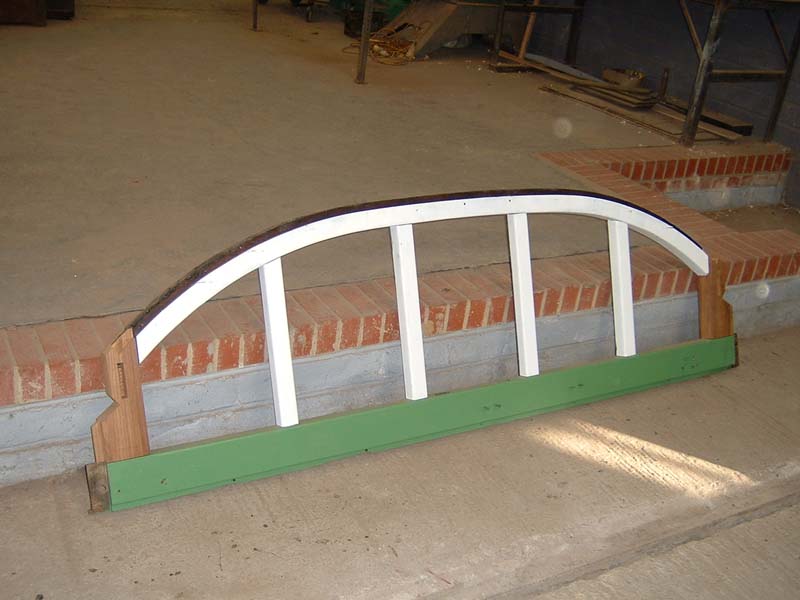 With repairs completed, and partially repainted, the new pieces of
teak at the sides which were required can be clearly seen.
With repairs completed, and partially repainted, the new pieces of
teak at the sides which were required can be clearly seen.
23 April 2003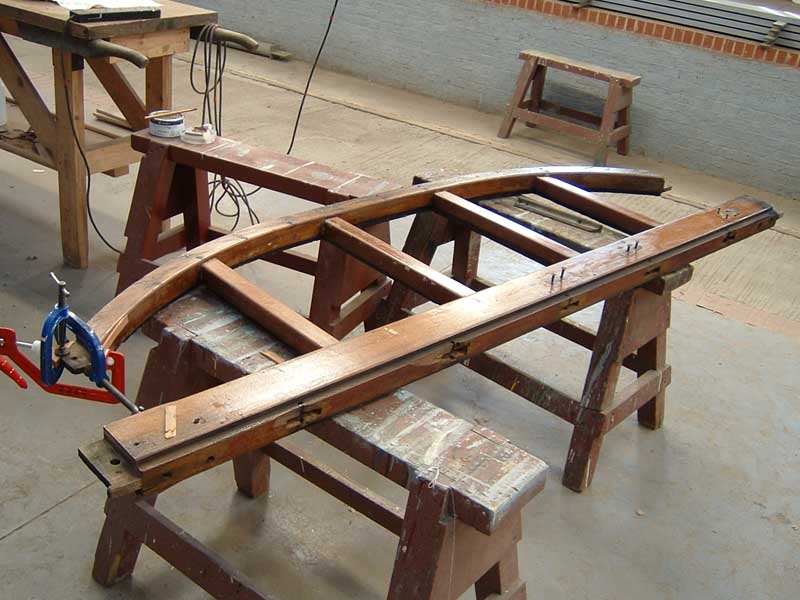 The dismantled end structure around the birdcage windows is seen
here, stripped and under repair.
The dismantled end structure around the birdcage windows is seen
here, stripped and under repair.2 April 2003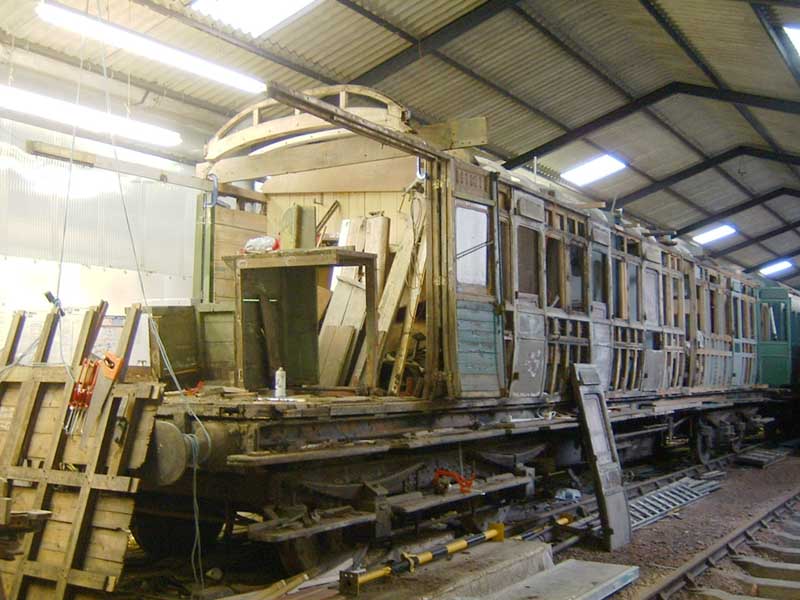 With the main structrural repairs now completed on most of the body,
only the birdcage end remains to be done. It is seen here having
been dismantled for the replacement of the corner pillars, which were
extensively rotten.
With the main structrural repairs now completed on most of the body,
only the birdcage end remains to be done. It is seen here having
been dismantled for the replacement of the corner pillars, which were
extensively rotten.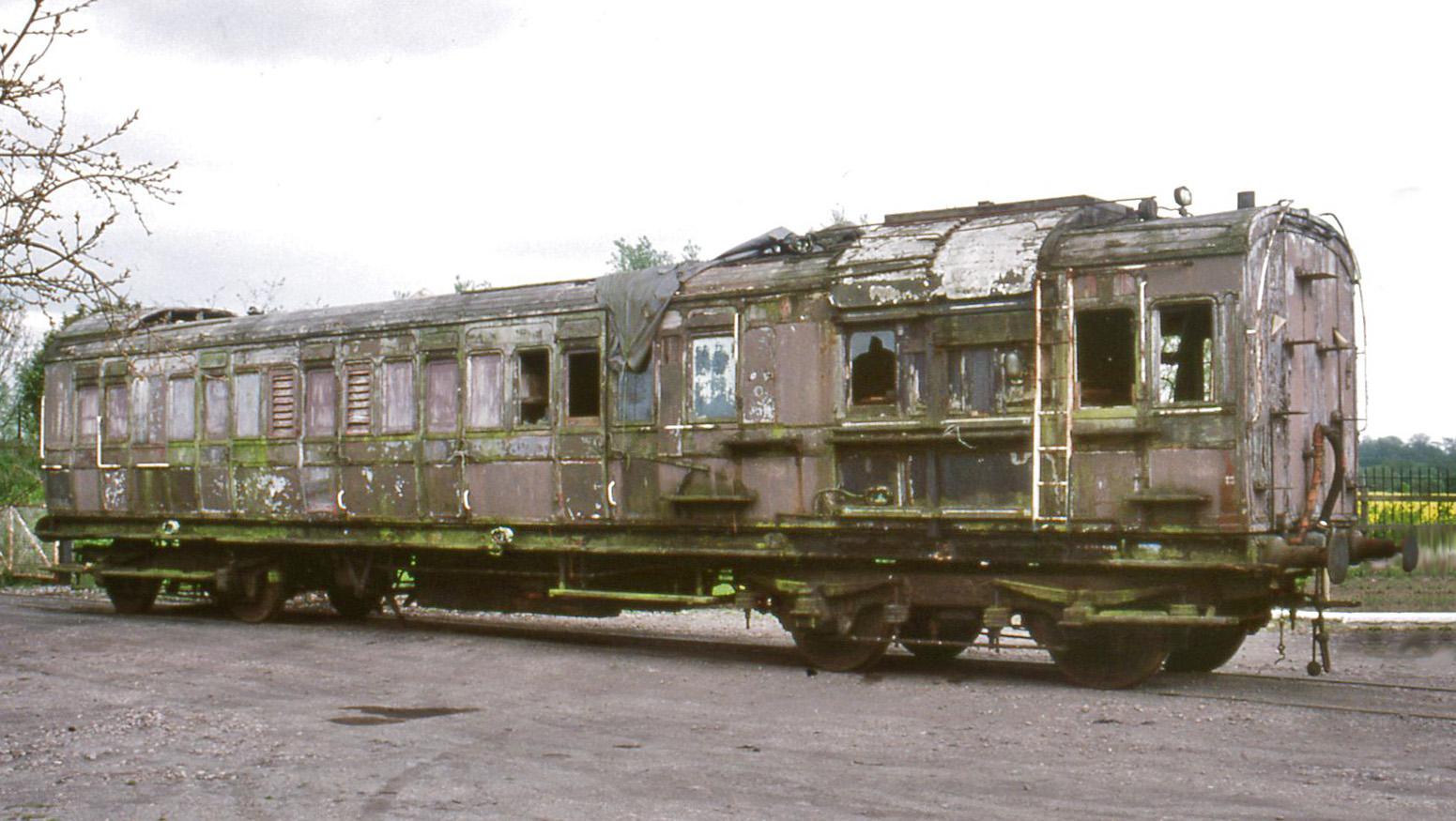
Pre-Bluebell
DS22 photographed in May 1998 at Wittersham Road just prior to its removal to Robertsbridge, and 18 months before its arrival on the Bluebell Railway (Jeremy Ovenden)
Return to the web page for this carriage, or the Carriage & Wagon Works News or the Works News Archive
See also Alex Morley's photos of the coach's return to service 
Return to BRPS Home Page, to the Timetable or to Special Events Carriages & Wagons - Intro - Development - Stock Lists: Carriages, Vans, Wagons & Multiple Units - Carriage Fleet Review - Join us C&W Works News - SR Coach Group - Goods Division - Operation Undercover - Carriage Shop - Technical Pages Visitor Info. - Museum - Trust - Catering - Contacts - What's New - Projects - Locos - Carriages & Wagons - Signals - History - Other - Links - Search - FAQ Why not become a BRPS Member? - Get more involved as a Volunteer  Last updated by Richard
Salmon, 30 December 2021
Last updated by Richard
Salmon, 30 December 2021
© Copyright BRPS. Privacy Policy |