Current Infrastucture News Current Infrastucture News
Archive of Infrastucture News: 2013-14 - 2015-16 - 2017 - 2018 - 2019 - 2020 - 2021-22 - 2023
Archive Reports: Northern Extension Project -
Permanent Way and Lineside News (2007-2011) - P-Way News (2002-4)


The Bluebell Railway's Extension:
Latest Progress towards East Grinstead
Archive 5 (2004 & 2005)
Extension Project archives:
2012 through to re-opening -
2011 -
2010 -
2009 -
2008 -
2006-7 -
2004-5 -
2003 -
2002 -
April - Dec 2001 -
Oct 2000 - Feb 2001 - April 2000
See also the Interactive map of progress on the East Grinstead Extension, showing the extent of track laying, and photos showing the fantastic progress being made.
Latest News page
November 2005
Text and photos from Martin Oakley, 27 November 2005.
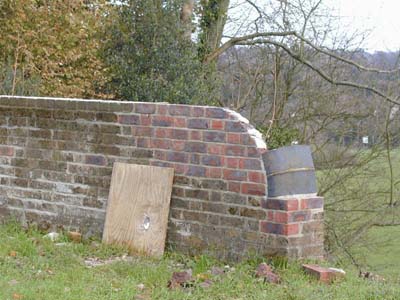
This photo (right) shows the bridge parapet immediately south of the viaduct. The brickwork has started to be repaired and some of the coping stores have been replaced. As this is a double-faced wall, the side not visible in the photograph needs to be rebuilt. The problem here is that the track underneath remains in use. This will therefore need scaffolding, or at least a working platform, to be constructed to allow safe working.
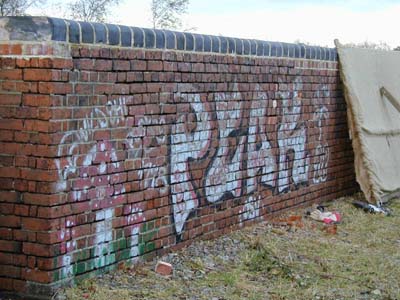
The walls within the viaduct have much of the original pointing either missing or very loose. This has to be raked out using chisel and hammer along the mortar lines. Much of the brick laying has been done with a weak sand/cement mix, using burnt earth in place of sand in some places. With this in mind it certainly hasn't detracted from the strength of the bond, and where in some places the brick face has 'blown', it is quite difficult to cut the bricks out for replacement.
All the raked mortar lines have to be brushed out, treated with weed killer to prevent any re-growth of vegetation, an application of PVA to provide stability before re-pointing can take place.
The photograph (left) shows a length approximately half the distance between two refuge points on the southwest wall.
The graffiti is of several years in age, and whilst some new 'artworks?' have appeared, it is not returning in abundance. This has much to do with the regular attendance of workers during the week and the two gates at each end of the viaduct
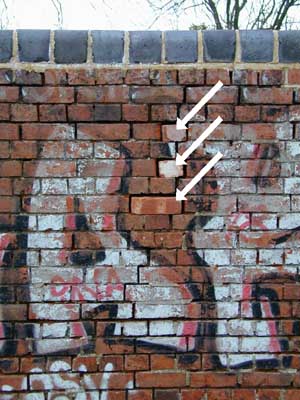
In certain areas the brick face has 'blown', or become so eroded, that the whole brick has to be cut out. The photograph (right) shows the positions of three such bricks (arrowed) that have failed. In this case, they have been cut out and replaced with a 'new' brick. This has to be sized and if possible matched in colour. These bricks will then be bedded in new mortar and pointed in.
Some thirty bricks, or part bricks, have already been cut out in an area representing one refuge to refuge length of wall on one side. Given this as an average, there could be five to six hundred to cut out. At least this can be mechanised with a percussive drill.
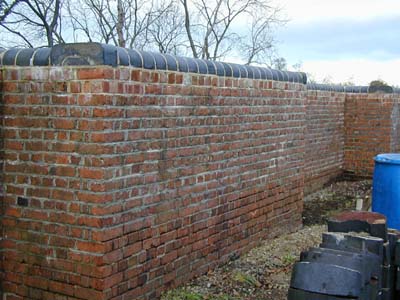
After the very laborious task of raking, weed killing, and PVA application, the skill of the craftsman takes over to re-point the bricks. The photo (left) shows some two-thirds of the wall between two refuges having been completed. The lower section of the wall has still to be re-pointed. The mix comprises sand, lime and cement, hand trowled and cut in, which in the hands of a professional looks quick and easy. It is certainly of a very high standard compared to the work on the coping stones done last year. The finished colour is complimentary to the original whereas the coping stonework is very 'buttery' in colour and a much weaker mix.

September 2005
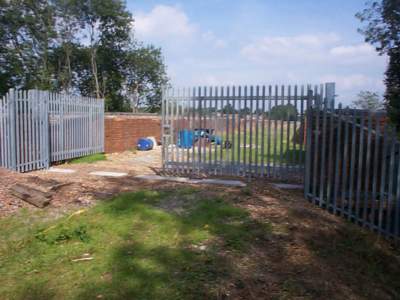 First of all the viaduct has been fenced at both ends in a bid to
prevent unauthorised access. A new waterproof membrane is still to be
installed on the viaduct at some time in the future, but meanwhile we are starting to prepare for re-pointing the remaining brickwork.
First of all the viaduct has been fenced at both ends in a bid to
prevent unauthorised access. A new waterproof membrane is still to be
installed on the viaduct at some time in the future, but meanwhile we are starting to prepare for re-pointing the remaining brickwork.
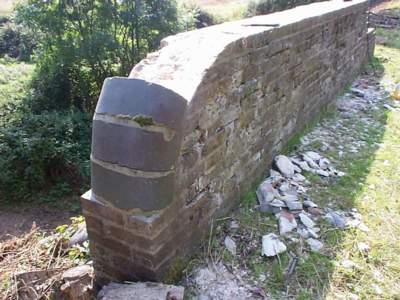
Our most recent activity has concentrated on preparing for remedial work
to the brick walls above the cattle creep immediately south of the
viaduct. This has involved removal of old mortar and damaged bricks,
plus cleaning the coping stones that will eventually be reinstated
across the top of the two walls, as seen in the photo below.
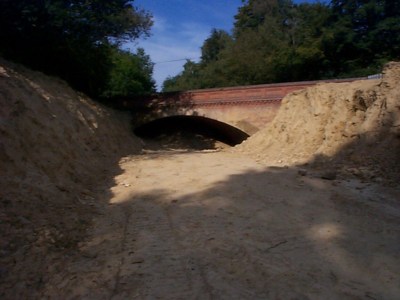
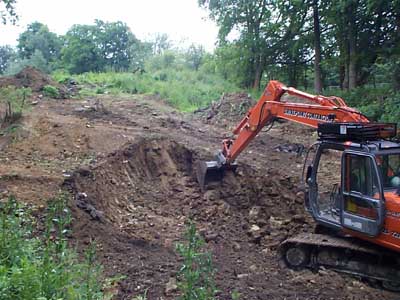
Although work on the excavation of spoil at Imberhorne Lane was
temporarily suspended, whilst the area receiving the spoil at the end of the Ardingly spur has been receiving attention, the picture below shows the situation at the end of August. Work has since re-started on the excavation at Imberhorne Lane.
There is probably about another twelve feet in depth to be dug out and
the cutting will be widened to the original alignment.
6 June 2005
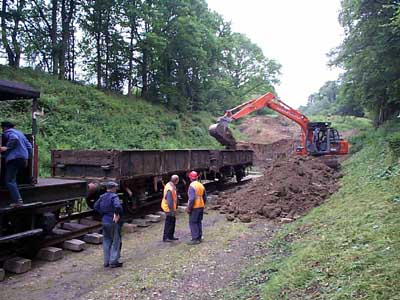
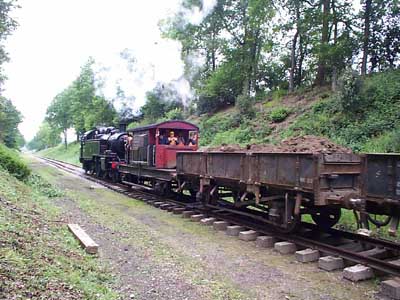
 Today saw another milestone on our Extension Project. These pictures show the start of the removal of spoil south of Imberhorne Lane bridge, loading the first wagon and the departure of the first train load, hauled by Ivatt tank No.41312.
Today (6th June) the train was limited to two Grampus, however, from tomorrow this should be increased to five wagons. Loading the wagons took about five minutes each so that part of the operation will not be a limiting factor; pathing with the scheduled service and unloading may well be. It is hoped that we will be able to load two trains per day. The initial plan is to clear sufficient spoil to allow more track to be laid which will facilitate side-loading from the spoil heap.
The wagons are worked down to Horsted Keynes, where they are unloaded on the newly laid Ardingly line, creating infill to rebuild the removed section of the embankment towards the former Sherriff Mill Viaduct.
Other recent activities have concentrated on the completion of the re-wiring of the fence and some remedial work to the fence.
You might also like to look at Chris Dadson's photos taken that day, and Jon Bowers' Report, Photos and Videos of the occasion
21 February 2005
Apologies for the length of time since the last update on this page. I hope Jon Bowers' interactive map has kept extension matters covered sufficiently in the interim.
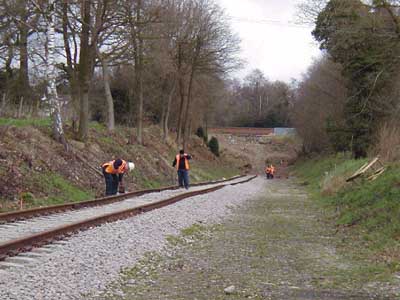
By last autumn the track laying was completed as far as it could go, i.e. the Imberhorne Lane Bridge, where the tip starts. This photo, taken on 19th February 2005 by Chris Dadson, shows the end of the track.
The first section of infill, on this side of the bridge, is not actually part of the main tip, and is sandstone and soil believed to have been excavated during the conversion of the former railway cutting towards Tunbridge Wells into the East Grinstead bypass. It is planned to relocate this material elsewhere on the Bluebell for engineering purposes, building up the embankment towards Ardingly which was partially excavated many years ago.
You can see more of Chris Dadson's photos taken that day on his Fotopic site.
20 May 2004
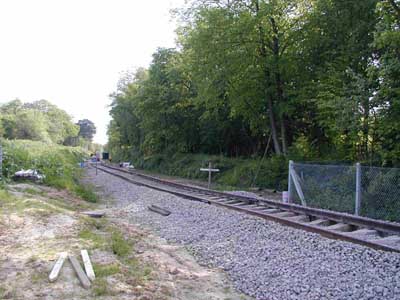
As seen in this photo from Martin Oakley, we are making steady progress and have now
entered the double track width section past Ash Lea Farm heading up towards the South face of the tip. Further levelling of
the trackbed in the vicinity of Hazelden Farm is taking place as time
permits.
19 April 2004
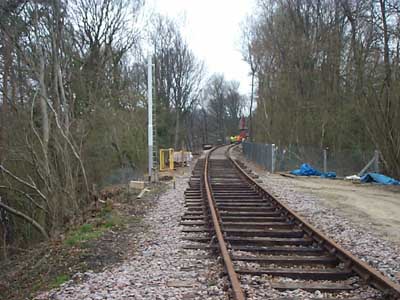
On 15th March 2004 a meeting was held with Chris White (Infrastructure Director) and the various groups working on the Extension to discuss the plans for completing the project. Briefly, the remaining part of the project is broken down into three phases: south of the tip to Kingscote, the tip and north of the tip to East Grinstead. The immediate priority is to complete the section south of the tip and to achieve this the various groups have combined to complete the outstanding work.
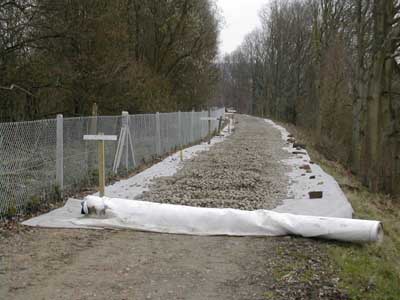
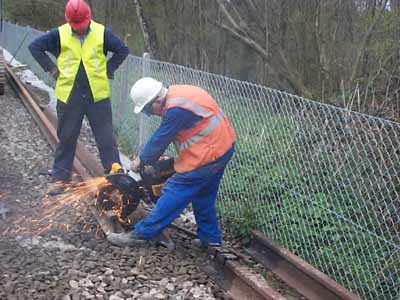
The push to lay track up to the tip started in earnest on 22nd March and work will continue most days. So far an initial layer of ballast has been laid along the "narrow" stretch (photo left) and track laying has commenced. The transition from bull head on wooden sleepers to flat bottom on concrete sleepers has been made (photo above) and by 17th April ten panels of flat bottom rail had been laid. Progress is limited by the rate that materials can be brought to the rail head and the fact that much of the rail needs the ends cutting (photo below) as it was gas cut when it was removed from its previous location. As the team gains experience the process should speed up: the target is to have the track laid to the tip by July.
If you are a member and would like to help, please contact Ron Harwood on 01342-313883 (it is essential that you wear steel toe-capped boots and heavy duty gloves). Please remember this is a construction site and casual visitors are not allowed.
8 February 2004
 Not much physical activity in the wintry weather we've experienced recently. Since Christmas the extension gang have completed the excavation of the cellar on Platforms 1/2
at Horsted Keynes. Despite the cellar being in-filled some 90 years ago the
condition of the brickwork looks very good.
Not much physical activity in the wintry weather we've experienced recently. Since Christmas the extension gang have completed the excavation of the cellar on Platforms 1/2
at Horsted Keynes. Despite the cellar being in-filled some 90 years ago the
condition of the brickwork looks very good.
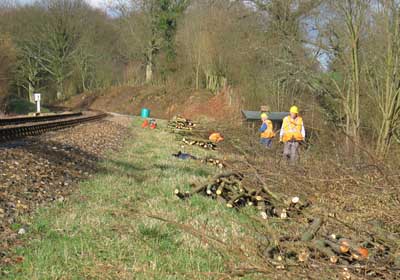
Since then, weather permitting, they have been supporting the Wednesday gang's
efforts in lineside clearance in the Holywell area (as seen in this photo). They will continue with
this activity until the weather improves and can return to East Grinstead
to commence work on the viaduct.
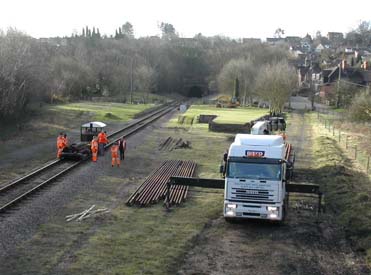
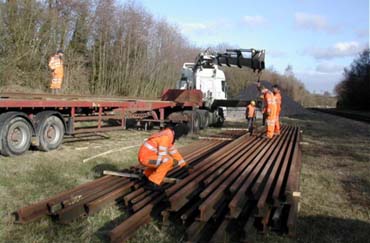 In the meantime, the first lorry-load of what will eventually be 1.5 miles of track (flat-bottomed rail and concrete sleepers) has arrived. This has been acquired at a very advantageous price, but somewhat ahead of the budget being available for it from the forthcoming share issue. Therefore the Bluebell Railway Trust has financed much of the cost (mainly transport), with part of that funding coming from a sum given to the Trust back in 1996 specifically for the extension. Together with the ballast obtained last year, this means we will shortly have all the materials needed to construct the track to East Grinstead.
The first of the rail is seen here being unloaded at West Hoathly by the volunteer P-Way Gang (photos from Jon Bowers). The policy is that flat-bottomed rail and concrete sleepers will only be used on plain line outside station areas, to maintain the traditional ambience.


Return to BRPS Home Page,
to the Timetable or to Special
Events
Current Infrastucture News
Archive of Infrastucture News: 2013-14 - 2015-16 - 2017 - 2018 - 2019 - 2020 - 2021-22 - 2023
Archive Reports: Northern Extension Project -
Permanent Way and Lineside News (2007-2011) - P-Way News (2002-4)
Extension Project archives:
2012 through to re-opening -
2011 -
2010 -
2009 -
2008 -
2006-7 -
2004-5 -
2003 -
2002 -
April - Dec 2001 -
Oct 2000 - Feb 2001 - April 2000
Visitor Info. -
Museum -
Trust -
Catering -
Contacts -
What's New -
Projects -
Locos -
Carriages & Wagons -
Signals -
History -
Other -
Links -
Search -
FAQ
Why not become a BRPS Member? -
Get more involved as a Volunteer
Your ideal Film/TV location?
 Page maintained by Richard Salmon with
thanks to Nigel Longdon, Chris Dadson and Jon Bowers.
Page maintained by Richard Salmon with
thanks to Nigel Longdon, Chris Dadson and Jon Bowers.
© Copyright BRPS. Privacy Policy
|