
You're on the Bluebell Railway web site

Kingscote Signal Box Diagram

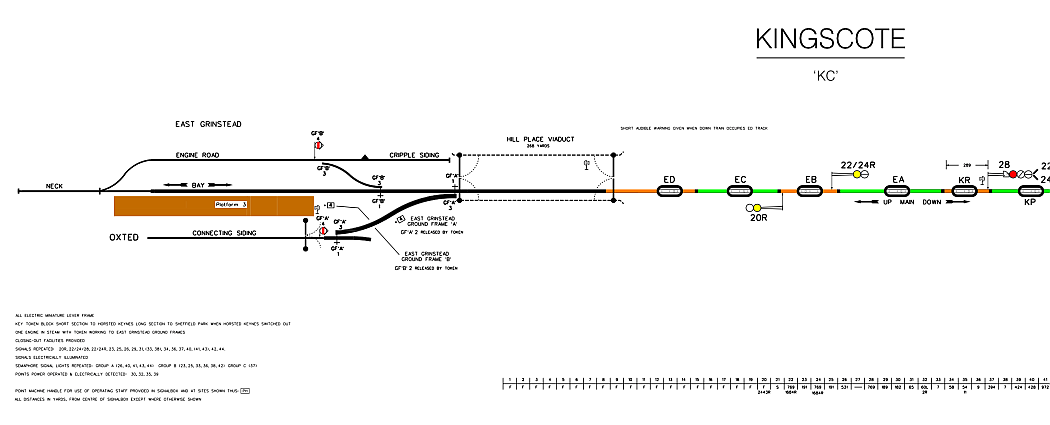
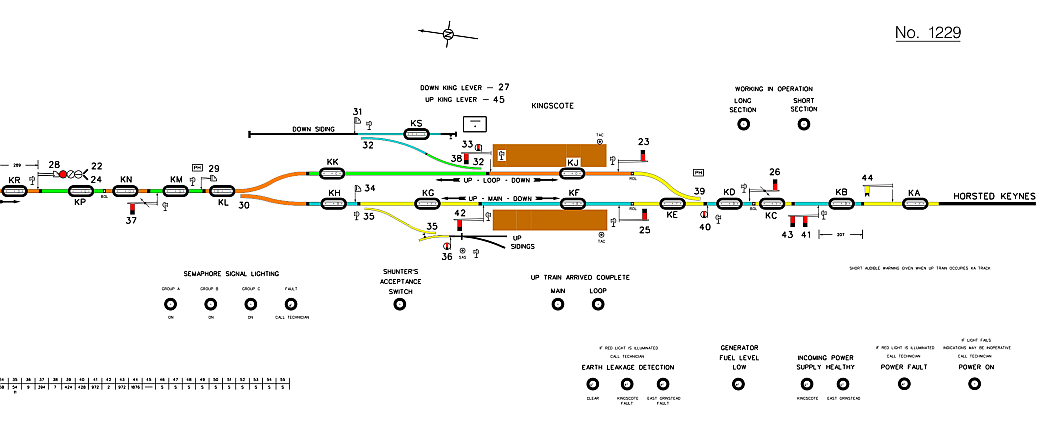
Kingscote Signalbox Diagram
Kingscote Signal Box Diagram - Bluebell Railway
There is a large-scale drawing available.

The track plan at Kingscote is very straight-forward at present; a basic run-round loop with four track circuits and closing out facilities to enable a single line token to be withdrawn at Horsted Keynes when it is necessary to run a train to Kingscote whilst that box is not manned. This frequently happens in the case of PW/S&T trolleys and before the Horsted Keynes re-signalling started, happened for the evening dining train. The box has an eleven lever frame (ten of which are in use) that was previously used as a ground frame before being stored in the open, resulting in the handles of the levers being quite badly corroded so they are not the usual polished steel but are painted white. There are four track circuits presently installed to tell the signalman the location of movements out of his sight and to lock the levers to prevent any accidental setting up of a conflicting movement. Let's follow the progress of the first train of the day arriving at Kingscote, where the box is manned.

The signalman has no warning provided to advise him of an approaching train so must keep a lookout for it when he knows one is due. Having said this, on quiet days he will hear the train before he sees it but if it is a noisy, windy day the first he will know of the approaching train is when he sees it appear from under Birchstone Bridge, having already passed a fixed distant signal sited on the east side of the track. When the signalman was advised that the train was "in section" by his opposite number at Horsted Keynes he will have ensured the route is set for the appropriate platform (that the point (5) is locked (4) and then that signals 2 and 3 are "off".) At present the Main platform is used during the winter (and is assumed for the illustrative sequence described above and below), whilst the Loop platform tends to be used in the summer, where it is convenient for the picnic area and refreshment kiosk. During special event days, the two platforms are used in equal measure. N°2 is the home signal and N°3 is a preceding shunt signal which is required when running the engine round its train, or should there be the need to enter the platform road when it is already occupied, eg. to strengthen a train with extra coaches or to join two trains to make one. Obviously, no movement is ordinarily allowed past a signal at danger, so N°3 signal must be "off" for any movement into the platform road, not just for a shunt movement. Thus it is known as a Preceding Shunt Signal. Although a shunt signal is not normally backlocked in this case N°3 is mechanically locked to the home signal and therefore controlled by the latter's backlocking. This means that the point 5 cannot be moved until the train is safely beyond them

N°2 signal is the uppermost arm and controls entry into the Main platform road. The lower signal, N°1, controls entry into the Loop platform road and being upper quadrant, does look a little odd when pulled "off" under N°2 signal which of course can only be "on". Although not common for this type of situation in the latter years of semaphore signalling (bracket signals were more usually to be found) the practice of mounting two or more home arms on one post could be found on many parts of the pre-grouping railway map. The top arm applies to the left-most road and, as you work down the post, each arm you come to controls the next road across to the right. Some gantry signals at terminal or large intermediate stations had four or five arms to each post. Very well-known examples of multi-armed country signal posts that survived until the late 1960s were to be found on the Isle of Man Railway. N°3 signal, the shunt signal mentioned above, controls either road according to how the point (5) is set.

The signalman's first action when he sees the train approaching is to advise the station staff of its imminent arrival with one ring on the platform bell (or two if using the Loop Platform). As the train approaches his box he will go outside to meet it and collect the key token, returning inside but not replacing the token in the token instrument until he has satisfied himself the train is complete (i.e. has a tail lamp) and he has replaced his signals to "on". When the signals are "on" and the key token is in the instrument he will then send "train out of section" to Horsted Keynes and, if there is not another movement to come from Horsted, request permission to return the train there.

KC South Box Left: The current (temporary) signal box at Kingscote. The signalman watches the train pass the box, after receiving the token. The small preceding shunt signal (3) is also visible. All other signals at Kingscote are full size upper quadrant arms on SR-style rail-posts.

In the meantime the train will have stopped in the station and the loco will have been detached. The driver will ring the signalbox to request permission to pass the "Stop" board and run round. Once given, he will take his loco up the headshunt, disappearing off the signalman's track circuit display, change the hand-operated points and return through the Loop platform and, as he does so, re-appear on track circuit F. As soon as the signalman gives his permission for the engine to run round he has to pull "off" the Loop platform starter (10) which, through the locking, makes it impossible to set up a conflicting movement. The loco will continue over and off track circuit D until he comes to a stand on track circuit C outside the signalbox. The signal (10) will be re-set, the point changed and locked (not necessary for a non-passenger carrying movement but the locking system in the frame cannot tell the difference, so the point must be locked for all facing movements) which will enable the signalman to pull off the shunt signal (3).

Once the loco has passed behind the Main platform Starter (9) the signalman will then pull "off" the Starter and the Advanced Starter (8) signals. The Advanced Starter cannot be pulled "off" until a token has been obtained as it controls entry to the single line section. Having obtained a token the signalman then has only one opportunity to pull off the Advanced Starter. If for any reason he cannot pull this lever, or has to re-set his signal and pull it "off" again, then he has to replace the token in the instrument, cancel his previous request to send a train and obtain a fresh release from Horsted Keynes.

When departure time draws nigh the train will leave the station, passing the box slowly whilst collecting the single line token, (the signalman having already sent "train entering section") with the driver keeping a sharp lookout should the signalman need to replace the Advanced Starter and the guard (due to the close proximity of the Advanced to the signalbox making it possible the signalman might not have sufficient time to replace the signal, should the need arise, once the train has passed him) keeping a watch on the signalman until he sees him re-enter his box after the train has passed safely into the single line section.

The Stop Boards (one at the north end of each platform road) instruct drivers that they may not proceed without the signalman's permission. Telephone communication with the signalbox is provided by the Outer Home signals (1 and 2), by the Advanced Starter (8), by the Platform Starters (9 and 10) and by each Stop Board. The numbers correspond to the levers that operate them with numbers 6 and 7 levers used to close the signalbox whilst allowing a token to be withdrawn at Horsted, with number 11 as a spare. Should a train (e.g. the dining train or, possibly, the first train of the day which is carrying the signalman to his post) arrive whilst the box is closed then the loco cannot run round its train nor return to Horsted until the box has been opened and the above procedures adhered to.

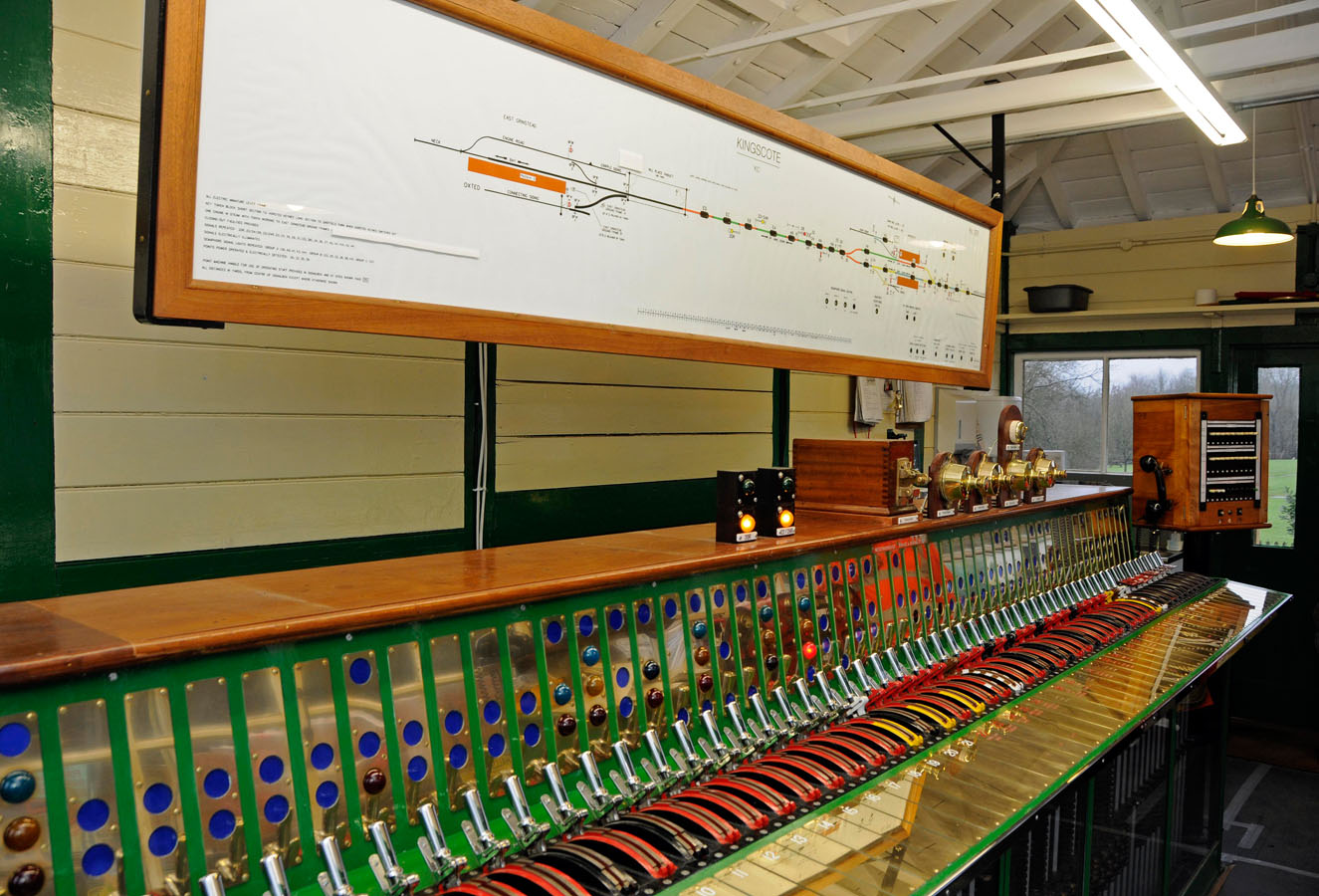
Inside the box the signalman is provided with indication lights for his Power Supply, to advise when Horsted Keynes box is switched out and to advise him when the backlocking of signal levers 1, 2, 9 and 10 is free and the levers can be replaced. There is a warning light to alert him to any Power Failure whilst a separate box controls the electric signal lighting. There are repeater instruments for signals 1 & 2, 8, 9 and 10. The point is electrically detected and the facing point lock stands out when the lever is normal in the frame. The longest signal wire pull is 536 yards, which is not much more than a third of the 1,474 yards that we used to have at Horsted Keynes!

Prior to the Horsted Keynes re-signalling, Kingscote and Horsted Keynes boxes were frequently worked by the same signalman for the evening dining train. By having Kingscote box closed out a token could be obtained at Horsted, which then closed out to the North so that when Kingscote was opened a token could be obtained there for the return journey. When the Horsted Keynes re-signalling is complete we will, no doubt, be able to return to this practice. When we are able to it is intended to introduce a "whole line" staff so that a train can operate between Sheffield Park and Kingscote (eventually East Grinstead) with just a signalman at either end of the line and Horsted box closed out.


Interested to learn more about Kingscote Station and its history?
splash
Return to Bluebell Home Page, to the Timetable or to Special Events
Signalling - Signal Boxes - The Signals - Bell Codes - Horsted Keynes Re-signalling
Signal Box Diagrams for Kingscote - Horsted Keynes - Sheffield Park

Visitor Info. - Catering - Contacts - What's New - Extension - Locos - Carriages & Wagons - Signals - History - Other - Links - Search the site - FAQ
Why not become a BRPS Member?     -     Get more involved as a Volunteer

Your ideal Film/TV location?


Valid HTML 3.2! Text and Drawing Copyright © Peter Richards.
This page updated 1 November 1999 by Peter Richards and 22 November 2004 by Richard Salmon.
Disclaimer and photo credits.