The Bluebell Railway's Locomotives
Locomotives Currently Receiving Overhaul or Under Restoration
News of some of these overhauls is available via the Loco Works News pages
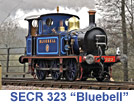
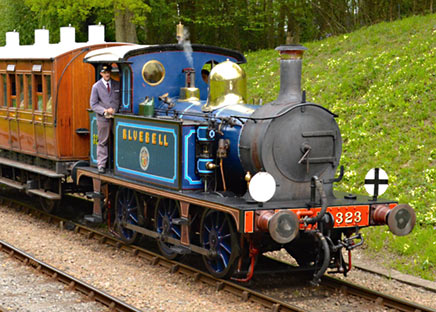 SECR Wainright P-class, No. 323 ‘Bluebell’
Class: P
Wheels: 0-6-0T
Built: 1910
Numbers carried: 323, A323, 1323, 31323
Previous major overhaul completed: March 2011 – Details of 2011 overhaul
Last operational: 9 February 2019
Owned by the Bluebell Railway
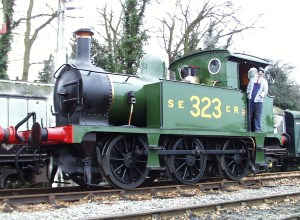 Long the flagship of the Bluebell’s fleet, painted blue and named ‘Bluebell’ between 1961 and 1998, this loco was repainted into SE&CR wartime plain green livery, for the 1999 centenary of the SE&CR (Photo: right).
The P-class tank locomotives were, in design terms, an updated copy of the LBSCR Terriers, but, with only eight of them built, made rather less of a name for themselves. However, with four of the eight surviving into preservation, they have blossomed, and are now much more favourably regarded as highly capable little locomotives. Their greater water capacity and larger cabs give them a slight advantage over the considerably older Terriers.
In preparation for the Bluebell Railway’s 50th anniversary, in September 2009 the loco entered the works. Getting it into service for August 2010 was thwarted by the discovery of the need for additional boiler repairs, and after this additional work, the loco returned to service just in time to put in an appearance at the Branch Line weekend in March 2011, painted in a more elaborate version of “Bluebell Blue” than formerly, as seen above.
Following its 2019 annual boiler inspection, it was withdrawn from service. Having run 78,000 miles in Bluebell service it will require significant mechanical work as part of its current overhaul, during which it will be reunited with the boiler it carried when it arrived at the Bluebell in 1960, which until recently was carried by No. 178.
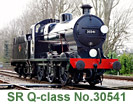
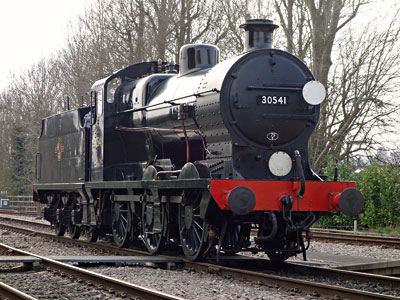 SR Maunsell Q-class No. 30541
Class: Q
Wheels: 0-6-0
Built: 1939
Numbers carried: 541, 30541
Last major overhaul completed: April 2015
Last operational: January 2023
Previously operational: 1983-1993
Owned by The Maunsell Locomotive Society – Their web page
Bluebell web page
News of current overhaul
Photo: at East Grinstead, Brian Lacey, 8 April 2015
Built as a basic goods engine to replace life-expired pre-grouping locomotives, this was Maunsell’s final design as Chief Mechanical Engineer of the Southern Railway. It could be described as a competent though not outstanding engine. Bulleid, Maunsell’s successor, improved the draughting arrangements with a multiple blast-pipe arrangement and new chimney, and it was in this condition that 541 was withdrawn from service in 1964. Sent to Barry scrapyard, like many other locos there it escaped the cutter’s torch and was bought by preservationists.
In 1973 it was moved to Ashchurch in Gloucestershire and moved on in 1978 to the Bluebell, where its owning group merged with those of U-class No. 1618 and S15 No. 847 to form the Maunsell Locomotive Society. The blast pipe and chimney arrangement have been further modified using BR Class 4 components, in the same way as BR had done to some of the class. This has the advantage of returning the locomotive visually to very close to its original form. Major restoration work saw it return to steam in 1983, operating for the following decade in Maunsell livery as No. 541.
An overhaul started in July 2011, and the Loco Works Working Group, who started by overhauling the tender, also assisted with work on the loco itself. It returned to service on 28 April 2015, carrying BR livery as No. 30541, and received a valve and piston exam in 2017. Its cylinders were re-bored and steam pipes and piston rods replaced early in 2022. Firebox defects have however now seen it withdrawn from service a couple of years earlier than had been hoped. Being in mechanically fairly good condition, but requiring work on tyres and a new tender tank, the plan is to do the work required quickly, in part using off-site contractors, to which end the locomotive (but not the tender) left the Bluebell on 6 July 2023.
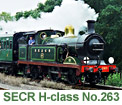
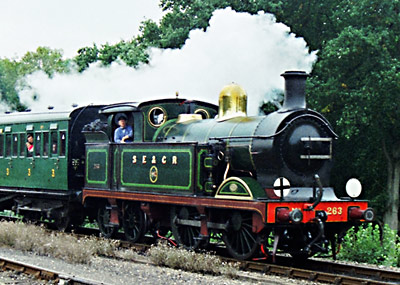 South Eastern & Chatham Railway No. 263
Class: H
Wheels: 0-4-4T
Built: 1905
Numbers carried: 263, A263, 1263, 31263
Last major overhaul completed: 28 May 2012 – Details of 2009-12 overhaul
Owned by The Bluebell Railway Trust
News of current overhaul
Web page
Photo: Richard Salmon, August 1996
Built as the standard loco for the SECR’s suburban services, the H-class were a popular loco in later years for services on rural branch lines in Sussex, especially after the withdrawal of the LBSCR D3 tanks. This particular locomotive ended up working the line between East Grinstead and Three Bridges and was withdrawn when that line was closed in January 1964. Purchased from BR by the H-Class Trust, it was initially located at Robertsbridge, but soon found a home at the South Eastern Steam Centre at Ashford, where the engine appeared at various open days. However, in 1975 the Trustees decided that the locomotive would have much more scope for running if based on the Bluebell. Since then it has had two periods in steam. In 2008 ownership was transferred to the Bluebell Railway Trust, which funded an overhaul which started in March 2009, with a return to service, again in full Edwardian SECR livery, in July 2012. In 2017 it received a full repaint in preparation for exhibition at the Warley model railway show.
Its recent boiler certificate expired in February 2022. The work is to be funded by a grant from the Bluebell Railway Trust, in part thanks to a bequest left by Ray Tanner specifically for work on this locomotive. It entered the Locomotive Works in November 2022 for what is expected to be a very rapid overhaul, in view of the generally good condition of the boiler, and recent significant mechanical work. The work planned includes a boiler lift, new crown girders and tubes, new tyres, new cylinder block, and new springs.
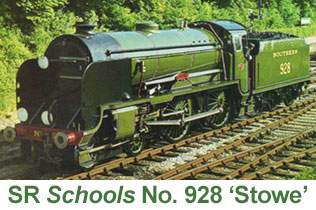
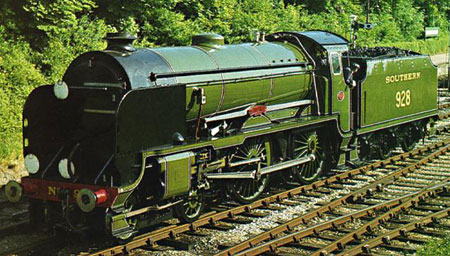 SR Schools-class, ‘Stowe’
Class: V, “Schools”
Wheels: 4-4-0
Built: 1934
Numbers carried: 928, 30928
Last major overhaul: 1980/1
Current status: Overhaul in progress; Tender has received overhaul.
Owned by the Maunsell Locomotive Society – Their web page and Latest News
The final development of the classic express 4-4-0, the Schools class were designed originally for the Hastings line with its restricted loading gauge, but proved themselves capable of hauling the Southern’s top expresses along side larger engines on the railway’s other main lines, and “Stowe” was built for the London-Portsmouth run. Bought from British Rail by Lord Montague, it was for a time displayed at his motor museum at Beaulieu, before moving to the East Somerset Railway in 1973 and the Bluebell in 1980 where it was rapidly restored to working order. Following expiry of its boiler certificate, it was been stored awaiting its turn in the workshop, in need of some very major (i.e. expensive) boiler repairs.
In September 2000 it was bought by the Maunsell Locomotive Society, so securing its future on the Bluebell. The team that rebuilt the tender for No.1638 then completed the major rebuild of Stowe’s tender, and the locomotive was repainted into Southern Railway Bulleid-period Malachite Green livery to ring the changes for the subsequent period when it was on display in the loco shed. In 2013 a start on the overhaul of the locomotive was made, with fund-raising also very much to the fore, since this will not be a cheap overhaul. Following re-wheeling of the overhauled chassis at Sheffield Park, the boiler and chassis have both been moved different contractors to speed the overhaul whilst the Bluebell’s loco works concentrated on ‘Fenchurch’ and ‘Sir Archibald Sinclair’. You can contribute towards the overhaul of this locomotive via the Bluebell Railway Trust.
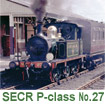
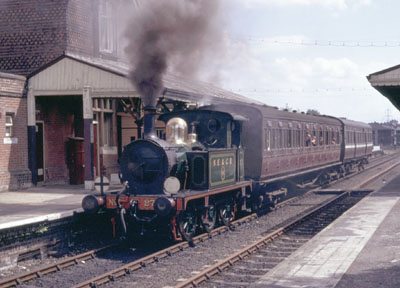 SECR Wainwright P-tank, No.A27
Class: P
Wheels: 0-6-0T
Built: 1910
Numbers carried: 27, ROD 5027, A27, 1027, 31027
Last operational: November 1974
Current status: overhaul in progress – Project 27 Blog, on the Little Loco Group web site and Facebook Page. See also News archive up to 2015
Owned by the Bluebell Railway
The P-class tank locomotives were, in design terms, an updated copy of the LBSCR Terriers. Coming to the Bluebell in 1961, for two years it carried the name “Primrose”. In 1963 it was repainted into full SECR passenger livery, and, with No.323, was a mainstay of the Bluebell’s operational fleet for much of that decade.
No.27 was dismantled in 1978 for a “quick” overhaul, but, as was so often the case at the time, this was found to be beyond the skills of the basic workshop capability we had back then, so the restoration stalled.
The restoration of 27 to working condition re-started in 2011 following a delay of over 30 years. The work on the locomotive is being undertaken by the Villas Gang and other volunteers, supported by the fund raising efforts of the ‘Fenchurch Fund’. Major work is required on the boiler and frames of the locomotive, the replacement of the cylinders, as well as some significant mechanical renewal and replacement of plate work, including the tanks.
You can contribute towards the overhaul of this locomotive via the Bluebell Railway Trust.
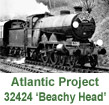
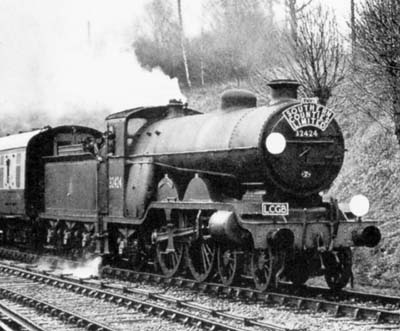 LBSCR Class H2 No. 32424 ‘Beachy Head’
Wheels: 4-4-2
Numbers carried: 424, B424, 2424, 32424
Name from June 1926: ‘Beachy Head’
Originally built: Sept 1911
Withdrawn: April 1958
Current status: construction in progress – latest news
Owned by the Bluebell Railway
This is our project to reconstruct a Brighton H2 Atlantic based on SR/BR period “Beachy Head”. It is based around a suitable boiler which was obtained some years ago, and the project is now moving ahead rapidly, with a building constructed to accommodate the components, the frames cut, wheels cast, cylinders and valves fabricated and fitted, motion made and fitted, such that the rolling chassis is nearly complete, as is the tender chassis. Various other original H2 components have been given to the project, including the locomotive’s original regulator handle, and a class identification plate.
The photo above shows Brighton Atlantic No.32424 “Beachy Head” at Horsted Keynes with the Locomotive Club of Great Britain “Southern Counties Limited”, 24th February 1957.
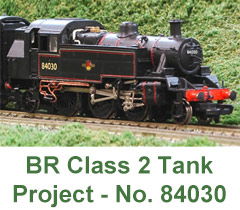
 BR Standard Class 2 No. 84030
Wheels: 2-6-2T (built as 2-6-0)
Originally built: 1956
Number: 84030 (was 78059 in BR service)
Current status: overhaul and conversion in progress – latest news
Owned by the Bluebell Railway
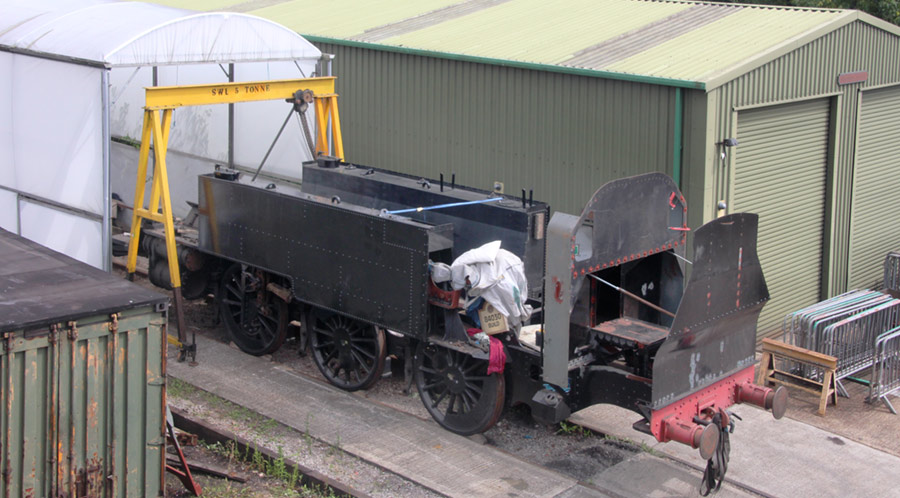
The photo shows the new side tanks in position on 84030’s extended frames, on 18 July 2023. Since then work has progressed on construction of the bunker and cab, and preparation of the boiler for its survey is planned.
The 2MT locomotives were built for light branch-line work. The tender engines, as this loco was originally, were almost unknown even as visitors to the South, whereas the 2MT tanks were used extensively on the Southern Region. Thus, when this loco was rescued from Barry scrapyard without a suitable tender being available, the decision was taken to restore the locomotive in the tank-engine form, of which there are otherwise no surviving examples. The last 2MT tank having been numbered 84029, this locomotive takes the next number in the sequence.
The loco will be very useful on the Bluebell, since it will be capable of hauling all but our very heaviest trains. The project is making good progress, and news reports are available here.
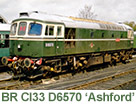
 BRCW Type 3 “KA-2B” (Class 33/0) D6570 ‘Ashford’ (33052)
Built: 1961
Current status: Undergoing overhaul
Owned by B350 Ltd – Facebook Group
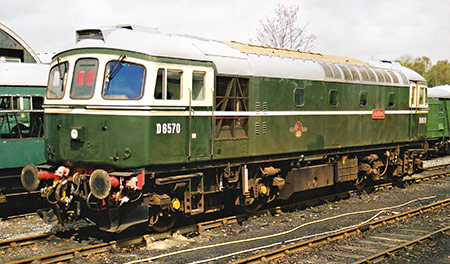
Jonathan Horrocks’ photo taken at Tenterden in April 2000 shows D6570 ‘Ashford’ at its previous preservation base, on the Kent & East Sussex Railway.
Class 33 locomotives were not just a specific Southern Region class, but were closely associated with services at East Grinstead in the early 1960s, and were still working peak-hours East Grinstead – London Bridge trains in the 1980s. The Bluebell having concluded that a thunderbird and dry weather/fire-risk cover locomotive was required, a group of Bluebell Locomotive Department members purchased this locomotive – see pdf document with full information/news release here.
On arrival at the Bluebell Railway, it has not entered service immediately, but the new owners (who also own and maintain shunter D4106) are implementing a re-commissioning programme to ensure the locomotive is reliable before being made available for service, and at the same time will undertake a number of bodywork and roofing repairs to make the loco weathertight. It will be hired for use on the Bluebell on an as-required basis.
- Operational Locomotives
- Locomotives under overhaul
- Locomotives on static display
- Multiple Units
- Locomotives formerly based on the Bluebell

Locomotive Roster – Loco Stock List – Loco Works News – Atlantic Project – Standard 2MT Project – Awake the Giant – Project 27
Last updated by Richard Salmon, 20 November 2023