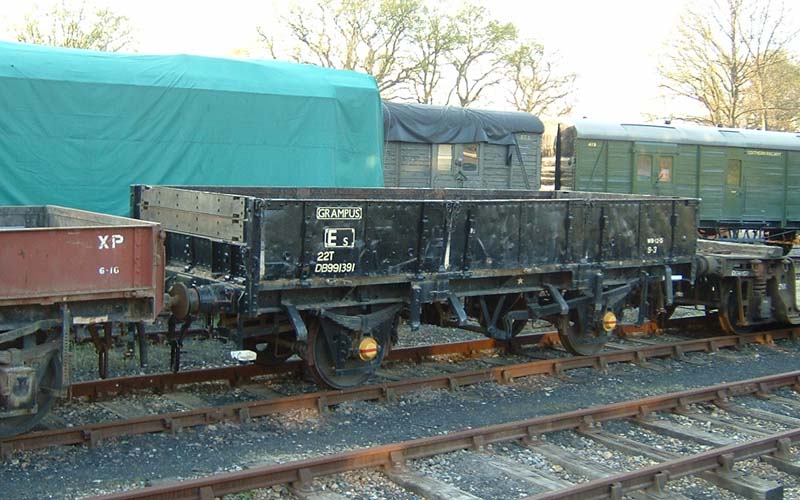
This is an example of a 20 ton drop side Ballast and Sleeper Wagon to diagram 1/574 designed by British
Railways and codenamed "Grampus". The wagon was designed specifically for the use of the Civil Engineering
Departments and carried the DB prefix to its number from new. The design owes its parentage to a similar
fixed-end vehicle designed by the pre-nationalisation Great Western Railway and codenamed "Tunney". The
end arrangements have a similarity to those of the SR-designed "Lamprey". Both the aforementioned types
were outshopped in 1949, shortly after nationalisation (1st January 1948). A total of 4,781 Grampus wagons
were built between 1951 and 1961, some with vacuum braking, most with handbrake only. This type of wagon
was used on every Region of British Railways.
The Grampus has drop sides enabling hand loading and unloading of materials. There are two removable
stanchions on each side. Standard sleepers could be stacked across the floor; crossing timbers along it.
The two top planks at each end are removable, allowing signal posts to be carried, overhanging adjacent
wagons. Wheeled vehicles could be moved along the Grampus over the hinged bottom steel end plank. Track
ballast for use under new track would have been regularly carried in these, together with granite
chippings (to replenish lineside bins and used for shovel-packing sinking sleepers) and sand (for
surfacing/profiling the trackbed - the Southern Region used granite dust from Meldon Quarry). In the steam
era these wagons would also have been used to carry locomotive ash from sheds to sites where it would
have been used to top off previous infill or to repair slipped embankments.
The Grampus was an extremely versatile vehicle. However its drawbacks in the modern age were its timber
floor, flimsy doors and removable end planks, all of which were easily damaged or distorted when it was
unloaded by a mechanical excavator.
722 Grampus wagons were built to diagram 1/574 either by BR's Shildon Works or, as in the case of this
vehicle, by private builder Pressed Steel. DB 991391 was one of 544 ordered under lot No. 3168 from
Pressed Steel in 1958/9. This wagon differs from the other Grampus wagons on the Bluebell Railway
(which were built to diagram 1/572) in that it was built with vacuum braking and 'clasp' type brake
gear from new.
DB 991391 was initially allocated to the District Civil Engineer at Stratford (East London) on the
Eastern Region. The regional allocation was originally denoted by a cast plate on the left hand door
on each side, but these were prone to breakage if the door was damaged. However the wagon was latterly
allocated to the Southern Region. In the 1980s the Southern's Grampus fleet was relegated to hauling
spoil or spent ballast from worksite to tip. A fleet or 'pool' of these vehicles was based at Tonbridge
and served tips at Godstone and Hoo Junction.
This wagon was selected by BR to form part of a display demonstrating safe loading to trainee loading
inspectors. It was transferred to Internal Use at Tattenham Corner and allocated the number 083658.
Following privatisation of the national railway network the display was abandoned and this vehicle was
offered to the Bluebell Railway.
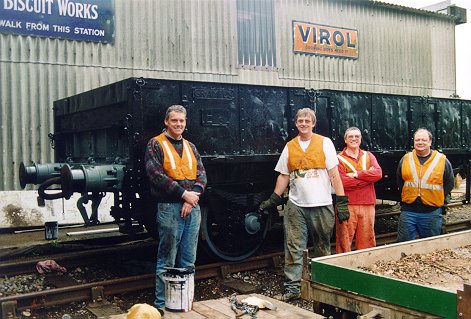
The 'Fencing Gang' took on DB 991391's restoration to traffic, including the fitting of a new floor
made from steel channel sections. Here the gang take a break during painting of the wagon. From left
to right: Roy Fletcher, Geoff Snow, John Rich and Geoff Hackett. Richard Salmon, October 2000
The exact origin of the BR practice of allocating 'fish' names to civil engineering vehicles is unknown.
When railway operations messages were conveyed by morse telegraph or teleprinter, if the number of
words in a message could be reduced, it could be transmitted more quickly. There were lists of code words
for certain regular instructions and also for wagon type and capacity. The Great Western Railway
favoured fish names for engineering wagons, and this may have been the origin. Whatever the reason,
if one refers to a "Grampus", any railwayman will know that one is not referring to the similar
'Lamprey' or 'Tunney'.
And what is a Grampus?
It is believed that the word was first coined by 18th century mariners, as a corruption of
'graunde pose'; this term itself being a corruption of the French 'grand poisson' (large or fat fish).
Subsequently the word Grampus was used to describe some whales, including the black-and-white killer whale.
Early in the 19th century Risso's dolphin was identified as 'Grampus Griseus' or 'Grey Grampus'. Adults
of this species reach 4m in length. As they age the majority of the creatures become covered with
distinctive linear scars on their sides and back. Judging by the appearance of many of these vehicles
in the latter days of BR, perhaps the "Grampus" designation became more apt than its originators intended!
Recommended reading:
Civil Engineers Wagons Volume 1 - British Railways: 1948-1967 by David Larkin. Published by Kestrel
Railway Books, 2011. ISBN 978-1-905505-23-4. This book may be available from the
Bluebell Railway Shop.