Right: Interior of former first-class compartment, 2003
The first class compartments were ones formerly in second class carriage No.792 of 1899, each compartment of that carriage being 6' 5" long. All five compartments of No.792 were used, forming one end of the new coach. Three third-class compartments (each 5' 71/2" wide) came from 6-compartment Third No. 568 (of 1897) along with two further compartments from an unknown donor vehicle, each 6' 13/4" wide. On the later production versions of the electric stock, if there was a mis-match between the lengths of the compartments used and the total length of the underframe, the extra was simply left as a small void between two compartments at the point where the vehicles were joined.
Comfortable as the centre coach of a Birdcage set.
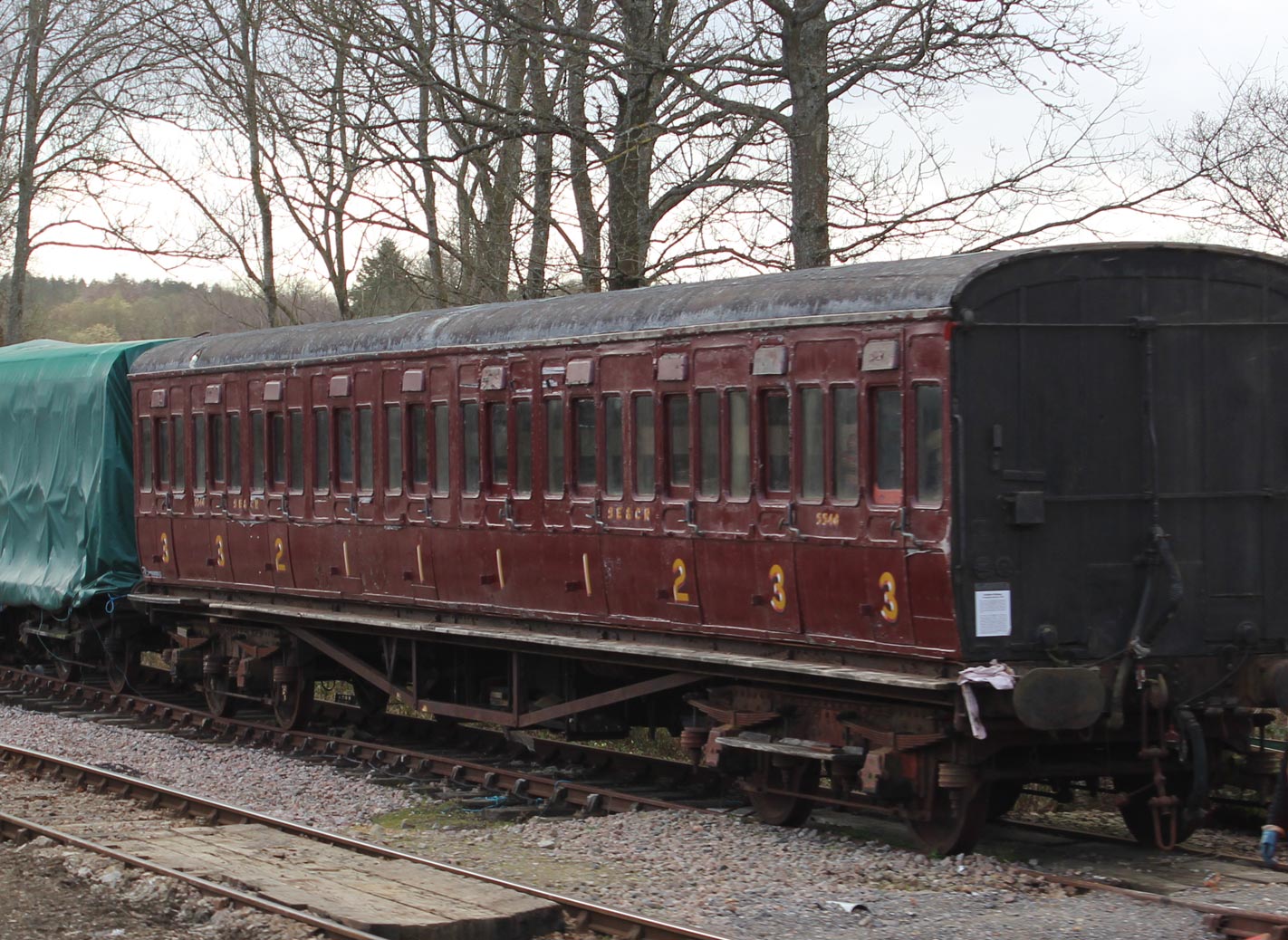
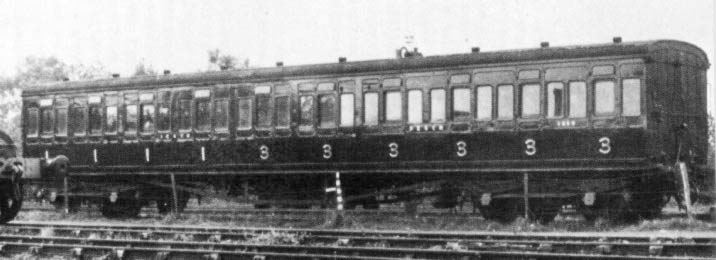
As SR No. 5546, it ran for a time as the centre coach of three-coach birdcage set 528, and was noted in 1935 as running in set 760 on Madstone West - Paddock Wood - Tonbridge services, between SECR brake first No.7735 and full third No.1093.
Push-pull trailer 1050.
When this set was replaced by a Maunsell set, it was downgraded to third class only, as a push-pull trailer (Diag.50) No. 1050, on 30 June 1943 at New Cross Gate. It served as a spare coach available to strengthen services on South Western branches, including Swanage, Lymington and Seaton.
Preserved by chance.
On withdrawal it was stored along with many other coaches on the Horsted Keynes to Ardingly branch, from where it was purchased by the Bluebell, a lucky survivor, being a replacement for another coach rejected by the Bluebell due to broken windows.
Entering service on the Bluebell in 1963, it was repainted in 1965 to match the 'Birdcage' brake No. 1061. Apart from some filming work, it has not been used for several years. It is hoped eventually to restore it as the centre composite coach of a three-coach SE&CR Birdcage set. Although not a typical centre-coach, it will not look out of place, completing this historic combination which was to be found all over the south-east from the early years of the last century until the 1950's, when they ended their days as the classic branch line train.