
|
|

|
|
Carriage & Wagon Dept - Stock Lists: Carriages, Vans, Wagons & Multiple Units - C&W News SR Coach Group - Goods Division - Operation Undercover - Technical - Join us Chesham Set: BASH - History - Engineer Article - Restoration Project - Full Third 394 - Brake Third 387 - Test Run Composite 368 - Composite 412 - Relaunch Gala - HRA Award - Relevant Links 
Bluebell Ashbury Supporters and HelpersThe history of the carriagesBack in 1961, the infant Bluebell Railway could ill afford to spend a single penny, but passenger numbers demanded more than just the original two Southern Railway coaches. The cheapest coaches on the market were some ex-Metropolitan Railway coaches, dating from the turn of the last century, for which London Transport were asking only £65 each. So it happened that four of the six coaches which had been used for the previous two decades on the Metropolitan Line's Chesham branch came to the Bluebell. Another went to the LT Museum, and the sixth was scrapped. Their story is one of considerable complication and their survival most definitely one of luck.
 Stepney with the four coaches at Horsted Keynes in the 1960s It is, here, worth stating some of the factual history of the Bluebell's four coaches, since all recent publications, from reference books on preserved carriages to the Bluebell's own stock book, have errors when dealing with these coaches. The coach numbers, builders and dates given here are taken from an article in Bluebell News in 1966 which was researched from original Metropolitan Railway documents, and have been confirmed by evidence found during the current restoration.
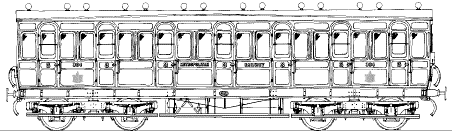 No.394 (LT 518) was built as a 7-compartment third by Ashburys in 1900. It originally seated 70, but this was reduced to 60 by the reconstruction of the end compartment as a driver's cab for electric multiple unit use in 1921. In 1940 it became a push-pull driving trailer. 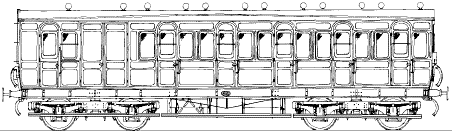 No.387 (LT 512) is the brake third, built by Ashburys in 1898 with 5 compartments 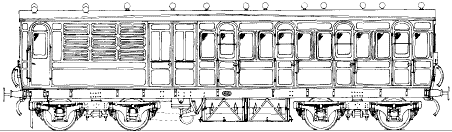 Substantially rebuilt in 1907 or 1908 as an electric driving motor coach with 4 compartments, it was soon found that there was insufficient luggage space, and 10 more seats were lost to form a guard's and luggage compartment, these seats being reinstated in 1940 using components from dreadnought stock. The motor equipment was removed creating a large new luggage space.
Composite No.368 (LT 515) was built by Ashburys in 1898, and composite No.412 (LT 516) by Cravens in 1900. Both composites have seating for 30 third and 24 first. The first class had been down-graded in 1940, involving removal of the folding arm-rests, which are now being reinstated. The first batch, built in 1898, came from The Ashbury Carriage, Wagon and Iron Co. Ltd, of Manchester, with the second batch in 1900 split between them, the Metropolitan's own Neasden Works, and Cravens. An article in "The Engineer" at that time went into detailed descriptions of the new stock. These fifty coaches were known as "the bogie stock", since this was one obvious difference from the previous rigid eight-wheelers. They were electrically lit, steam heated, and were very short at just under 40 feet long. The first change came as, starting in 1906, they were progressively converted to electric multiple unit use. By 1938 they were getting distinctly long in the tooth and were withdrawn. However the war intervened, and they were stored against any unexpected contingency. Indeed, one set was put back into service for a time. In 1940 five of them, plus a much rebuilt 1899 experimental electric motor coach, were converted back to steam haulage, as two three-coach push-pull sets for the Chesham branch, on which they alternated one week on, one week off. Their next bit of luck was the Bluebell's requirement for something cheap in the year after they were displaced on electrification of the Chesham line. They served the Bluebell well, carrying many of the railway's visitors in its formative years. In 1963 they returned briefly to LT to take part in the Metropolitan's Centenary celebrations. However, one by one, they started showing their age. Roofs leaked and interiors rotted. First, one of the composites succumbed (in early 1965), and then the entire set by the middle of the following year - being close coupled precluded their use as single vehicles. In 1969 they became the first stock to move from the Railway's base at Sheffield Park to the newly purchased sidings at Horsted Keynes, where their restoration was attempted. One roof was stripped, the supporting structure repaired, and a new roof, in plywood, applied. The paintwork was stripped off, and three of the four coaches in the next five years reverted to a natural wood finish. Some of the teak panels were now plywood, and some, LT replacements in metal, which were suitably scumbled. As such, they ran occasionally for filming work, including the Betjeman "Metroland". However, it became evident that a full return to service would require much further work, beyond the railway's capabilities at that time.
In the meantime, they had been accommodated in the Bluebell's new carriage shed at Horsted Keynes, where they were to remain for a quarter of a century, safe, but with apparently little future, their interiors crammed with such components as spare coach seats and doors, and with dry-rot taking hold in places. Through the 1980s, as the shed was cleared of stock in storage to make more restoration space, they were again lucky and remained under cover. Their next lucky break was to be selected for a filming job, for which the BBC provided a shipping container into which to decant the assorted spares inside.
How this led to their restoration is explained in the next page, which introduces the BASH restoration project.
Return to BRPS Home Page, to the Timetable or to Special Events Carriages & Wagons - Intro - Development - Stock Lists: Carriages, Vans, Wagons & Multiple Units - Carriage Fleet Review - Join us C&W Works News - SR Coach Group - Goods Division - Operation Undercover - Carriage Shop - Technical Pages Chesham Set: BASH - History - Engineer Article - Restoration Project -Full Third 394 - Brake Third 387 - Test Run Composite 368 - Composite 412 - Relaunch Gala - HRA Award - Relevant Links Visitor Info. - Museum - Trust - Catering - Contacts - What's New - Projects - Locos - Carriages & Wagons - Signals - History - Other - Links - Search - FAQ Why not become a BRPS Member? - Get more involved as a Volunteer  Copyright © 14 January 1996 - 14 January 2007 by Richard Salmon. Last update 19 October 2024
Original drawings by Gerry Bixley, modified by Richard Salmon. © Copyright BRPS. Privacy Policy |

