
|
|

|
|
Carriage & Wagon Dept - Stock Lists: Carriages, Vans, Wagons & Multiple Units - C&W News SR Coach Group - Goods Division - Operation Undercover - Technical - Join us Chesham Set: BASH - History - Engineer Article - Restoration Project - Full Third 394 - Brake Third 387 - Test Run Composite 368 - Composite 412 - Relaunch Gala - HRA Award - Relevant Links 
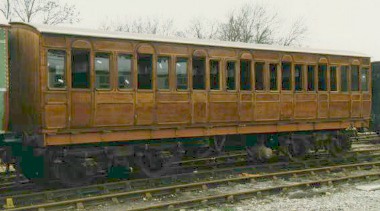
Bluebell Ashbury Supporters and HelpersThe restoration of Full Third 394No.394 (LT 518) was built as a 7-compartment third by Ashburys in 1900. It originally seated 70, but this was reduced to 60 by the reconstruction of the end compartment as a driver's cab for electric multiple unit use in 1921. In 1940 it became a push-pull driving trailer.
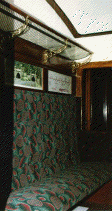
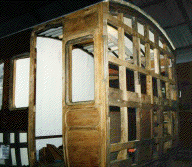
The softwood of the interior at the driving end of this coach was riddled with dry rot, so whilst this was stripped out, we had the mistaken idea that it would not be too much extra work to convert it back to its pre-1921 form as a full third, but it's done now, and you'd be hard pressed to notice the alterations, or notice that the interior is a brand new copy of what is in the other compartments. If you want to see what it used to look like, you can visit its brother in the LT Museum at Covent Garden. Several of the compartment partitions were rotten, and as this was the vehicle which had received a thin plywood roof, it was found easiest to replace the partitions with the roof off. The roof was replaced with the traditional inch-thick boarding. Advice from the Vintage Carriages Trust has led to the roof being covered in a synthetic material, which was certainly rather easier to apply than a traditional canvas.
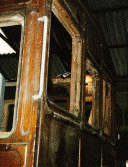
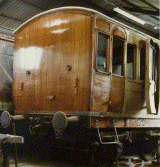
The reconstruction of the driver's cab as a passenger compartment involved rebuilding the end structure where windows had been inserted, and turning the doors round from inwards to outwards opening. The teak-framing of the coach was sound, with only slight repairs required at one end. As compared to a more modern (1930s or '50s) coach, built from poorer quality wood, this has been the easy part. The difficulty came with the interior and the exterior. Many new interior mouldings and components were required, both to replace some lost since the earlier aborted restoration and those surviving but beyond repair, and also to equip the "new" compartment. Many of these have been made on site. The exterior required new teak panels to replace split ones, and those which had given way to ply or metal over the years, together with complex cover mouldings, again shaped from teak, covering the joints between panels. 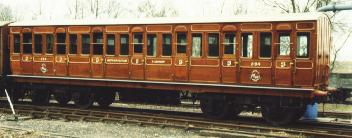 Full Third 394 seen in 1997 upon completion of most of the restoration work, but before the overhaul of its bogies and running gear. The first two coaches undertook a test run behind "Birch Grove" on 25th January 1999 and, apart from the inevitable minor faults, this was very successful. These problems were attended to, and the electrical system completed, during the following week, thus enabled our supporters to enjoy a private day out on the coaches prior to their public launch into service on 13th February 1999. 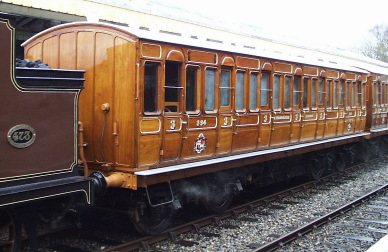 The Full Third, No.394, at Kingscote on the test run. (Lewis Nodes) 

Return to BRPS Home Page, to the Timetable or to Special Events Carriages & Wagons - Intro - Development - Stock Lists: Carriages, Vans, Wagons & Multiple Units - Carriage Fleet Review - Join us C&W Works News - SR Coach Group - Goods Division - Operation Undercover - Carriage Shop - Technical Pages Chesham Set: BASH - History - Engineer Article - Restoration Project -Full Third 394 - Brake Third 387 - Test Run Composite 368 - Composite 412 - Relaunch Gala - HRA Award - Relevant Links Visitor Info. - Museum - Trust - Catering - Contacts - What's New - Projects - Locos - Carriages & Wagons - Signals - History - Other - Links - Search - FAQ Why not become a BRPS Member? - Get more involved as a Volunteer  Copyright © 14 January 1996 - 30 September 1999 by Richard Salmon - Last updated 29 July 2007.
© Copyright BRPS. Privacy Policy |