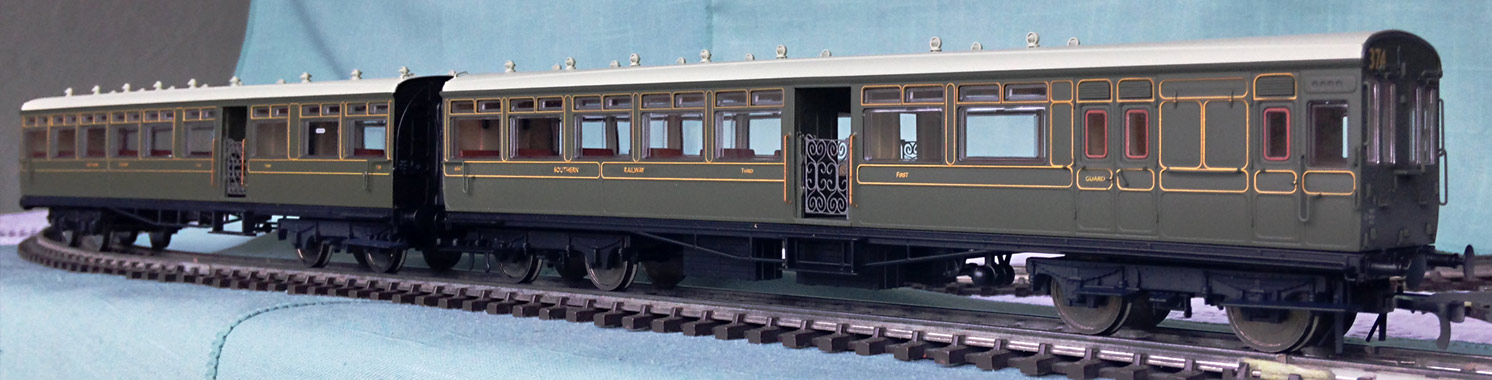
Following a staring role behind Beattie 2-4-0 Well Tank 30587 at the
Centenary celebrations for Exeter Central station on 19th. July 1960,
Mr. John Leroy, then President of the embryonic Bluebell Railway
Preservation Society, thought he had purchased both coaches for
preservation on the Horsted Keynes to Sheffield Park line. But it was
not to be. In October 1960, while stored on a siding at Crediton, they
were officially withdrawn after having suffered some minor immersion
damage when the River Creedy went on one of its periodic rampages.
Unaware of this, but aware of the Bluebell's interest, imagine my
elation when on the way home from school one Friday evening I saw the
set in Eardley Sidings. The next afternoon, for we still had school on
Saturday mornings then, I was on my bike and over the fence to inspect
them. Apart from some mustiness, not uncommon in older coaches, I could
certainly see no signs of terminal damage. And besides, they had safely
made the trip up from Devon. Much later I was to learn that the Driving
Brake Third from the set had even made a few solo trips up and down the
Yeovil Junction to Yeovil Town branch, whilst in transit from Devon to
London.
By the following Monday they had gone... to the scrappers' bonfire at
Newhaven Town's voracious North Quay sidings. By way of consolation the British
Transport Commission assured me that one set of gate ironwork had been
preserved for eventual display at Clapham Museum. But several visits
and repeated enquiries over the years failed to turn up any trace of
them. The whole sad story is remarkably akin to that of Stratford Works
wanton destruction in 1957 of officially preserved ex-Wisbeach & Upwell
Tramway bogie coach No. 8, a type imortalised by sister coach No. 7 in
Ealing Studios, classic comedy film "The Titfield Thunderbolt". In both
cases local officials acted directly contrary to instructions from
higher up because they thought they knew best.
I remember how upset ('apoplectic'
would not be too strong a word) John Leroy was when British Railways told him
about their little "misunderstanding".
The early days in general
Has anybody ever written an unexpurgated history of the early days
of the Bluebell? Stirring stuff!
Who could ever forget those early
meetings in Haywards Heath's "tin tabernacle", the Fred Tallant Hall.
Or Horace May's bombastic (but essentially well meaning) impersonation
of somebody who knew what they were doing. Or the imbecilic reporter
from the 'Daily Sketch', to whom my father patiently explained on
Opening Day why 'Stepney' was called 'Stepney', only to be greeting in
print the next day by the photocaption "...inexplicably named
'Stepney'". Or the day we had THREE emergency deliveries of 'Walls' ice
cream to the old Maunsell Restaurant Car marooned in the end loading
dock and broke all the ice cream sales records for the sales region. Or
constantly washing up the same dozen or so old assorted teaspoons culled
from my grandma's 'odds & sods' drawer, because in those days proper tea
was served in cups, on saucers, with a spoon - or else!
Or that
wonderful old Brighton driver and true gent Ralph Stent and his tales of
whacking off clouds of pre-myxamatosis bunny rabbits on the trackside
with well aimed lumps of coal (more than one home fire was kept burning
with the unsuccessful projectiles, yet the 'score' rate was also
amazingly high).
 Or that delightful rascal Fred Miles, castaway by
Waterloo to Horsted Keynes into his very own little Buggleskelly-like
world of village intrigue and somnolent inactivity - occasionally
interrupted by shuttling 2-BILs on their lackadaisical way to and from
Seaford. Or the 'patent' Turnerised wood-&-canvas carriage roof
repairing schemes that turned out to be such a disaster.
Or that delightful rascal Fred Miles, castaway by
Waterloo to Horsted Keynes into his very own little Buggleskelly-like
world of village intrigue and somnolent inactivity - occasionally
interrupted by shuttling 2-BILs on their lackadaisical way to and from
Seaford. Or the 'patent' Turnerised wood-&-canvas carriage roof
repairing schemes that turned out to be such a disaster.
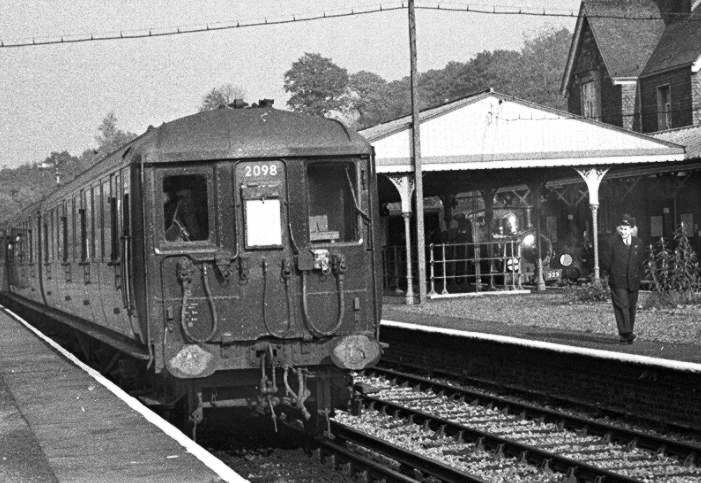
Right: Keith Harwood took this photo of 2-BIL electric unit No 2098 at Horsted Keynes in the early 1960s.
No.323 "Bluebell" is visible on what was then the Bluebell side of the station.
Or firing on
Richard Gomm's 'Dukedog', when it was a race to get to the other end of
the line before all the water poured out of the incredibly rust-wasted
tender. Or the happy oaf who sawed off one end of a vintage LBSCR
starter signal arm to better balance it, being quite unable to work out
how to adjust the balance weight arms. Or riding the North London tank
up through dripping cuttings, as track panels were being unceremoniously
ripped out on what is now the 'Northern Extension'.
I also remember slapping an instant coat of
blue paint onto the first two BR castoff coaches days before the
Opening, stripping and painting the SECR 'Birdcage' in the
overgrown loading dock at Sheffield Park, and Richard Hearne ("Mr. Pastry") making his one and only mad
dash up to Freshfield with a Maunsell Brake and the Aveling & Porter
'Blue Circle'.
The Russians
Then there was the day when 'SuperMac' (Prime
Minister Harold Macmillan, Esq., to you), who lived at nearby 'Birch
Grove', (what a coincidence!) turned up quite unannounced with a couple
of senior Russian diplomats who were visiting for a country house
weekend of intrigue. Fortunately, Horace was 'off' that afternoon,
otherwise the fawning would have been unbearable! One of the Russians
had been a Stakhanovite fireman on Russian railways in his formative
years, which was how he had gained his first leg up in The Party. He
was truly delighted to fire the Adams Radial, whilst Macmillan and the rest
of the party 'rode the cushions' in the train behind, with their ice
creams and a couple of surly 'minders' from MI5 or wherever in the next
compartment. All very low key and informal, and this at the very height
of the 'Cold War', when Russian diplomats weren't ever allowed to wander
more than 20 miles from their Embassy - period! I often wondered what
little piece of covert diplomacy was in prospect that afternoon.
Happy days!
Mike South.