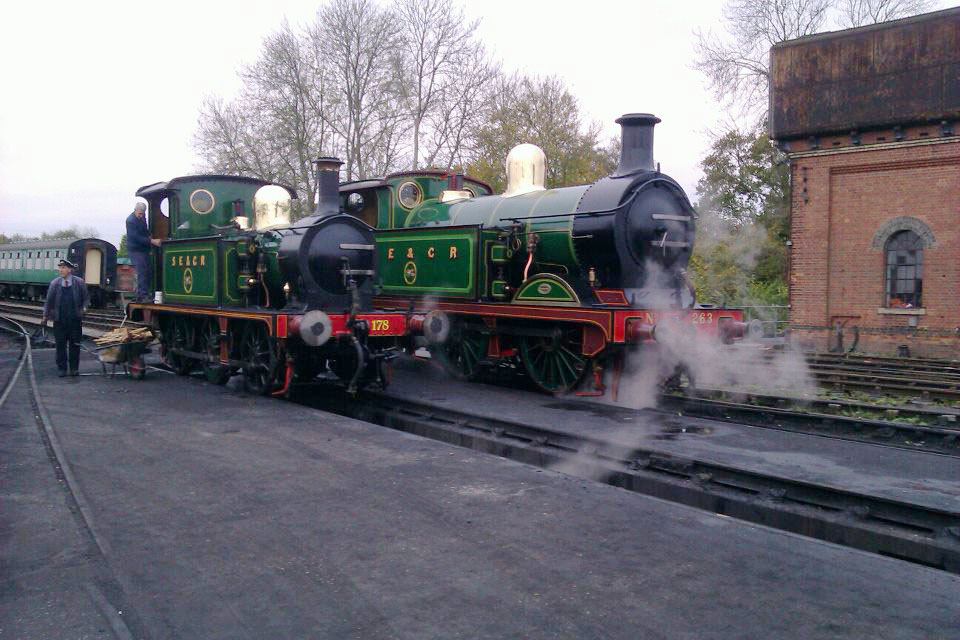
 Tom Bayford's photo shows SECR P-class 178 and H-class 263 on shed in October 2012
The Bluebell Railway has the UK's largest and most comprehensive collection of locomotives from the former Southern Railway and its three main constituents. It also, surprisingly, has the largest collection of BR standard design steam locomotives. This is the finest collection outside of the National Railway Museum in York. As a UK preserved railway the Bluebell is rare, in that we can almost guarantee you will not be hauled by a diesel on our normal timetabled passenger trains. Up to 2006 we even did all our shunting by steam, and on most Mondays and Thursdays the LSWR B4 (usually) could be seen employed on the only regular steam shunting turn on any railway in the country. Various diesel locomotives (two class 08s, a class 73 and a class 33) were hired to assist with the construction of the extension, and to take some of the strain off our fleet of steam engines by undertaking most of the regular shunting work. The Railway now has the use of a class 09 shunter, purchased and maintained by a consortium of Locomotive Department members, who have also now acquired a class 33, largely due to its ability to provide an earlier morning service from East Grinstead on peak summer days, but also to act as a thunderbird locomotive, and for use in the event of high fire risk. The growing diesel fleet remains relevant to the locality, with an Oxted-line Thumper and class 73 coming to the line.
After ten years' operation all steam locomotives require a complete strip-down for a boiler overhaul and insurance inspection. The opportunity is taken at this time to examine and repair all the other parts of the engine. These overhauls can take many months or even years, and require both large sums of money and specialist workshop skills. You can find news and photos of the current loco overhauls here.
At any time, therefore, only a selection of our locomotives are serviceable, and there is a page specifically for these Operational Locomotives. With our oldest locos now around 140 years old, the work required to keep them running is, as might be expected, quite onerous. The Locomotive Roster shows the shedmaster's intention as to which locos should be in steam on any particular day.
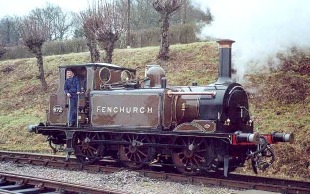 Right: "Fenchurch" is the oldest locomotive at the Bluebell Railway. It is seen here on the day of its return to public service after overhaul, 11th February 2001.
The Locomotive Stock List provides full details of all the locomotives at the Bluebell. They range from "Stepney" and "Fenchurch", the two diminutive Brighton "Terriers" built in the 1870s, to the most modern, a BR Standard 9F heavy freight locomotive - built for British Railways three years after the Bluebell line originally closed, and just two years before we re-opened the line.
When the Bluebell Railway first started operating, steam locomotives were still commonplace on British Railways; and our Preservation Society aimed to purchase a representative selection of them. Only examples in full working order were considered and, as at that time we were the only preserved line in the country, locomotives such as the GWR "Dukedog" and the North London Railway "Dock Tank" came to the Bluebell, even though originating from outside the geographical area which the Bluebell collection aimed to represent.
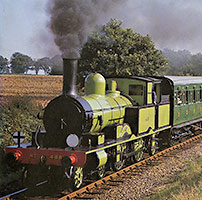 Adams Radial Tank No.488 had remained in use on the Lyme Regis branch long after most of its classmates had gone, and thus survived long enough to be bought by the Bluebell.
Some locos on our "wanted list" were preserved elsewhere as other railways followed our lead, but the Bluebell nonetheless did obtain historic gems such as the Adams Radial Tank, "Birch Grove" and the SECR P-tanks - considered second-best to a "Terrier" at first, but quickly proving their value.
However other locos on the railway's "wanted list", such as an LBSCR K-class Mogul and the final locomotive built at Brighton, BR Standard class 4 tank No.80154, could not be afforded because the time when they were available coincided with the years when all money available had to be channelled into the purchase of the freehold of the line (which had initially been leased from BR). If the purchase price of the line had not been raised then the railway would have had to close. Several locos which we would like to have saved were therefore lost forever.
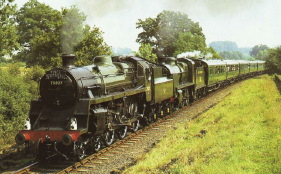 BR withdrew its last steam locos from service in 1968, and the last one to arrive at the Bluebell in working order was No.75027 (see photo, right), purchased privately by a member and donated to the railway. At the time it was thought ridiculously large for the line - but it has since proved ideally suited, and has been one of our most regular performers over the years. Its most recent spell in traffic was for a full decade following a thorough overhaul which was completed in 1997.
In the 1970s the fleet continued to expand, most notably by the influx of locomotives which had initially been preserved at the Ashford and Longmoor steam centres. At the same time improvements to the workshop facilities, and the construction of the locomotive works, enabled full overhauls to be undertaken. One new arrival was Southern Railway U-class No.1618, which had been one of the first locos to be rescued from Barry Scrapyard. The success of this locomotive led to many more ex-Barry "wrecks" arriving at Sheffield Park, and most of these have subsequently returned to traffic.
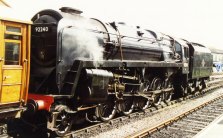 No.92240 was the first ex-Barry Scrapyard BR Standard 9F 2-10-0 heavy freight locomotive to be restored to working order on a heritage railway. The restoration, which took 12 years, included the construction of a new tender body in our own workshop.
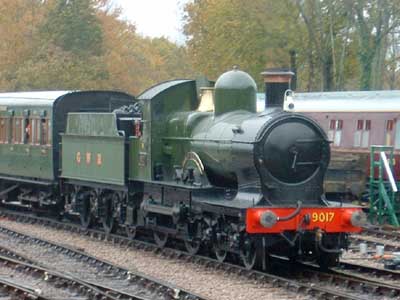 GWR "Dukedog" No.9017 "Earl of Berkeley" at Horsted Keynes on 2nd November 2003, the weekend of its return to service after its most recent overhaul.
One of the more recent locomotives to arrive was another of the exhibits from the former Ashford Steam Centre, which closed in 1970. South Eastern Railway O1-class 0-6-0 No.65 had been hidden from public view for 20 years, but was restored to working order at Sheffield Park, re-entering service on 5th August 1999 - the centenary of the formation of the South Eastern & Chatham Railway.
The Bulleid Society's "West Country" Pacific No.21C123 "Blackmoor Vale" arrived from initial preservation at Longmoor in Hampshire. It has had two operational periods on the Bluebell, first returning to steam in 1976 and subsequently, following an overhaul, from August 2000 until January 2009. It is still, 30 years after it first appeared in this guise, the only preserved Bulleid Pacific to carry full Southern Railway malachite green livery.
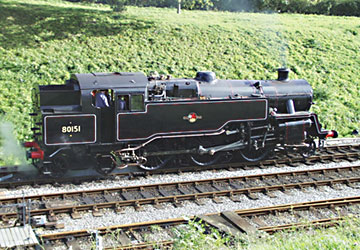
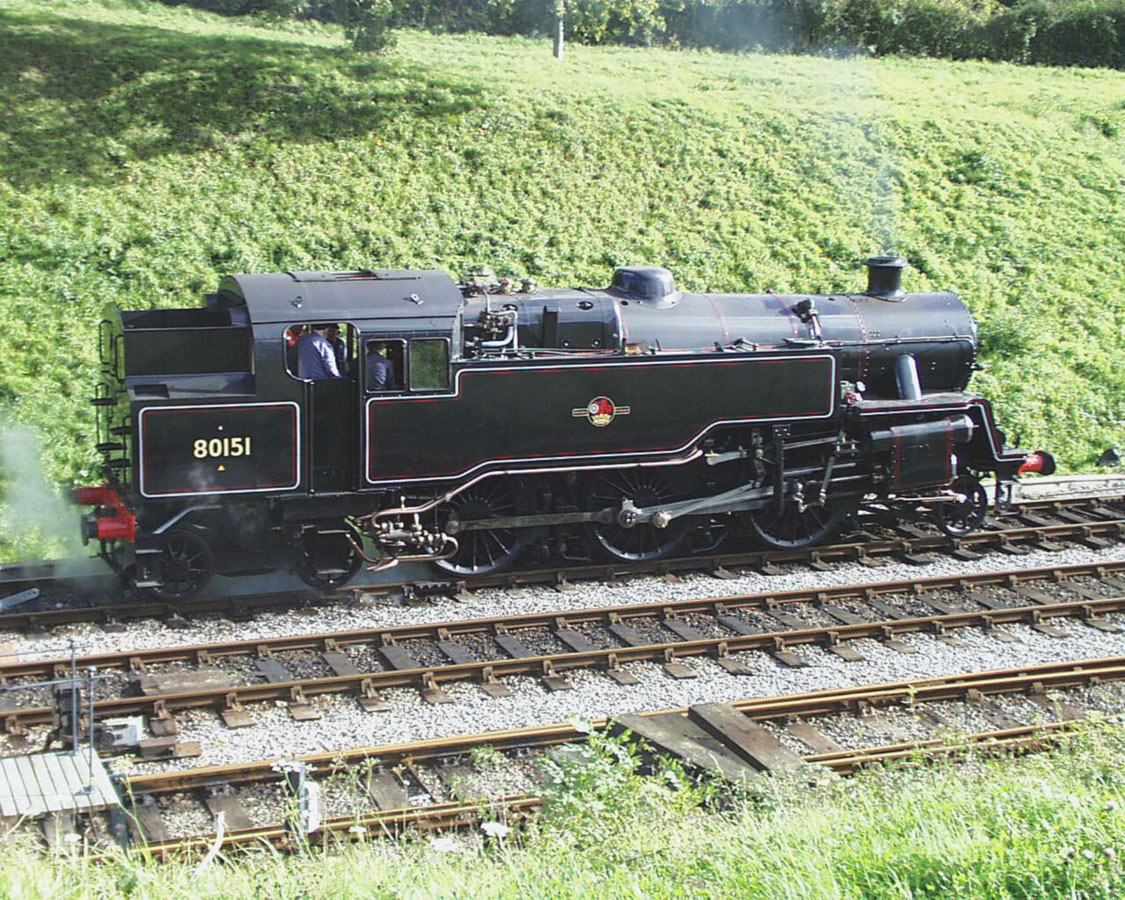
British Railways Class 4 Tank locomotive No.80151 is the newest Brighton-built locomotive in preservation, having been built in 1957. It returned to steam on the Bluebell Railway in October 2001, after rescue from Barry scrapyard, and many years under repair, initially at Chappel & Wakes Colne.
The Bluebell Railway Atlantic Project - recreating a locomotive which, when scrapped in 1958, acted as a wake-up call to Brighton enthusiasts, and one catalyst for the formation of the Bluebell Railway Preservation Society.
Details of this exciting project are available explaining how we are progressing with the long-term scheme to build a replica LBSCR Atlantic, based around a very similar GNR Atlantic boiler and using many genuine LBSCR parts which have been obtained over the years.
The Bluebell Standard Class 2 Project is also now making progress. Details of the project are available, as are news reports on progress on the conversion of this ex-Barry Scrapyard 2-6-0 to the 2-6-2 tank version, which would otherwise not be represented in preservation.

More detailed information on some of the Bluebell's locomotive fleet can be found on this and other servers:
If you fancy driving a steam loco, you can join the Loco Department as a Cleaner and work your way up through the grades through Fireman to Driver.
If you want to become more familiar with the world of steam locomotives, Piers Connor has produced a comprehensive Glossary of Steam Locomotive Terminology.
Our own Martin Nichols has written a description about how a locomotive injector works.
Lewis Nodes has provided a photo feature on boiler repairs.
For other details of how steam locomotives work, we are very pleased to be able to provide this link to our neighbours at the Kent & East Sussex Railway - the information is in their "Technical Area".





 Copyright © 6 August 1997 by Richard Salmon.