
This is an Archive for the main News from the Bluebell page. Please note that due to the historical nature of this page, some links may no longer work correctly.

28 April:
Photo News reports are available on:
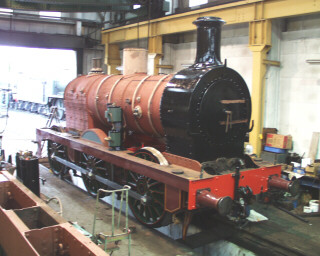 Progress with the restoration of the SER/SECR 'O1' class locomotive;
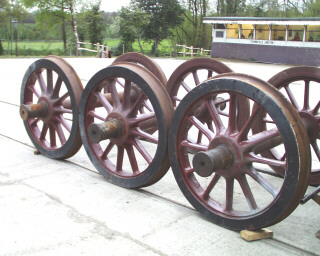 and the arrival of tender components for the Brighton Atlantic Project.
Return to Bluebell Railway Home Page,
or to Mark Dewell's
UK Heritage Railways or the Heritage Railway Association
See also Lewis Nodes' Loco Works News Photos and News from the Maunsell Locomotive Society.
Visitor Info. - Catering - Contacts - News - Locos - Carriages - Signals - History - Other - Links - Search the site
Why not become a BRPS Member?  - Get more involved as a Volunteer - Get more involved as a Volunteer
News of Victorian Evenings
An additional Victorian Evening has been added on Wednesday 14th July in view of the demand experienced for the one in 16th June, which is already fully booked.
Tickets may be booked through our catering department.
News Flash 7/4/99
This Saturday, 10th April, The Transport Trust will be presenting the Bluebell's BASH group with a Peter Allen Award and a cheque for £750, which has been awarded to the group for the restoration of Metropolitan Railway Coach No.387, which dates from 1898.
The presentation will take place at 11.30 at Sheffield Park Station, on the arrival of the railway's timetabled "Vintage Branch-line Train". This train, with Locomotive "Birch Grove", two SECR coaches and the two Metropolitan Railway Coaches is available for public use, for no extra fare, as part of the Bluebell's normal timetabled trains. The Vintage Branch Line Train is running every weekend in April, and on Bank Holiday Sundays/Mondays in May.
Also, this year for the first time, the daily running of trains has been extended to a three-week period for the Easter Holiday, and so trains are running Monday-Friday until 16th April, leaving only a two-week break before daily running recommences for the entire summer period.
The restoration by volunteers over a seven and a half year period of the two Metropolitan coaches, Nos. 394 and 387, culminated in their return to service, after 30 years abscence, at the Railway's Winter Steam-up event in February, where the four service trains were formed entirely of pre-nationalisation and pre-grouping carriages, of which the Bluebell now has 18 available for service, as well as two more which should return to service later this year.
Further details of the BASH group, and the work being undertaken by them, is to be found on the BASH web page, which has photos of the two coaches now in traffic and also details of the other two Metropolitan Railway coaches which are now the focus of the group's fund-raising and restoration activities.
Return to Bluebell Railway Home Page,
or to Mark Dewell's
UK Heritage Railways or the Heritage Railway Association
See also Lewis Nodes' Loco Works News Photos and News from the Maunsell Locomotive Society.
Visitor Info. - Catering - Contacts - News - Locos - Carriages - Signals - History - Other - Links - Search the site
Why not become a BRPS Member? - Get more involved as a Volunteer
News Update 26/3/99
Vintage Bus Day - Sunday April 25th
Full details on the web page for this event.
Bluebell's Carriage & Wagon win yet another award!
The restoration of Maunsell Brake No.6686 has been Highly Commended in the 1998/9 Heritage Railway Association Carriage and Wagon awards. Our other entrant, LBSCR Billinton Bogie First No.142 (SR 7598), which would have been a strong contender to win the competition outright, was unfortunately not completed in time.
Martin Lock reports that an LBSCR Billinton carriage on the Isle of Wight was also highly commended. The winner of the coach section was an Ex MoD narrow gauge carriage on the Leighton Buzzard, and the overall winner was a Wickham Trolley on the Colne Valley.
Loco News:
The Maunsell Locomotive Society report progress on both of their current projects. On U-class 1638, the rolling tender chassis (which has been rebuilt from a schools-class tender which had become a snow-plough) has had its steam heat and vacuum piping fitted, and has been attached to the engine itself. The next job is the construction of the tender tank to be fitted to the chassis. Meanwhile on the engine the cab roof is being tweaked after fitting, it looks like a U class now. The brakes are being fitted up to the engine too, and attention is being given to the threaded holes on the main steam ports under the smokebox, in the saddle. The weighshaft, around 8 foot in length, and 4" diameter, has had its bearings machined and matched to the restored journals, and can go back on the engine.
The Society's work on their S15 No.847 carries on apace, with Adrian Pinkess leading a determined team. Many firebox screws have been removed, holes retapped and new fitted. Boiler stays are next in line, and the boiler could get a lift at any time as everything has been released to make this possible. If 541 (our Q class) enters the works first, as planned, it would create the possibility for the future whereby we could have 3 engines overhauled and available in traffic at the same time, 541, 1638 and 847. Now that's a thought to provide inspiration.
SER O1 No.65 - report from Peter Jessup
The rush at the moment, as many will know, is the completion of the O1 in time for the South East and Chatham Railway centenary in July. At the moment the restoration seems to be on track. The frames are ready, the wheels are back from turning at Swindon, ready to go in as soon as the axle boxes are sorted. The connecting rod to replace the damaged one has been cast and is being machined in Manchester. The boiler is being retubed presently. The tender in the meantime is being stripped apart. The frames are on stands in the yard and the tank has been on its side for cutting out all the bad bits (and that's quite a lot). My friend on the O1 site has used a couple of snaps I took and tells me that you will find them here.
Other works progress - as reported on Lewis Nodes' Photo News Pages
The Dukedog, No.3217: Work on the new tubeplate is proceeding with drilling the new tube holes, following the welding on of the flange. Inside the firebox patch screws are being installed where the rivet heads have burnt away.
Blackmore Vale: Following the completion of boiler work, the lagging and pipework have been fitted, and new steel sheeting is being made for the entire loco, including new cab roof and sides. Boiler fittings are in place, and the injectors and pipework reinstalled. Repairs have been made to the tender side sheeting. The steam reverser, previously one of its most unreliable components, has been thoroughly overhauled.
BR Standard 4MT Tank 80151: The boiler has been removed to allow insurance examination, and in the meantime work continues on its various components.
LBSCR Terrier "Fenchurch": As almost the final job on the new wheelset, the backs of the crankpins have been welded into the wheel castings. A number of new fitted bolts have been made for the hornstays to replace old bolts and rivets which had worked loose. The front buffer beam has been grit-blasted, revealing the material supplier's stamp, and indicating that it may be the original item. The buffers have been dismantled for repairs and grit-blasted. Spring-hanger sockets have been newly-fabricated.
Whilst new cylinders may not be required for Fenchurch's current overhaul, many of the preserved Terriers will need them before too long. Brian Wilkie has recently been working on a pattern for an exhaust steam passage, having completed, along with Roy Stirling, patterns for a cylinder barrel, and for the side framing which fixes the cylinders onto the frames.
Other changes around the Loco Yard: Foundations have been laid for the new warehouse building in the upper car park. A second-hand kit-form building will be used to store locomotive parts which are currently stored in the workshop (taking up valuable working space), in various shipping containers, or lying outside on the ground.
A new track is being laid to the East of the loco yard headshunt, and this will accommodate several of the sleeping coaches, freeing up space in the pump-house siding.
Horsted Keynes
The Permanent way changes to the entrance of the carriage yard were completed in three weeks, and involved the replacement of the partially disused single slip with a more gentle point, and also a new point to give access to the dock, which will also act as the protection point for the running line during shunting of the carriage yard. This latter restores a feature of the original yard layout, lost in the early years of the century.
On the signalling side, some of the brickwork alterations and repairs to the signal box base have been completed, as reported on Peter Richards' Horsted Keynes Re-signalling page.
Extension:
The local newspaper report that contracts had been exchanged for the viaduct repairs was premature. As revealed on Radio 4, a new company has been set up to handle the landfill tax credit funding for the removal of the Imberhorne Tip.
Carriage Matters:
Test diggings have been made for the foundations of the works extension. These were favourable, although towards the south end, where the land is built up, a significant depth of clay was found.
The main works project, SR Maunsell drop-light open third 1336, is becoming a bigger job, to the extent of having to decide whether the restoration should be continued or aborted. The decision was made to continue with the work, which will be rather more expensive than anticipated, since the entire coach body is being dismantled from the roof down to the solebar! This will be by far the most extensive structural overhaul of a coach on a preserved railway, with the roof being lifted off, and the sides completely dismantled to enable the pillars to be removed and repaired. The extent of the work required is down to the failure of the original design, which leaves the whole of the structure open to water penetration through the droplight openings. Once completed, we shall have an essentially brand-new vehicle, but overhead cover will be essential if the investment is to last! Had the decision been to abort the project, the only practicable con!
clusion would have been the scrapp
ing of the coach.
Andrew Pepper has sent a report on that other major structural rebuild, the LSWR Brake Third, which is available on the LSWR Coach Project web page.
BASH is not resting on its laurels. A vast amount of work is ongoing on the third of the four Metropolitan coaches, the most major of which is the replacement of about a third of the cant-rail on one side of the coach. This large teak member is about six inches deep by 3 inches wide, and was found to be rotten in several places. The replacement teak has come from the last two of our stock of 4-SUB shoe-beams. The first of the rebuilt doors are now being re-hung on the body, and external teak mouldings are coming off our production line. The bogies are stripped of all their brake gear, much of which will require remanufacture. An overhauled bogie is nearly ready to go back under the fourth coach.
What's New on this Web Site?
All of these are accessible via the What's New page.
New page added for Information for disabled visitors.
New technical and link pages about carriage restoration.
Report on the Special Winter Steam-Up Weekend.
New picture of Metropolitan Coach No.387 taken by Chris Majer in the early 1960s.
Also new is The Villa Team's Photo Index Page.
Updates to the following pages: Horsted Keynes Track Layout. The re-signalling of Horsted Keynes. The BASH page, with details of our Transport Trust "Peter Allen" Award. The NLR Tank loco page expanded. The page on operational locomotives now includes more information about each loco. More comprehensive details of our Travel Fares and Station Tickets are now available. Also the monthly updates to the results of the Football competition.
A variety of new links added: LT Museum Shop, West Sussex Records Office, Christopher and Diana Awdry's page for young volunteers, which features our 9F Club, Preserved Steam Locomotive Database programme, Virtual Brighton and Hove and the South East England Tourist Board web sites, overnight accommodation near Horsted Keynes, Smooth Hound, Wealden District Council, Places of interest in the Mid Sussex, and East and West Sussex Travel information. Also to Barrow Hill Engine Shed Society where the North London tank is on loan.
Return to Bluebell Railway Home Page,
or to Mark Dewell's
UK Heritage Railways or the Heritage Railway Association
See also Lewis Nodes' Loco Works News Photos and News from the Maunsell Locomotive Society.
Visitor Info. - Catering - Contacts - News - Locos - Carriages - Signals - History - Other - Links - Search the site
Why not become a BRPS Member? - Get more involved as a Volunteer
Brief News Update 4/3/99
Metropolitan Coach wins Transport Trust Restoration Award
The Restoration of 101-year-old Metropolitan Railway Brake coach No.387 has
won The Peter Allen Award and a cheque for £750, which will be used
for further restoration work on the Metropolitan Coaches. The competition
was for projects not completed at the time of judgeing, but due for
completion within a year. The Coach returned to public service on 13th
February along with a second Metropolitan Railway coach, No.394.
As a member of the restoration team, I can only say "thank you" for all the
messages of congratulation we've received from those who've already seen or
travelled in the coaches, or have viewed the photos on the web site. In
turn, I should very much thank all those who have supported this entirely
volunteer and donation-funded project over the last seven and a half years, and hope that the level of support we've received will continue as
we are now working flat out on the third of the coaches, which was very
nearly scrapped in the 1970s due to the extensive dry rot.
NRM's GNR J52 Saddle Tank to celebrate its centenary on the Bluebell
Having last visited the Bluebell Railway for the centenary celebrations of
our GNR Directors' Saloon in 1997, a return visit has now been arranged to
throw a party for the centenary of the locomotive itself. The engine will
be visiting the Bluebell between May 8th and June 6th.
The team who maintain the GNR Saloon are themselves working flat out to
complete a major overhaul of the structure and internal panelling of the
end vestibules of the coach, where corrosion of metal brackets had split
some of the teak structure. As a result of the extensive nature of this
work, the saloon is not expected to run at Easter, but should be completed
in time to help host the birthday party for the Saddle Tank, which first
visited the line in 1962 on a railtour.
Return to Bluebell Railway Home Page,
or to Mark Dewell's
UK Heritage Railways or the Heritage Railway Association
See also Lewis Nodes' Loco Works News Photos and News from the Maunsell Locomotive Society.
Visitor Info. - Catering - Contacts - News - Locos - Carriages - Signals - History - Other - Links - Search the site
Why not become a BRPS Member? - Get more involved as a Volunteer
News Snippets 17/2/99
The Winter Steam-up last weekend was generally acknowledged as another Bluebell triumph. Everyone seemed to thoroughly enjoy it. The variety of coaches and locos were very well received, and the Metropolitan Railway coaches were very popular on their first public outing for over 30 years. With six locos, and eight different combinations of coaching stock used (15 carriages, and not a BR Mk.1 among them) variety was the norm!
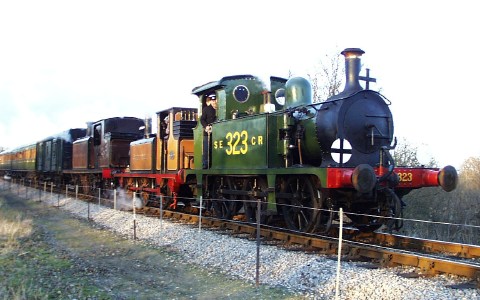
Lewis Nodes was at the lineside with his digital camera. Some of his photos are now on the Bluebell web site, as part of a report on the weekend. Here's one of his shots of the triple-headed pre-grouping tanks to wet the appetite:
Radio 4 programme: "Chuffed" 11am Friday 19th Feb. Features the Bluebell.
The March issue of "Your Cat" magazine has a gem of an article on Lucky, Misses and Piggy. Their photographer was down on the railway on the day of the test run for the Metropolitan coaches, and so the general views of Sheffield Park station which accompany the article happen to feature two shiny teak coaches with Birch Grove. The only slight problem with the article is that Misses and Piggy now have the hump, having been referred to as former strays! Certainly not; they were born and bred to be railway cats!
Return to Bluebell Railway Home Page,
or to Mark Dewell's
UK Heritage Railways or the Heritage Railway Association
See also Lewis Nodes' Loco Works News Photos and News from the Maunsell Locomotive Society.
Visitor Info. - Catering - Contacts - News - Locos - Carriages - Signals - History - Other - Links - Search the site
Why not become a BRPS Member? - Get more involved as a Volunteer
News Update 5/2/99
Winter Steam-up Weekend, 13-14 February
This annual event takes on an extra dimension this year, in that we shall be operating four trains, all formed of pre-Nationalisation rolling stock. Six of the smaller locomotives will be operating, with Stepney and Bluebell double-heading for part of the day, and the LSWR dock tank, "Normandy" unusually hauling a train the length of the line. The timetable is an ambitious one, with nothing in the way of recovery time. The event will see the first public service for the two restored Metropolitan Railway coaches, dating from the reign of Victoria, and other trains will be formed of SECR, SR Maunsell and SR Bulleid stock. The first train of the morning runs non-stop through Horsted Keynes, and the finale occurs when two coaching sets are combined and hauled by a "Triple Header" with locomotives having an average age of 105 years.
Full details are on this web site. I am running guided tours of the Carriage Works, which are not normally open to the public, on both days.
Steam Trains also operate every weekend in February plus Half term Week, 15th-19th
1998 Traffic Figures
The Bluebell carried 3.5 per-cent more passengers than 1997, resulting in revenue 5 per-cent higher. With no fares increase for 1999, the challenge is to maintain this level of traffic growth.
Extension non-News
It was reported, erroniously in a magazine, that contracts have been exchanged for the maintenance work on the viaduct.
Loco matters:
SECR P-class No.323 is the first loco to carry SECR Wartime livery in preservation, and first appeared in this guise to haul the SECR goods train on January 1st. Photos are further down this page.
Reports from Sheffield Park talk about a return to traffic for both Bulleid Pacific "Blackmore Vale" and the SER O1 by the middle of the year.
The North London Tank, some way down the restoration queue, has gone on loan to the award-winning Barrow Hill round-house, where it can benefit from overhead cover, and free up some precious space in our own shed, as well as acting as an LMS ambassador for the Bluebell.
An examination of the boiler of "Sir Archibald Sinclair" has indicated that there is considerable work to do, including replacement of the firebox tubeplate and the bases of the two thermic siphons. It is hoped that the fund-raising to achieve these repairs is possible this year.
After a lull, work has resumed on the BR Standard 2 Tank conversion, with grit-blasting of components taking place.
Lewis Nodes reports that LBSCR Terrier, "Fenchurch" should be back on its wheels in early summer. The boiler will then be put in place to make up the new smokebox, although it will have to be taken out again to tube it. The cylinders have been patched up with a new steam pipe flange and the holes covered over. Pictures of this work should appear on Lewis' photo news web page in the next few weeks. Externally Fenchurch is being converted to original A1 form, possible since it was little altered over the years, and with a new smokebox saddle required as part of the current overhaul, now was the time to do it.
Carriage News
The two Metropolitan coaches should turn quite a few heads both at the Winter Steam-up, and also with photos. They made the front page of the Mid-Sussex Leader. If you've not looked yet, Lewis Nodes has supplied some photos, which are on the BASH page.
The Maunsell Drop-light Open Third is being dismantled, with one end and the toilet so far removed, all external steel panelling removed and the floor being broken out. This will enable the sides to be removed and re-constructed one side at a time.
The Brighton Bogie First is now fully lettered and lined, and awaits completion of the seat trimming, plus a spell of suitable weather (or a week in the paint shop) to receive its final coats of varnish.
The major steelwork repairs at the lavatory end of Bulleid Open Third 1482 are nearly complete, and new timber is being fitted around the steel. Teak is being used, since this will resist the rot that always seems to occur at floor level in this location.
Signalling Work at Horsted Keynes
Up-to-date news of the re-signalling is now available.
Currently work has involved disconnecting points and signals from the signal-box, which retains its block instruments and telephone systems, helping ensure the safety of the temporary arrangements. A temporary ground frame has been installed to control the south end of the station in a similar way to that at the north of Platforms 2 and 3.
Bluebell Web Site
The many recent new pages and changes and are to be found listed on the "Updates page"
Amongst them are:
Return to Bluebell Railway Home Page,
or to Mark Dewell's
UK Heritage Railways or the Heritage Railway Association
See also Lewis Nodes' Loco Works News Photos and News from the Maunsell Locomotive Society.
Visitor Info. - Catering - Contacts - News - Locos - Carriages - Signals - History - Other - Links - Search the site
Why not become a BRPS Member? - Get more involved as a Volunteer
New photos of SE&CR No.323
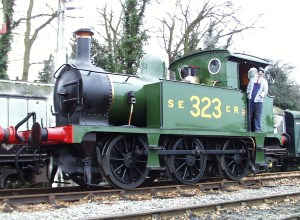 Thanks to Lewis Nodes we now have pictures of 323, (formerly "Bluebell") available on the web site. The plain Olive Green livery has been applied for the SE&CR centenary year celebrations, and it is the first time that this livery has been seen in preservation. 323's boiler certificate runs out in March 2000, so the timing of the repaint is quite advantageous.
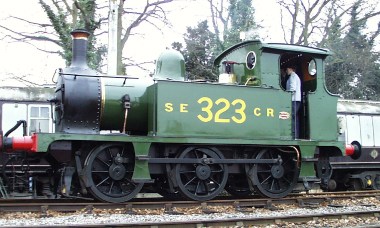 The loco is now known to volunteers as "Greenbell" for obvious reasons, and the thought that the polished brass dome had been painted over caused apoplexy amongst certain members of the loco department. Needless to say, all is not quite as it appears!
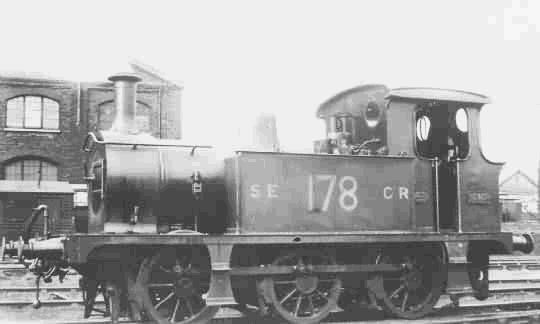 The Southern Locos Ltd. website has a photo of P-class No.178 in this livery, which is included here for comparison. It was taken at Bricklayers Arms in 1917. (Our thanks to SLL for making the photo available to us).
January: The Test Run for Metropolitan Railway Coaches 387 and 394
(News posted 27/1/99 and updated slightly 1/2/99)
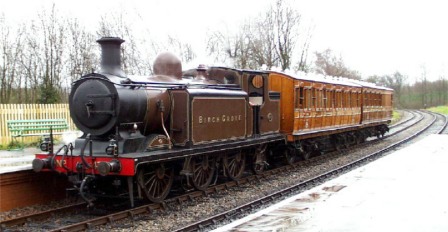
The first two coaches at Kingscote on their test run. (Lewis Nodes)
Following the completion of eight years of restoration work by volunteers of BASH, these two Victorian coaches undertook a test run behind "Birch Grove" on 25th January 1999 and, apart from the inevitable minor faults, this was very successful. These problems were attended to, and the electrical system completed, during the following week, thus enabled BASH supporters and volunteers to enjoy a private day out on the coaches prior to their public launch into service on 13th and 14th February at the Winter Steam-up Weekend.
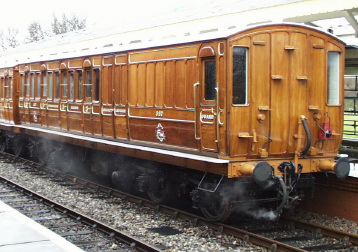
The Brake coach, No.387, at Kingscote on the test run. (Lewis Nodes)
The test run started with a run up to Kingscote from Horsted Keynes, with a stop just outside the latter station to carry out a steam heat test and examination. All was found to be well with the steam heat, excepting for a couple of minor adjustments which were done in the next week. The photos above and below were taken at Kingscote, where the recently rebuilt canopy can also be seen.
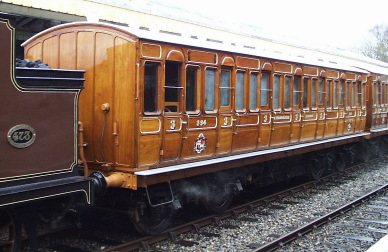
The Full Third, No.394, at Kingscote on the test run. (Lewis Nodes)
The test train entered Kingscote on platform 1, but also ran into platform 2 which has a platform built to modern standards and therefore slightly higher than the others on the railway. Clearances were found to be satisfactory between the coach running boards and the platform, which had been one area of concern. One of the wheel bearings was a bit warm, which put a slight damper on proceedings. However, it was judged to be safe to return to Horsted Keynes.
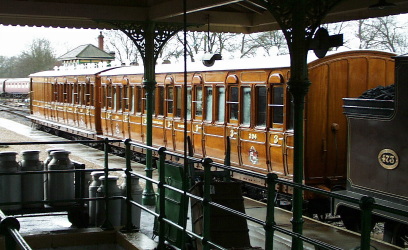
The test run train pauses at Horsted Keynes. (Lewis Nodes)
Back at Horsted Keynes the Monday shunt was in full swing and we would have been rather in the way. So after picking up some packing and a jack, we proceeded to Sheffield Park where an examination of the problematic wheel bearing could be undertaken. Whilst it did not prove possible to remove the bearing, the problem was diagnosed as faulty machining of the white-metal slipper leading to poor distribution of the lubricant. This was rectified during the following week. Following a look around the loco yard and a cup of tea in the loco lobby, it was back to Horsted Keynes.
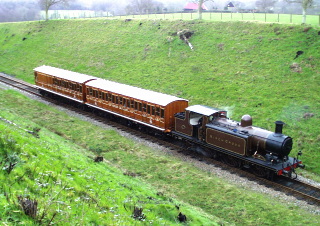
The test run train approaches 3-Arch Bridge. (Lewis Nodes)
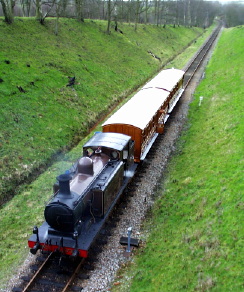 We were held at Three-Arch Bridge (site of the outer home signal) because the shunt was occupying all three platforms at Horsted Keynes. And there we stayed for some time, discovering the advantages of the location for photograpic purposes, and examining the condition of the bridge; something of a landmark on the line.
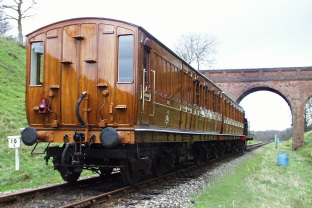
The test run train at 3-Arch Bridge. (Lewis Nodes)
We finally got the all clear and the train was soon tucked up safely in the shed for the remaining work to be completed.
The following week the batteries were installed and the various adjustments made as has been described above. On Saturday 30th January the coaches conveyed our volunteers and supporters on their inaugural run, which started at Horsted Keynes, and passed through this station twice more, non-stop, during a complete circuit of the line before returning there again. Tea and a buffet were served in the brake van during each run-round stop at the termini. Friends from the LURS brought down some genuine Metropolitan destination boards which adorned No.394 for the day.

Return to BRPS Home Page,
to the Timetable or to Special
Events
News from the Bluebell Archives:
2006: Jan-Dec
2005: Jan-June, July-Dec
2004: Jan-April, May-July, Aug-Dec
2003: Jan-March, April-June, July-Sept, Oct-Dec
2002: Jan-March, April-June, July-Sept, Oct-Dec
2001: Jan-March, April-July, Aug-Dec
2000: Jan-April, May-Aug, Sept-Dec
1999: Jan-April, May-Aug, Sept-Dec
1998: Jan-June, July-Dec
1997: Jan-June, July-Dec
1996: Jan-July, Aug-Dec
1995: June-Dec
Other archives of online news and newsletters:
Bluebell Times (March 2020 - Present) on the Bluebell's main site
Archive of e-Newsletters (November 2011-August 2020) maintained by the Bluebell's Museum and Archive team.
Archive of "What's New/Blog" (1997 - Present) on this server
Visitor Info. -
Museum -
Trust -
Catering -
Contacts -
What's New -
Projects -
Locos -
Carriages & Wagons -
Signals -
History -
Other -
Links -
Search -
FAQ
Why not become a BRPS Member? -
Get more involved as a Volunteer
Your ideal Film/TV location?
 Compiled by Richard Salmon.
© Copyright BRPS. Privacy Policy
|